

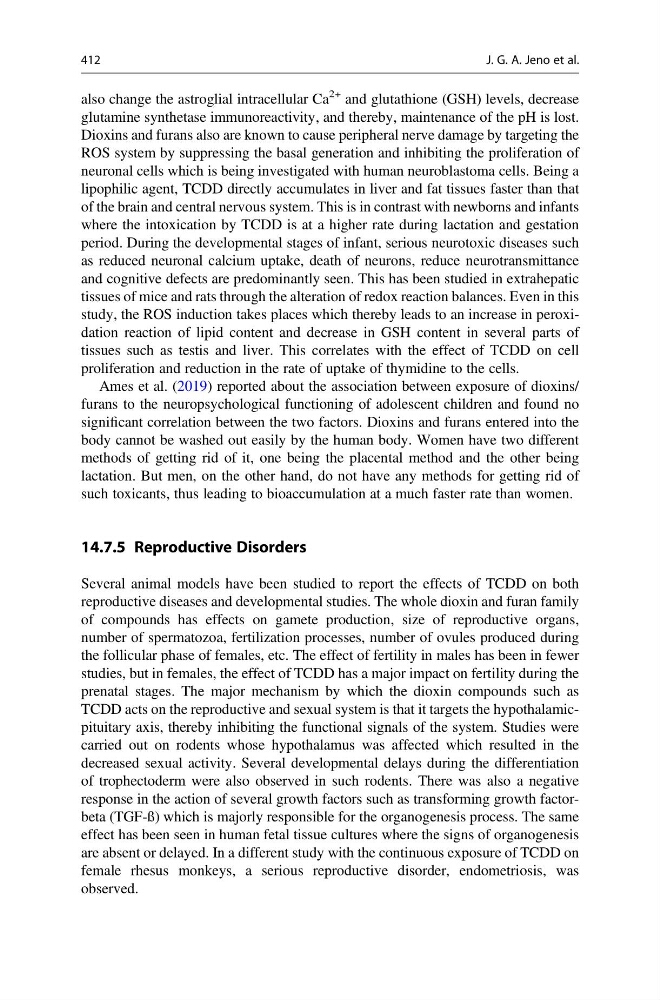
also change the astroglial intracellular Ca
2+ and glutathione (GSH) levels, decrease
glutamine synthetase immunoreactivity, and thereby, maintenance of the pH is lost.
Dioxins and furans also are known to cause peripheral nerve damage by targeting the
ROS system by suppressing the basal generation and inhibiting the proliferation of
neuronal cells which is being investigated with human neuroblastoma cells. Being a
lipophilic agent, TCDD directly accumulates in liver and fat tissues faster than that
of the brain and central nervous system. This is in contrast with newborns and infants
where the intoxication by TCDD is at a higher rate during lactation and gestation
period. During the developmental stages of infant, serious neurotoxic diseases such
as reduced neuronal calcium uptake, death of neurons, reduce neurotransmittance
and cognitive defects are predominantly seen. This has been studied in extrahepatic
tissues of mice and rats through the alteration of redox reaction balances. Even in this
study, the ROS induction takes places which thereby leads to an increase in peroxidation reaction of lipid content and decrease in GSH content in several parts of
tissues such as testis and liver. This correlates with the effect of TCDD on cell
proliferation and reduction in the rate of uptake of thymidine to the cells.
Ames et al. (2019) reported about the association between exposure of dioxins/
furans to the neuropsychological functioning of adolescent children and found no
significant correlation between the two factors. Dioxins and furans entered into the
body cannot be washed out easily by the human body. Women have two different
methods of getting rid of it, one being the placental method and the other being
lactation. But men, on the other hand, do not have any methods for getting rid of
such toxicants, thus leading to bioaccumulation at a much faster rate than women.
14.7.5 Reproductive Disorders
Several animal models have been studied to report the effects of TCDD on both
reproductive diseases and developmental studies. The whole dioxin and furan family
of compounds has effects on gamete production, size of reproductive organs,
number of spermatozoa, fertilization processes, number of ovules produced during
the follicular phase of females, etc. The effect of fertility in males has been in fewer
studies, but in females, the effect of TCDD has a major impact on fertility during the
prenatal stages. The major mechanism by which the dioxin compounds such as
TCDD acts on the reproductive and sexual system is that it targets the hypothalamicpituitary axis, thereby inhibiting the functional signals of the system. Studies were
carried out on rodents whose hypothalamus was affected which resulted in the
decreased sexual activity. Several developmental delays during the differentiation
of trophectoderm were also observed in such rodents. There was also a negative
response in the action of several growth factors such as transforming growth factorbeta (TGF-ß) which is majorly responsible for the organogenesis process. The same
effect has been seen in human fetal tissue cultures where the signs of organogenesis
are absent or delayed. In a different study with the continuous exposure of TCDD on
female rhesus monkeys, a serious reproductive disorder, endometriosis, was
observed.
412
J. G. A. Jeno et al.
2+ and glutathione (GSH) levels, decrease
glutamine synthetase immunoreactivity, and thereby, maintenance of the pH is lost.
Dioxins and furans also are known to cause peripheral nerve damage by targeting the
ROS system by suppressing the basal generation and inhibiting the proliferation of
neuronal cells which is being investigated with human neuroblastoma cells. Being a
lipophilic agent, TCDD directly accumulates in liver and fat tissues faster than that
of the brain and central nervous system. This is in contrast with newborns and infants
where the intoxication by TCDD is at a higher rate during lactation and gestation
period. During the developmental stages of infant, serious neurotoxic diseases such
as reduced neuronal calcium uptake, death of neurons, reduce neurotransmittance
and cognitive defects are predominantly seen. This has been studied in extrahepatic
tissues of mice and rats through the alteration of redox reaction balances. Even in this
study, the ROS induction takes places which thereby leads to an increase in peroxidation reaction of lipid content and decrease in GSH content in several parts of
tissues such as testis and liver. This correlates with the effect of TCDD on cell
proliferation and reduction in the rate of uptake of thymidine to the cells.
Ames et al. (2019) reported about the association between exposure of dioxins/
furans to the neuropsychological functioning of adolescent children and found no
significant correlation between the two factors. Dioxins and furans entered into the
body cannot be washed out easily by the human body. Women have two different
methods of getting rid of it, one being the placental method and the other being
lactation. But men, on the other hand, do not have any methods for getting rid of
such toxicants, thus leading to bioaccumulation at a much faster rate than women.
14.7.5 Reproductive Disorders
Several animal models have been studied to report the effects of TCDD on both
reproductive diseases and developmental studies. The whole dioxin and furan family
of compounds has effects on gamete production, size of reproductive organs,
number of spermatozoa, fertilization processes, number of ovules produced during
the follicular phase of females, etc. The effect of fertility in males has been in fewer
studies, but in females, the effect of TCDD has a major impact on fertility during the
prenatal stages. The major mechanism by which the dioxin compounds such as
TCDD acts on the reproductive and sexual system is that it targets the hypothalamicpituitary axis, thereby inhibiting the functional signals of the system. Studies were
carried out on rodents whose hypothalamus was affected which resulted in the
decreased sexual activity. Several developmental delays during the differentiation
of trophectoderm were also observed in such rodents. There was also a negative
response in the action of several growth factors such as transforming growth factorbeta (TGF-ß) which is majorly responsible for the organogenesis process. The same
effect has been seen in human fetal tissue cultures where the signs of organogenesis
are absent or delayed. In a different study with the continuous exposure of TCDD on
female rhesus monkeys, a serious reproductive disorder, endometriosis, was
observed.
412
J. G. A. Jeno et al.