

exposure in terms of thyroid volume, FT4 serum level, cytochrome P450 1A1 and
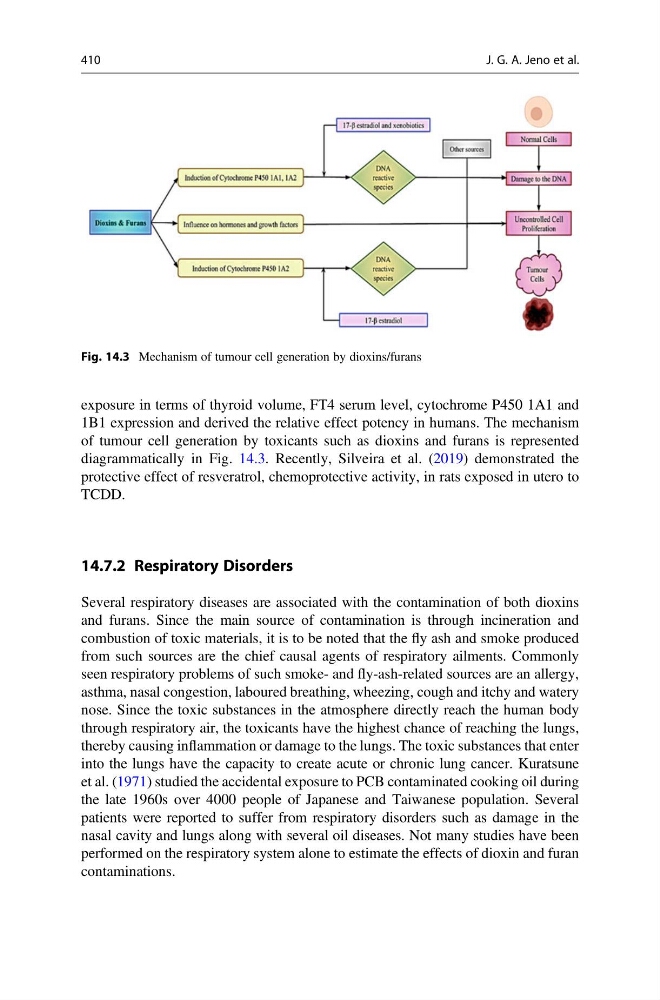
1B1 expression and derived the relative effect potency in humans. The mechanism
of tumour cell generation by toxicants such as dioxins and furans is represented
diagrammatically in Fig. 14.3. Recently, Silveira et al. (2019) demonstrated the
protective effect of resveratrol, chemoprotective activity, in rats exposed in utero to
TCDD.
14.7.2 Respiratory Disorders
Several respiratory diseases are associated with the contamination of both dioxins
and furans. Since the main source of contamination is through incineration and
combustion of toxic materials, it is to be noted that the fly ash and smoke produced
from such sources are the chief causal agents of respiratory ailments. Commonly
seen respiratory problems of such smoke- and fly-ash-related sources are an allergy,
asthma, nasal congestion, laboured breathing, wheezing, cough and itchy and watery
nose. Since the toxic substances in the atmosphere directly reach the human body
through respiratory air, the toxicants have the highest chance of reaching the lungs,
thereby causing inflammation or damage to the lungs. The toxic substances that enter
into the lungs have the capacity to create acute or chronic lung cancer. Kuratsune
et al. (1971) studied the accidental exposure to PCB contaminated cooking oil during
the late 1960s over 4000 people of Japanese and Taiwanese population. Several
patients were reported to suffer from respiratory disorders such as damage in the
nasal cavity and lungs along with several oil diseases. Not many studies have been
performed on the respiratory system alone to estimate the effects of dioxin and furan
contaminations.
Fig. 14.3 Mechanism of tumour cell generation by dioxins/furans
410
J. G. A. Jeno et al.
1B1 expression and derived the relative effect potency in humans. The mechanism
of tumour cell generation by toxicants such as dioxins and furans is represented
diagrammatically in Fig. 14.3. Recently, Silveira et al. (2019) demonstrated the
protective effect of resveratrol, chemoprotective activity, in rats exposed in utero to
TCDD.
14.7.2 Respiratory Disorders
Several respiratory diseases are associated with the contamination of both dioxins
and furans. Since the main source of contamination is through incineration and
combustion of toxic materials, it is to be noted that the fly ash and smoke produced
from such sources are the chief causal agents of respiratory ailments. Commonly
seen respiratory problems of such smoke- and fly-ash-related sources are an allergy,
asthma, nasal congestion, laboured breathing, wheezing, cough and itchy and watery
nose. Since the toxic substances in the atmosphere directly reach the human body
through respiratory air, the toxicants have the highest chance of reaching the lungs,
thereby causing inflammation or damage to the lungs. The toxic substances that enter
into the lungs have the capacity to create acute or chronic lung cancer. Kuratsune
et al. (1971) studied the accidental exposure to PCB contaminated cooking oil during
the late 1960s over 4000 people of Japanese and Taiwanese population. Several
patients were reported to suffer from respiratory disorders such as damage in the
nasal cavity and lungs along with several oil diseases. Not many studies have been
performed on the respiratory system alone to estimate the effects of dioxin and furan
contaminations.
Fig. 14.3 Mechanism of tumour cell generation by dioxins/furans
410
J. G. A. Jeno et al.