

2015; Li et al. 2018). The main process of removal of heavy metals followed by SRB
is definitely the precipitation of metal sulfides. The generation of sulfide diminishes
the acidity promoting the precipitation of metals as insoluble metal sulfides that can
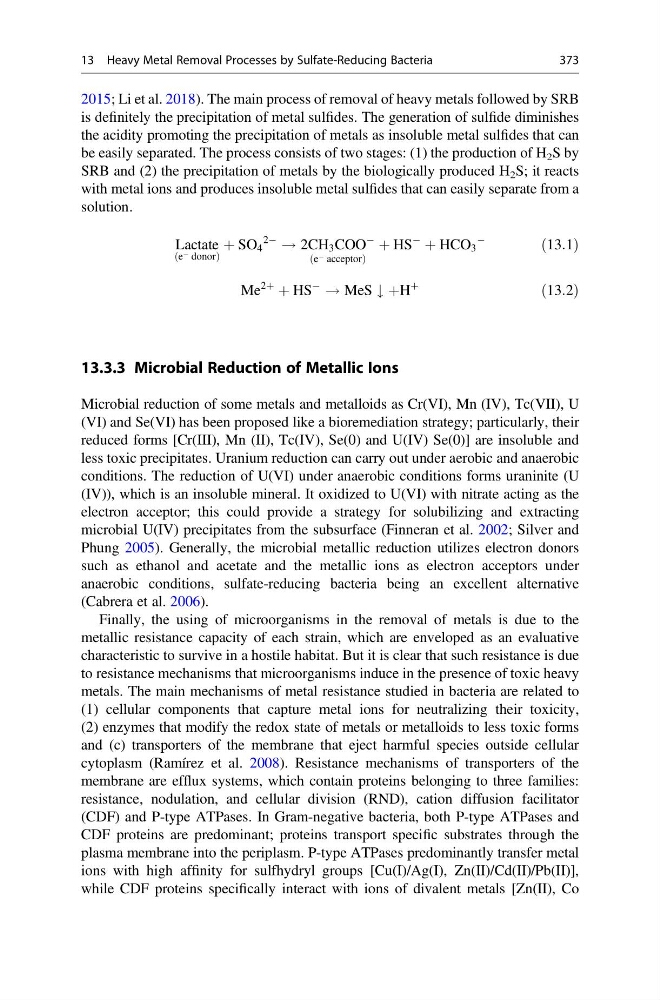
be easily separated. The process consists of two stages: (1) the production of H 2 S by
SRB and (2) the precipitation of metals by the biologically produced H 2 S; it reacts
with metal ions and produces insoluble metal sulfides that can easily separate from a
solution.
Lactate
e À donor
ð
Þ
þ SO 4
2À
! 2CH 3 COO
À
e À acceptor
ð
Þ
þ HS
À
þ HCO 3
À
ð13:1Þ
Me
2þ
þ HS
À
! MeS # þH
þ
ð13:2Þ
13.3.3 Microbial Reduction of Metallic Ions
Microbial reduction of some metals and metalloids as Cr(VI), Mn (IV), Tc(VII), U
(VI) and Se(VI) has been proposed like a bioremediation strategy; particularly, their
reduced forms [Cr(III), Mn (II), Tc(IV), Se(0) and U(IV) Se(0)] are insoluble and
less toxic precipitates. Uranium reduction can carry out under aerobic and anaerobic
conditions. The reduction of U(VI) under anaerobic conditions forms uraninite (U
(IV)), which is an insoluble mineral. It oxidized to U(VI) with nitrate acting as the
electron acceptor; this could provide a strategy for solubilizing and extracting
microbial U(IV) precipitates from the subsurface (Finneran et al. 2002; Silver and
Phung 2005). Generally, the microbial metallic reduction utilizes electron donors
such as ethanol and acetate and the metallic ions as electron acceptors under
anaerobic conditions, sulfate-reducing bacteria being an excellent alternative
(Cabrera et al. 2006).
Finally, the using of microorganisms in the removal of metals is due to the
metallic resistance capacity of each strain, which are enveloped as an evaluative
characteristic to survive in a hostile habitat. But it is clear that such resistance is due
to resistance mechanisms that microorganisms induce in the presence of toxic heavy
metals. The main mechanisms of metal resistance studied in bacteria are related to
(1) cellular components that capture metal ions for neutralizing their toxicity,
(2) enzymes that modify the redox state of metals or metalloids to less toxic forms
and (c) transporters of the membrane that eject harmful species outside cellular
cytoplasm (Ramírez et al. 2008). Resistance mechanisms of transporters of the
membrane are efflux systems, which contain proteins belonging to three families:
resistance, nodulation, and cellular division (RND), cation diffusion facilitator
(CDF) and P-type ATPases. In Gram-negative bacteria, both P-type ATPases and
CDF proteins are predominant; proteins transport specific substrates through the
plasma membrane into the periplasm. P-type ATPases predominantly transfer metal
ions with high affinity for sulfhydryl groups [Cu(I)/Ag(I), Zn(II)/Cd(II)/Pb(II)],
while CDF proteins specifically interact with ions of divalent metals [Zn(II), Co
13 Heavy Metal Removal Processes by Sulfate-Reducing Bacteria
373
is definitely the precipitation of metal sulfides. The generation of sulfide diminishes
the acidity promoting the precipitation of metals as insoluble metal sulfides that can
be easily separated. The process consists of two stages: (1) the production of H 2 S by
SRB and (2) the precipitation of metals by the biologically produced H 2 S; it reacts
with metal ions and produces insoluble metal sulfides that can easily separate from a
solution.
Lactate
e À donor
ð
Þ
þ SO 4
2À
! 2CH 3 COO
À
e À acceptor
ð
Þ
þ HS
À
þ HCO 3
À
ð13:1Þ
Me
2þ
þ HS
À
! MeS # þH
þ
ð13:2Þ
13.3.3 Microbial Reduction of Metallic Ions
Microbial reduction of some metals and metalloids as Cr(VI), Mn (IV), Tc(VII), U
(VI) and Se(VI) has been proposed like a bioremediation strategy; particularly, their
reduced forms [Cr(III), Mn (II), Tc(IV), Se(0) and U(IV) Se(0)] are insoluble and
less toxic precipitates. Uranium reduction can carry out under aerobic and anaerobic
conditions. The reduction of U(VI) under anaerobic conditions forms uraninite (U
(IV)), which is an insoluble mineral. It oxidized to U(VI) with nitrate acting as the
electron acceptor; this could provide a strategy for solubilizing and extracting
microbial U(IV) precipitates from the subsurface (Finneran et al. 2002; Silver and
Phung 2005). Generally, the microbial metallic reduction utilizes electron donors
such as ethanol and acetate and the metallic ions as electron acceptors under
anaerobic conditions, sulfate-reducing bacteria being an excellent alternative
(Cabrera et al. 2006).
Finally, the using of microorganisms in the removal of metals is due to the
metallic resistance capacity of each strain, which are enveloped as an evaluative
characteristic to survive in a hostile habitat. But it is clear that such resistance is due
to resistance mechanisms that microorganisms induce in the presence of toxic heavy
metals. The main mechanisms of metal resistance studied in bacteria are related to
(1) cellular components that capture metal ions for neutralizing their toxicity,
(2) enzymes that modify the redox state of metals or metalloids to less toxic forms
and (c) transporters of the membrane that eject harmful species outside cellular
cytoplasm (Ramírez et al. 2008). Resistance mechanisms of transporters of the
membrane are efflux systems, which contain proteins belonging to three families:
resistance, nodulation, and cellular division (RND), cation diffusion facilitator
(CDF) and P-type ATPases. In Gram-negative bacteria, both P-type ATPases and
CDF proteins are predominant; proteins transport specific substrates through the
plasma membrane into the periplasm. P-type ATPases predominantly transfer metal
ions with high affinity for sulfhydryl groups [Cu(I)/Ag(I), Zn(II)/Cd(II)/Pb(II)],
while CDF proteins specifically interact with ions of divalent metals [Zn(II), Co
13 Heavy Metal Removal Processes by Sulfate-Reducing Bacteria
373