

used as a reactor in which a gas-liquid mass transfer occurs concurrently in downward direction through a fixed bed of catalyst particles where reaction occurs to
conversion of toxin in effluents. The term ‘trickling filter’ has been used because the
removal of organic matter by aerobic bacterial action from wastewater streams
through a bed. There are biological growths that attach themselves either to a matrix
or bed of stone or any other support material over which the wastewater is made to
trickle in contact with the surrounding air (Satterfield 1975).
11.2.5 Bubble Column Reactors (BCRs)
Sublation of solvents as a non-foaming effluent treatment method incorporates the
advantages of bubble fractionation and fluid extraction without mixers, settlers or
consequent downstream treatment (Lucas et al. 2009). Previous research on lab-scale
BCRs revealed better efficiencies for removal of non-volatile and volatile organic
compounds than bubble fractionation, air stripping and conventional liquid-liquid
extraction (Smith et al. 1996). There are three transport mechanisms available by
which pollutants mainly gases are removed. They are transport by air bubbles, water
entrainment due to the rising air bubbles and molecular mass transport across the
gas-water interface. After the sublation, soluble antibiotics, dye and suspended
microbial debris are removed from the aqueous phase by further diversification to
other unit operations, and volatile pollutants are removed from the top zone of BCR
(Turhan and Turgut 2009).
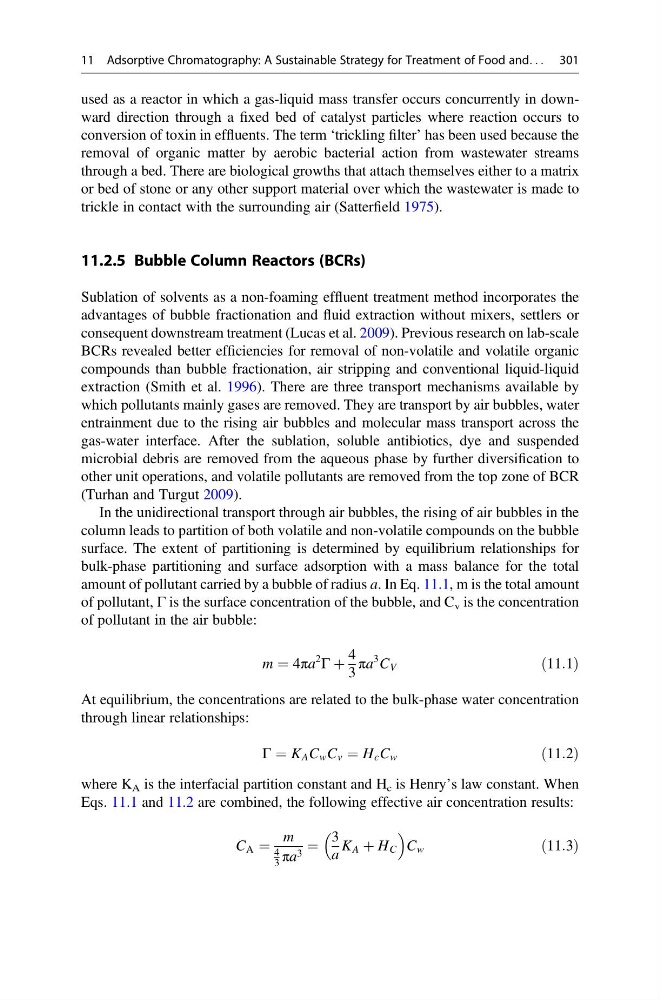
In the unidirectional transport through air bubbles, the rising of air bubbles in the
column leads to partition of both volatile and non-volatile compounds on the bubble
surface. The extent of partitioning is determined by equilibrium relationships for
bulk-phase partitioning and surface adsorption with a mass balance for the total
amount of pollutant carried by a bubble of radius a. In Eq. 11.1, m is the total amount
of pollutant, Γ is the surface concentration of the bubble, and C v is the concentration
of pollutant in the air bubble:
m ¼ 4πa
2
Γ þ
4
3
πa
3 C V
ð11:1Þ
At equilibrium, the concentrations are related to the bulk-phase water concentration
through linear relationships:
Γ ¼ K A C w C v ¼ H c C w
ð11:2Þ
where K A is the interfacial partition constant and H c is Henry’s law constant. When
Eqs. 11.1 and 11.2 are combined, the following effective air concentration results:
C A ¼
m
4
3 πa 3 ¼
3
a
K A þ H C
C w
ð11:3Þ
11 Adsorptive Chromatography: A Sustainable Strategy for Treatment of Food and. . . 301
conversion of toxin in effluents. The term ‘trickling filter’ has been used because the
removal of organic matter by aerobic bacterial action from wastewater streams
through a bed. There are biological growths that attach themselves either to a matrix
or bed of stone or any other support material over which the wastewater is made to
trickle in contact with the surrounding air (Satterfield 1975).
11.2.5 Bubble Column Reactors (BCRs)
Sublation of solvents as a non-foaming effluent treatment method incorporates the
advantages of bubble fractionation and fluid extraction without mixers, settlers or
consequent downstream treatment (Lucas et al. 2009). Previous research on lab-scale
BCRs revealed better efficiencies for removal of non-volatile and volatile organic
compounds than bubble fractionation, air stripping and conventional liquid-liquid
extraction (Smith et al. 1996). There are three transport mechanisms available by
which pollutants mainly gases are removed. They are transport by air bubbles, water
entrainment due to the rising air bubbles and molecular mass transport across the
gas-water interface. After the sublation, soluble antibiotics, dye and suspended
microbial debris are removed from the aqueous phase by further diversification to
other unit operations, and volatile pollutants are removed from the top zone of BCR
(Turhan and Turgut 2009).
In the unidirectional transport through air bubbles, the rising of air bubbles in the
column leads to partition of both volatile and non-volatile compounds on the bubble
surface. The extent of partitioning is determined by equilibrium relationships for
bulk-phase partitioning and surface adsorption with a mass balance for the total
amount of pollutant carried by a bubble of radius a. In Eq. 11.1, m is the total amount
of pollutant, Γ is the surface concentration of the bubble, and C v is the concentration
of pollutant in the air bubble:
m ¼ 4πa
2
Γ þ
4
3
πa
3 C V
ð11:1Þ
At equilibrium, the concentrations are related to the bulk-phase water concentration
through linear relationships:
Γ ¼ K A C w C v ¼ H c C w
ð11:2Þ
where K A is the interfacial partition constant and H c is Henry’s law constant. When
Eqs. 11.1 and 11.2 are combined, the following effective air concentration results:
C A ¼
m
4
3 πa 3 ¼
3
a
K A þ H C
C w
ð11:3Þ
11 Adsorptive Chromatography: A Sustainable Strategy for Treatment of Food and. . . 301