

chromatography (AC) (Cooney 1998). The major challenges involved in process
engineering are increasing volumetric throughput and quality output back into water
bodies after treatment.
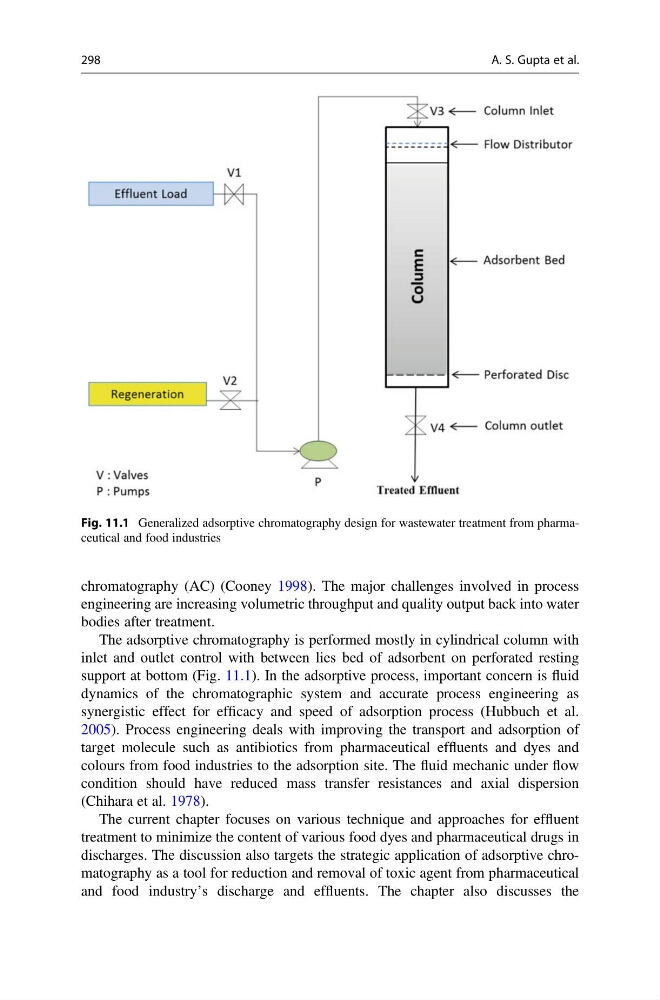
The adsorptive chromatography is performed mostly in cylindrical column with
inlet and outlet control with between lies bed of adsorbent on perforated resting
support at bottom (Fig. 11.1). In the adsorptive process, important concern is fluid
dynamics of the chromatographic system and accurate process engineering as
synergistic effect for efficacy and speed of adsorption process (Hubbuch et al.
2005). Process engineering deals with improving the transport and adsorption of
target molecule such as antibiotics from pharmaceutical effluents and dyes and
colours from food industries to the adsorption site. The fluid mechanic under flow
condition should have reduced mass transfer resistances and axial dispersion
(Chihara et al. 1978).
The current chapter focuses on various technique and approaches for effluent
treatment to minimize the content of various food dyes and pharmaceutical drugs in
discharges. The discussion also targets the strategic application of adsorptive chromatography as a tool for reduction and removal of toxic agent from pharmaceutical
and food industry’s discharge and effluents. The chapter also discusses the
Fig. 11.1 Generalized adsorptive chromatography design for wastewater treatment from pharmaceutical and food industries
298
A. S. Gupta et al.
engineering are increasing volumetric throughput and quality output back into water
bodies after treatment.
The adsorptive chromatography is performed mostly in cylindrical column with
inlet and outlet control with between lies bed of adsorbent on perforated resting
support at bottom (Fig. 11.1). In the adsorptive process, important concern is fluid
dynamics of the chromatographic system and accurate process engineering as
synergistic effect for efficacy and speed of adsorption process (Hubbuch et al.
2005). Process engineering deals with improving the transport and adsorption of
target molecule such as antibiotics from pharmaceutical effluents and dyes and
colours from food industries to the adsorption site. The fluid mechanic under flow
condition should have reduced mass transfer resistances and axial dispersion
(Chihara et al. 1978).
The current chapter focuses on various technique and approaches for effluent
treatment to minimize the content of various food dyes and pharmaceutical drugs in
discharges. The discussion also targets the strategic application of adsorptive chromatography as a tool for reduction and removal of toxic agent from pharmaceutical
and food industry’s discharge and effluents. The chapter also discusses the
Fig. 11.1 Generalized adsorptive chromatography design for wastewater treatment from pharmaceutical and food industries
298
A. S. Gupta et al.