

structure, characteristics of the target analyte such as a cation or anion, or organic
molecules’ structure such as drug candidates. Apart from this, it is also essential to
consider the nature of the solvent including polarity, pH, and ionic strength, which
can affect the capability of the receptor to detect and bind the target analyte.
There are several metal ions that play a significant role in our routine life,
including sodium (Na
+
), calcium (Ca
2+ ), potassium (K
+ ), and zinc (Zn
2+ ). However,
certain heavy metal ions like lead (Pb
2+ ), cadmium (Cd
2+ ), and mercury (Hg
2+ ) are
highly toxic and lead to severe health and environmental issues. It is necessary to
develop tools like chemosensors to detect these toxic metals/chemicals. The most
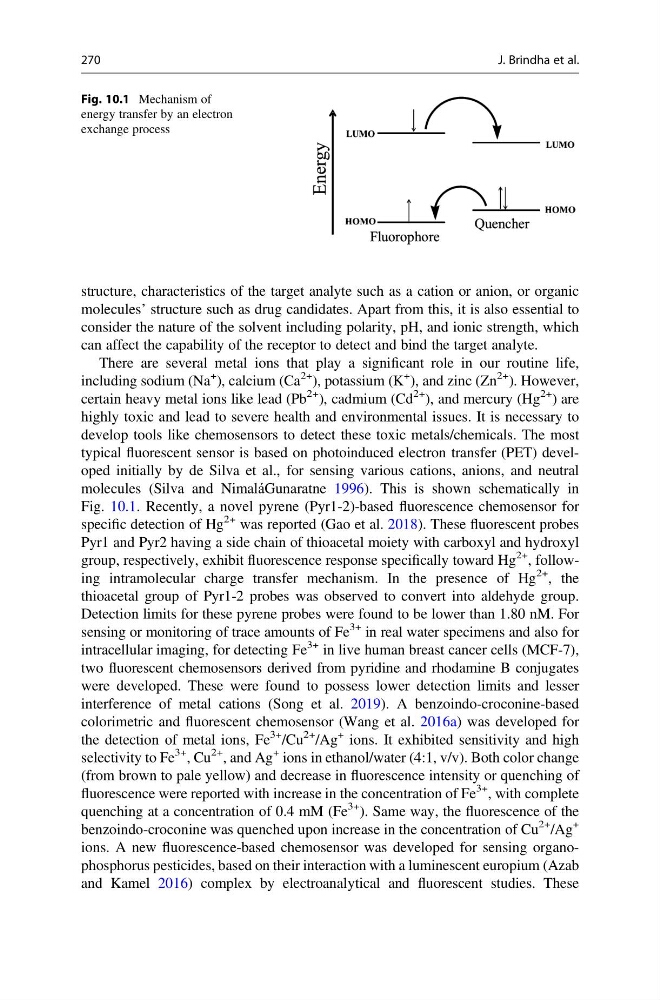
typical fluorescent sensor is based on photoinduced electron transfer (PET) developed initially by de Silva et al., for sensing various cations, anions, and neutral
molecules (Silva and NimaláGunaratne 1996). This is shown schematically in
Fig. 10.1. Recently, a novel pyrene (Pyr1-2)-based fluorescence chemosensor for
specific detection of Hg
2+ was reported (Gao et al. 2018). These fluorescent probes
Pyr1 and Pyr2 having a side chain of thioacetal moiety with carboxyl and hydroxyl
group, respectively, exhibit fluorescence response specifically toward Hg
2+ , following intramolecular charge transfer mechanism. In the presence of Hg
2+ , the
thioacetal group of Pyr1-2 probes was observed to convert into aldehyde group.
Detection limits for these pyrene probes were found to be lower than 1.80 nM. For
sensing or monitoring of trace amounts of Fe
3+ in real water specimens and also for
intracellular imaging, for detecting Fe
3+ in live human breast cancer cells (MCF-7),
two fluorescent chemosensors derived from pyridine and rhodamine B conjugates
were developed. These were found to possess lower detection limits and lesser
interference of metal cations (Song et al. 2019). A benzoindo-croconine-based
colorimetric and fluorescent chemosensor (Wang et al. 2016a) was developed for
the detection of metal ions, Fe
3+ /Cu
2+ /Ag
+ ions. It exhibited sensitivity and high
selectivity to Fe
3+ , Cu
2+ , and Ag
+ ions in ethanol/water (4:1, v/v). Both color change
(from brown to pale yellow) and decrease in fluorescence intensity or quenching of
fluorescence were reported with increase in the concentration of Fe
3+ , with complete
quenching at a concentration of 0.4 mM (Fe
3+ ). Same way, the fluorescence of the
benzoindo-croconine was quenched upon increase in the concentration of Cu
2+ /Ag
+
ions. A new fluorescence-based chemosensor was developed for sensing organophosphorus pesticides, based on their interaction with a luminescent europium (Azab
and Kamel 2016) complex by electroanalytical and fluorescent studies. These
Fig. 10.1 Mechanism of
energy transfer by an electron
exchange process
270
J. Brindha et al.
molecules’ structure such as drug candidates. Apart from this, it is also essential to
consider the nature of the solvent including polarity, pH, and ionic strength, which
can affect the capability of the receptor to detect and bind the target analyte.
There are several metal ions that play a significant role in our routine life,
including sodium (Na
+
), calcium (Ca
2+ ), potassium (K
+ ), and zinc (Zn
2+ ). However,
certain heavy metal ions like lead (Pb
2+ ), cadmium (Cd
2+ ), and mercury (Hg
2+ ) are
highly toxic and lead to severe health and environmental issues. It is necessary to
develop tools like chemosensors to detect these toxic metals/chemicals. The most
typical fluorescent sensor is based on photoinduced electron transfer (PET) developed initially by de Silva et al., for sensing various cations, anions, and neutral
molecules (Silva and NimaláGunaratne 1996). This is shown schematically in
Fig. 10.1. Recently, a novel pyrene (Pyr1-2)-based fluorescence chemosensor for
specific detection of Hg
2+ was reported (Gao et al. 2018). These fluorescent probes
Pyr1 and Pyr2 having a side chain of thioacetal moiety with carboxyl and hydroxyl
group, respectively, exhibit fluorescence response specifically toward Hg
2+ , following intramolecular charge transfer mechanism. In the presence of Hg
2+ , the
thioacetal group of Pyr1-2 probes was observed to convert into aldehyde group.
Detection limits for these pyrene probes were found to be lower than 1.80 nM. For
sensing or monitoring of trace amounts of Fe
3+ in real water specimens and also for
intracellular imaging, for detecting Fe
3+ in live human breast cancer cells (MCF-7),
two fluorescent chemosensors derived from pyridine and rhodamine B conjugates
were developed. These were found to possess lower detection limits and lesser
interference of metal cations (Song et al. 2019). A benzoindo-croconine-based
colorimetric and fluorescent chemosensor (Wang et al. 2016a) was developed for
the detection of metal ions, Fe
3+ /Cu
2+ /Ag
+ ions. It exhibited sensitivity and high
selectivity to Fe
3+ , Cu
2+ , and Ag
+ ions in ethanol/water (4:1, v/v). Both color change
(from brown to pale yellow) and decrease in fluorescence intensity or quenching of
fluorescence were reported with increase in the concentration of Fe
3+ , with complete
quenching at a concentration of 0.4 mM (Fe
3+ ). Same way, the fluorescence of the
benzoindo-croconine was quenched upon increase in the concentration of Cu
2+ /Ag
+
ions. A new fluorescence-based chemosensor was developed for sensing organophosphorus pesticides, based on their interaction with a luminescent europium (Azab
and Kamel 2016) complex by electroanalytical and fluorescent studies. These
Fig. 10.1 Mechanism of
energy transfer by an electron
exchange process
270
J. Brindha et al.