

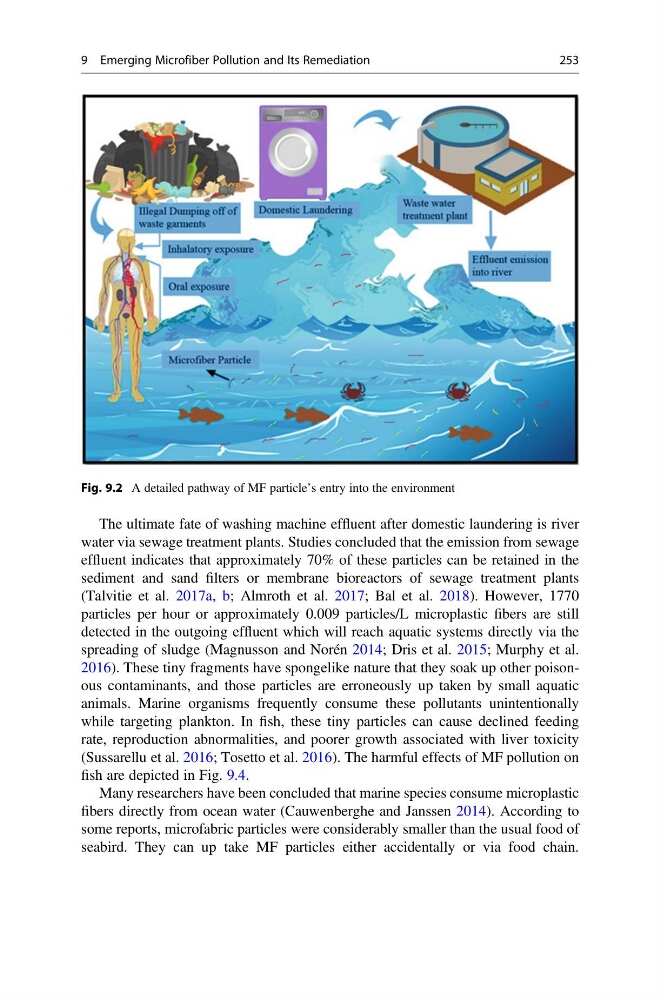
The ultimate fate of washing machine effluent after domestic laundering is river
water via sewage treatment plants. Studies concluded that the emission from sewage
effluent indicates that approximately 70% of these particles can be retained in the
sediment and sand filters or membrane bioreactors of sewage treatment plants
(Talvitie et al. 2017a, b; Almroth et al. 2017; Bal et al. 2018). However, 1770
particles per hour or approximately 0.009 particles/L microplastic fibers are still
detected in the outgoing effluent which will reach aquatic systems directly via the
spreading of sludge (Magnusson and Norén 2014; Dris et al. 2015; Murphy et al.
2016). These tiny fragments have spongelike nature that they soak up other poisonous contaminants, and those particles are erroneously up taken by small aquatic
animals. Marine organisms frequently consume these pollutants unintentionally
while targeting plankton. In fish, these tiny particles can cause declined feeding
rate, reproduction abnormalities, and poorer growth associated with liver toxicity
(Sussarellu et al. 2016; Tosetto et al. 2016). The harmful effects of MF pollution on
fish are depicted in Fig. 9.4.
Many researchers have been concluded that marine species consume microplastic
fibers directly from ocean water (Cauwenberghe and Janssen 2014). According to
some reports, microfabric particles were considerably smaller than the usual food of
seabird. They can up take MF particles either accidentally or via food chain.
Fig. 9.2 A detailed pathway of MF particle’s entry into the environment
9 Emerging Microfiber Pollution and Its Remediation
253
water via sewage treatment plants. Studies concluded that the emission from sewage
effluent indicates that approximately 70% of these particles can be retained in the
sediment and sand filters or membrane bioreactors of sewage treatment plants
(Talvitie et al. 2017a, b; Almroth et al. 2017; Bal et al. 2018). However, 1770
particles per hour or approximately 0.009 particles/L microplastic fibers are still
detected in the outgoing effluent which will reach aquatic systems directly via the
spreading of sludge (Magnusson and Norén 2014; Dris et al. 2015; Murphy et al.
2016). These tiny fragments have spongelike nature that they soak up other poisonous contaminants, and those particles are erroneously up taken by small aquatic
animals. Marine organisms frequently consume these pollutants unintentionally
while targeting plankton. In fish, these tiny particles can cause declined feeding
rate, reproduction abnormalities, and poorer growth associated with liver toxicity
(Sussarellu et al. 2016; Tosetto et al. 2016). The harmful effects of MF pollution on
fish are depicted in Fig. 9.4.
Many researchers have been concluded that marine species consume microplastic
fibers directly from ocean water (Cauwenberghe and Janssen 2014). According to
some reports, microfabric particles were considerably smaller than the usual food of
seabird. They can up take MF particles either accidentally or via food chain.
Fig. 9.2 A detailed pathway of MF particle’s entry into the environment
9 Emerging Microfiber Pollution and Its Remediation
253