

25 days. The degradation of bentazone, mecoprop, and dichlorprop in groundwater
through biostimulation, i.e., by providing additional oxygen, was observed in a study
by Levi et al. (2014). The 98% biodegradation and transformation of methoxychlor
and DDT through reductive dechlorination by using human intestinal bacterium
Eubacterium limosum under strict anaerobic conditions was observed within 16 days
(Yim et al. 2008). The degradation of DDT, DDD, and DDE by a bacterial strain
DDT-6 (D6), Sphingobacterium sp., was also reported by Fang et al. (2010). The
94.4 % degradation of DDT by fungal culture (Fusarium oxysporum) was observed
in the study by Kulshrestha and Kumari (2010). Recently, Mansouri et al. (2017)
have provided a detailed overview about different bioremediation approaches and
their potential degrading of DDTs and its metabolites.
8.6.2 Adsorption Process
Adsorption process is considered as the most effective and highly recognized
method of wastewater as compared to other wastewater methods because of the
cost effectiveness and flexible and simple operations and designs. In addition, no
harmful by-products are generated in the adsorption process. This is an effective
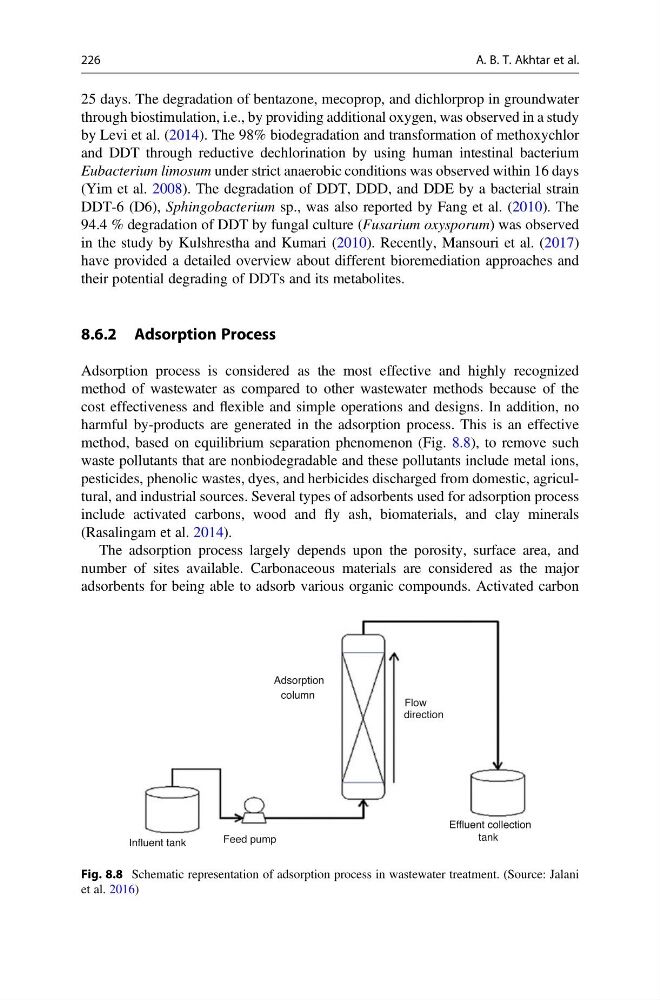
method, based on equilibrium separation phenomenon (Fig. 8.8), to remove such
waste pollutants that are nonbiodegradable and these pollutants include metal ions,
pesticides, phenolic wastes, dyes, and herbicides discharged from domestic, agricultural, and industrial sources. Several types of adsorbents used for adsorption process
include activated carbons, wood and fly ash, biomaterials, and clay minerals
(Rasalingam et al. 2014).
The adsorption process largely depends upon the porosity, surface area, and
number of sites available. Carbonaceous materials are considered as the major
adsorbents for being able to adsorb various organic compounds. Activated carbon
Adsorption
column
Flow
direction
Effluent collection
tank
Influent tank
Feed pump
Fig. 8.8 Schematic representation of adsorption process in wastewater treatment. (Source: Jalani
et al. 2016)
226
A. B. T. Akhtar et al.
through biostimulation, i.e., by providing additional oxygen, was observed in a study
by Levi et al. (2014). The 98% biodegradation and transformation of methoxychlor
and DDT through reductive dechlorination by using human intestinal bacterium
Eubacterium limosum under strict anaerobic conditions was observed within 16 days
(Yim et al. 2008). The degradation of DDT, DDD, and DDE by a bacterial strain
DDT-6 (D6), Sphingobacterium sp., was also reported by Fang et al. (2010). The
94.4 % degradation of DDT by fungal culture (Fusarium oxysporum) was observed
in the study by Kulshrestha and Kumari (2010). Recently, Mansouri et al. (2017)
have provided a detailed overview about different bioremediation approaches and
their potential degrading of DDTs and its metabolites.
8.6.2 Adsorption Process
Adsorption process is considered as the most effective and highly recognized
method of wastewater as compared to other wastewater methods because of the
cost effectiveness and flexible and simple operations and designs. In addition, no
harmful by-products are generated in the adsorption process. This is an effective
method, based on equilibrium separation phenomenon (Fig. 8.8), to remove such
waste pollutants that are nonbiodegradable and these pollutants include metal ions,
pesticides, phenolic wastes, dyes, and herbicides discharged from domestic, agricultural, and industrial sources. Several types of adsorbents used for adsorption process
include activated carbons, wood and fly ash, biomaterials, and clay minerals
(Rasalingam et al. 2014).
The adsorption process largely depends upon the porosity, surface area, and
number of sites available. Carbonaceous materials are considered as the major
adsorbents for being able to adsorb various organic compounds. Activated carbon
Adsorption
column
Flow
direction
Effluent collection
tank
Influent tank
Feed pump
Fig. 8.8 Schematic representation of adsorption process in wastewater treatment. (Source: Jalani
et al. 2016)
226
A. B. T. Akhtar et al.