

boiling point, and nonflammability, PCBs have been utilized in numerous industrial
applications such as plasticizers in rubber, plastic, and paints, heat transfer, hydraulic
and electrical equipment, carbonless papers, and several other commercial
applications (U.S. EPA 2011). They have been made so useful because of their
high dielectric properties. PCBs were produced as a mixture of PCB congeners and
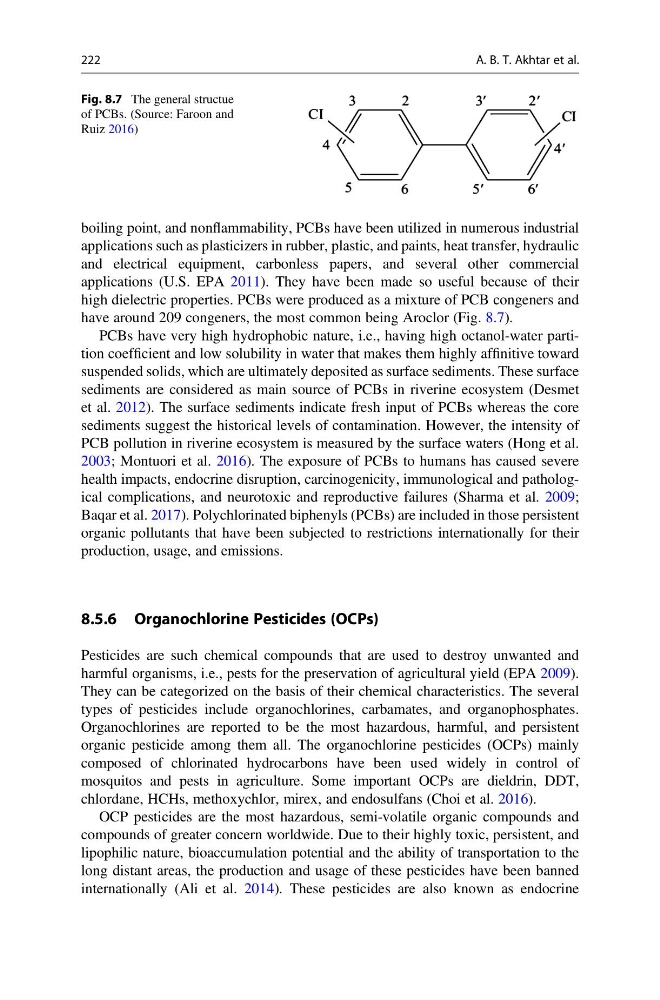
have around 209 congeners, the most common being Aroclor (Fig. 8.7).
PCBs have very high hydrophobic nature, i.e., having high octanol-water partition coefficient and low solubility in water that makes them highly affinitive toward
suspended solids, which are ultimately deposited as surface sediments. These surface
sediments are considered as main source of PCBs in riverine ecosystem (Desmet
et al. 2012). The surface sediments indicate fresh input of PCBs whereas the core
sediments suggest the historical levels of contamination. However, the intensity of
PCB pollution in riverine ecosystem is measured by the surface waters (Hong et al.
2003; Montuori et al. 2016). The exposure of PCBs to humans has caused severe
health impacts, endocrine disruption, carcinogenicity, immunological and pathological complications, and neurotoxic and reproductive failures (Sharma et al. 2009;
Baqar et al. 2017). Polychlorinated biphenyls (PCBs) are included in those persistent
organic pollutants that have been subjected to restrictions internationally for their
production, usage, and emissions.
8.5.6 Organochlorine Pesticides (OCPs)
Pesticides are such chemical compounds that are used to destroy unwanted and
harmful organisms, i.e., pests for the preservation of agricultural yield (EPA 2009).
They can be categorized on the basis of their chemical characteristics. The several
types of pesticides include organochlorines, carbamates, and organophosphates.
Organochlorines are reported to be the most hazardous, harmful, and persistent
organic pesticide among them all. The organochlorine pesticides (OCPs) mainly
composed of chlorinated hydrocarbons have been used widely in control of
mosquitos and pests in agriculture. Some important OCPs are dieldrin, DDT,
chlordane, HCHs, methoxychlor, mirex, and endosulfans (Choi et al. 2016).
OCP pesticides are the most hazardous, semi-volatile organic compounds and
compounds of greater concern worldwide. Due to their highly toxic, persistent, and
lipophilic nature, bioaccumulation potential and the ability of transportation to the
long distant areas, the production and usage of these pesticides have been banned
internationally (Ali et al. 2014). These pesticides are also known as endocrine
Fig. 8.7 The general structue
of PCBs. (Source: Faroon and
Ruiz 2016)
222
A. B. T. Akhtar et al.
applications such as plasticizers in rubber, plastic, and paints, heat transfer, hydraulic
and electrical equipment, carbonless papers, and several other commercial
applications (U.S. EPA 2011). They have been made so useful because of their
high dielectric properties. PCBs were produced as a mixture of PCB congeners and
have around 209 congeners, the most common being Aroclor (Fig. 8.7).
PCBs have very high hydrophobic nature, i.e., having high octanol-water partition coefficient and low solubility in water that makes them highly affinitive toward
suspended solids, which are ultimately deposited as surface sediments. These surface
sediments are considered as main source of PCBs in riverine ecosystem (Desmet
et al. 2012). The surface sediments indicate fresh input of PCBs whereas the core
sediments suggest the historical levels of contamination. However, the intensity of
PCB pollution in riverine ecosystem is measured by the surface waters (Hong et al.
2003; Montuori et al. 2016). The exposure of PCBs to humans has caused severe
health impacts, endocrine disruption, carcinogenicity, immunological and pathological complications, and neurotoxic and reproductive failures (Sharma et al. 2009;
Baqar et al. 2017). Polychlorinated biphenyls (PCBs) are included in those persistent
organic pollutants that have been subjected to restrictions internationally for their
production, usage, and emissions.
8.5.6 Organochlorine Pesticides (OCPs)
Pesticides are such chemical compounds that are used to destroy unwanted and
harmful organisms, i.e., pests for the preservation of agricultural yield (EPA 2009).
They can be categorized on the basis of their chemical characteristics. The several
types of pesticides include organochlorines, carbamates, and organophosphates.
Organochlorines are reported to be the most hazardous, harmful, and persistent
organic pesticide among them all. The organochlorine pesticides (OCPs) mainly
composed of chlorinated hydrocarbons have been used widely in control of
mosquitos and pests in agriculture. Some important OCPs are dieldrin, DDT,
chlordane, HCHs, methoxychlor, mirex, and endosulfans (Choi et al. 2016).
OCP pesticides are the most hazardous, semi-volatile organic compounds and
compounds of greater concern worldwide. Due to their highly toxic, persistent, and
lipophilic nature, bioaccumulation potential and the ability of transportation to the
long distant areas, the production and usage of these pesticides have been banned
internationally (Ali et al. 2014). These pesticides are also known as endocrine
Fig. 8.7 The general structue
of PCBs. (Source: Faroon and
Ruiz 2016)
222
A. B. T. Akhtar et al.