

layers. The trapped air is forced by the supernatant water to move downward. The
water is then drained vertically by gravity through the porous media layers of the bed
in an unsaturated flow mode (Stefanakis and Tsihrintzis 2012). As the water drains,
air from the atmosphere enters the system and fills the void space of the media
(Maier et al. 2009), replacing the water volume that drains. In this way, the bed
aeration is enhanced, and the microbial activity is stimulated (Stefanakis et al. 2014).
Once the water reaches the bottom of the bed, a network of collecting pipes collects
it and sends it with gravity to the second stage wetland. The VFCW basin has a total
depth of 1 m, of which 65 cm is the gravel layer and the rest the freeboard. The
bottom of the bed is also lined with an HDPE membrane of 1.5 mm thickness. Α
layer of compacted clay sand was installed below the HPDE liner in order to
eliminate the potential leakage of polluted water into the ground soil during the
operation of the new wetland facility.
The second stage is an ACW with horizontal subsurface flow mode (surface of
800 m
2 ) gravitationally receiving the partially treated water of the first-stage wetland
bed and providing final wastewater treatment reaching the desired quality (Fig. 7.4).
Step-feeding of raw wastewater (screened inflow from the settlement lift station) is
also applied in the ACW, with a small volume being routed to the second stage to
provide additional carbon source for denitrification. The practice of wastewater stepfeeding has been found to improve the treatment performance in HSFCWs
(Stefanakis et al. 2011). Water is distributed through a PVC pipe with orifices,
which extends along the upstream width side and is placed on top of the gravel
media layer. The total depth of the bed is 1.3 m, of which 1 m is the depth of the
gravel media layer and the rest is freeboard.
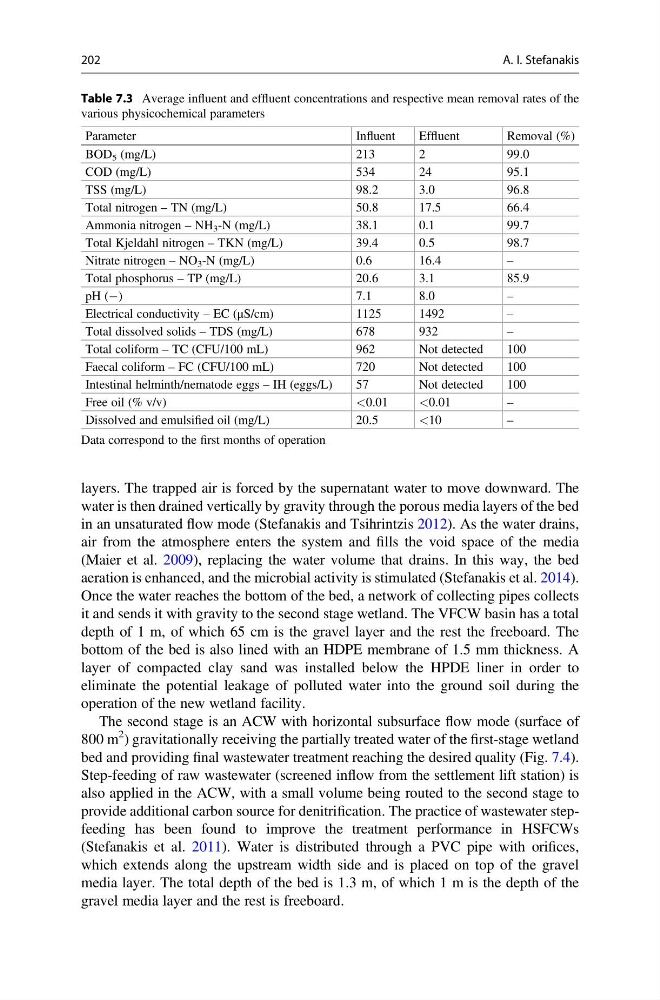
Table 7.3 Average influent and effluent concentrations and respective mean removal rates of the
various physicochemical parameters
Parameter
Influent
Effluent
Removal (%)
BOD 5 (mg/L)
213
2
99.0
COD (mg/L)
534
24
95.1
TSS (mg/L)
98.2
3.0
96.8
Total nitrogen – TN (mg/L)
50.8
17.5
66.4
Ammonia nitrogen – NH 3 -N (mg/L)
38.1
0.1
99.7
Total Kjeldahl nitrogen – TKN (mg/L)
39.4
0.5
98.7
Nitrate nitrogen – NO 3 -N (mg/L)
0.6
16.4
–
Total phosphorus – TP (mg/L)
20.6
3.1
85.9
pH (À)
7.1
8.0
–
Electrical conductivity – EC (μS/cm)
1125
1492
–
Total dissolved solids – TDS (mg/L)
678
932
–
Total coliform – TC (CFU/100 mL)
962
Not detected
100
Faecal coliform – FC (CFU/100 mL)
720
Not detected
100
Intestinal helminth/nematode eggs – IH (eggs/L)
57
Not detected
100
Free oil (% v/v)
<0.01
<0.01
–
Dissolved and emulsified oil (mg/L)
20.5
<10
–
Data correspond to the first months of operation
202
A. I. Stefanakis
water is then drained vertically by gravity through the porous media layers of the bed
in an unsaturated flow mode (Stefanakis and Tsihrintzis 2012). As the water drains,
air from the atmosphere enters the system and fills the void space of the media
(Maier et al. 2009), replacing the water volume that drains. In this way, the bed
aeration is enhanced, and the microbial activity is stimulated (Stefanakis et al. 2014).
Once the water reaches the bottom of the bed, a network of collecting pipes collects
it and sends it with gravity to the second stage wetland. The VFCW basin has a total
depth of 1 m, of which 65 cm is the gravel layer and the rest the freeboard. The
bottom of the bed is also lined with an HDPE membrane of 1.5 mm thickness. Α
layer of compacted clay sand was installed below the HPDE liner in order to
eliminate the potential leakage of polluted water into the ground soil during the
operation of the new wetland facility.
The second stage is an ACW with horizontal subsurface flow mode (surface of
800 m
2 ) gravitationally receiving the partially treated water of the first-stage wetland
bed and providing final wastewater treatment reaching the desired quality (Fig. 7.4).
Step-feeding of raw wastewater (screened inflow from the settlement lift station) is
also applied in the ACW, with a small volume being routed to the second stage to
provide additional carbon source for denitrification. The practice of wastewater stepfeeding has been found to improve the treatment performance in HSFCWs
(Stefanakis et al. 2011). Water is distributed through a PVC pipe with orifices,
which extends along the upstream width side and is placed on top of the gravel
media layer. The total depth of the bed is 1.3 m, of which 1 m is the depth of the
gravel media layer and the rest is freeboard.
Table 7.3 Average influent and effluent concentrations and respective mean removal rates of the
various physicochemical parameters
Parameter
Influent
Effluent
Removal (%)
BOD 5 (mg/L)
213
2
99.0
COD (mg/L)
534
24
95.1
TSS (mg/L)
98.2
3.0
96.8
Total nitrogen – TN (mg/L)
50.8
17.5
66.4
Ammonia nitrogen – NH 3 -N (mg/L)
38.1
0.1
99.7
Total Kjeldahl nitrogen – TKN (mg/L)
39.4
0.5
98.7
Nitrate nitrogen – NO 3 -N (mg/L)
0.6
16.4
–
Total phosphorus – TP (mg/L)
20.6
3.1
85.9
pH (À)
7.1
8.0
–
Electrical conductivity – EC (μS/cm)
1125
1492
–
Total dissolved solids – TDS (mg/L)
678
932
–
Total coliform – TC (CFU/100 mL)
962
Not detected
100
Faecal coliform – FC (CFU/100 mL)
720
Not detected
100
Intestinal helminth/nematode eggs – IH (eggs/L)
57
Not detected
100
Free oil (% v/v)
<0.01
<0.01
–
Dissolved and emulsified oil (mg/L)
20.5
<10
–
Data correspond to the first months of operation
202
A. I. Stefanakis