

metabolites of microscopic filamentous fungus Aspergillus niger was evaluated in
laboratory-scale batch experiments.
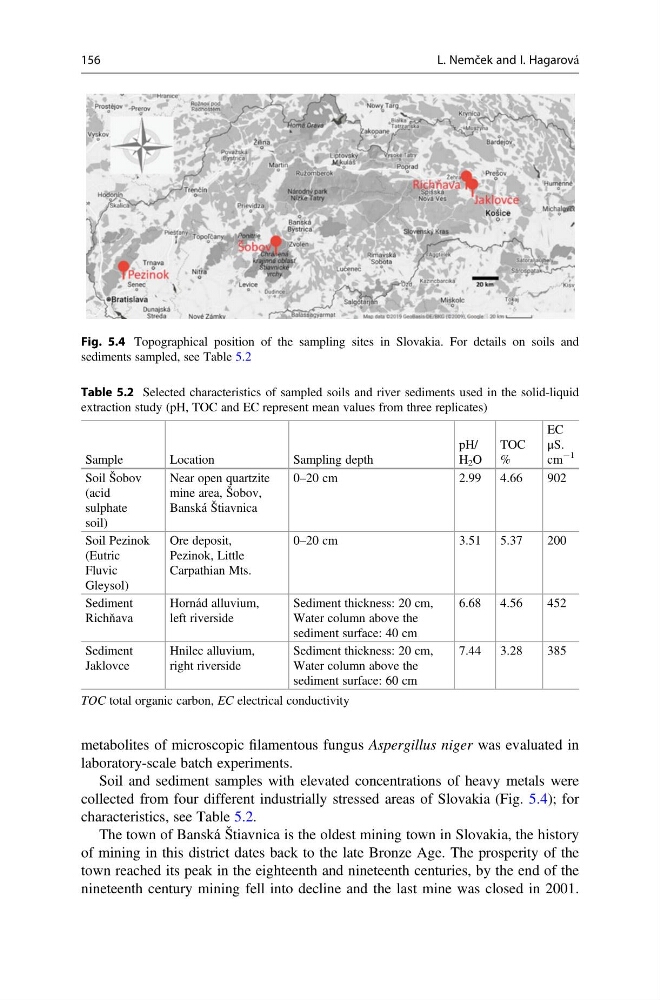
Soil and sediment samples with elevated concentrations of heavy metals were
collected from four different industrially stressed areas of Slovakia (Fig. 5.4); for
characteristics, see Table 5.2.
The town of Banská Štiavnica is the oldest mining town in Slovakia, the history
of mining in this district dates back to the late Bronze Age. The prosperity of the
town reached its peak in the eighteenth and nineteenth centuries, by the end of the
nineteenth century mining fell into decline and the last mine was closed in 2001.
Fig. 5.4 Topographical position of the sampling sites in Slovakia. For details on soils and
sediments sampled, see Table 5.2
Table 5.2 Selected characteristics of sampled soils and river sediments used in the solid-liquid
extraction study (pH, TOC and EC represent mean values from three replicates)
Sample
Location
Sampling depth
pH/
H 2 O
TOC
%
EC
μS.
cm
À1
Soil Šobov
(acid
sulphate
soil)
Near open quartzite
mine area, Šobov,
Banská Štiavnica
0–20 cm
2.99 4.66
902
Soil Pezinok
(Eutric
Fluvic
Gleysol)
Ore deposit,
Pezinok, Little
Carpathian Mts.
0–20 cm
3.51 5.37
200
Sediment
Richňava
Hornád alluvium,
left riverside
Sediment thickness: 20 cm,
Water column above the
sediment surface: 40 cm
6.68 4.56
452
Sediment
Jaklovce
Hnilec alluvium,
right riverside
Sediment thickness: 20 cm,
Water column above the
sediment surface: 60 cm
7.44 3.28
385
TOC total organic carbon, EC electrical conductivity
156
L. Nemček and I. Hagarová
laboratory-scale batch experiments.
Soil and sediment samples with elevated concentrations of heavy metals were
collected from four different industrially stressed areas of Slovakia (Fig. 5.4); for
characteristics, see Table 5.2.
The town of Banská Štiavnica is the oldest mining town in Slovakia, the history
of mining in this district dates back to the late Bronze Age. The prosperity of the
town reached its peak in the eighteenth and nineteenth centuries, by the end of the
nineteenth century mining fell into decline and the last mine was closed in 2001.
Fig. 5.4 Topographical position of the sampling sites in Slovakia. For details on soils and
sediments sampled, see Table 5.2
Table 5.2 Selected characteristics of sampled soils and river sediments used in the solid-liquid
extraction study (pH, TOC and EC represent mean values from three replicates)
Sample
Location
Sampling depth
pH/
H 2 O
TOC
%
EC
μS.
cm
À1
Soil Šobov
(acid
sulphate
soil)
Near open quartzite
mine area, Šobov,
Banská Štiavnica
0–20 cm
2.99 4.66
902
Soil Pezinok
(Eutric
Fluvic
Gleysol)
Ore deposit,
Pezinok, Little
Carpathian Mts.
0–20 cm
3.51 5.37
200
Sediment
Richňava
Hornád alluvium,
left riverside
Sediment thickness: 20 cm,
Water column above the
sediment surface: 40 cm
6.68 4.56
452
Sediment
Jaklovce
Hnilec alluvium,
right riverside
Sediment thickness: 20 cm,
Water column above the
sediment surface: 60 cm
7.44 3.28
385
TOC total organic carbon, EC electrical conductivity
156
L. Nemček and I. Hagarová