

4.4.1 The Erosion
When biomass is removed from many plants, soil erosion is exacerbated. As a
consequence of the increased soil erosion, there is not enough organic substance to
penetrate the soil to maintain a sustained crop production, and the vegetation begins
to degrade. The expression “desertification” has not been used critically and by
definition. The debate to determine the causes of desertification, namely, the effects
of demographic growth or meteorological changes, is old. There are no data records
of sufficient duration to distinguish between temporary fluctuations, climate change
or not, and long-term climate change. Destruction of vegetation can affect climatic
conditions.
On a global scale, as a result of the greenhouse effect, climate warming began.
Salinization is a major cause of the destruction of soil fertility and is reflected in a
sharp deterioration of nutrient reserves. Soil salinization has great economic and
social repercussions and has a severe impact on the living standards of populations in
arid areas; the causes of salinization are both natural and anthropogenic. The most
important prerequisites for the appearance of salinated soils are groundwater mineralization close to the surface. By evaporating the capillary moisture of the upper
layers of the soil, it becomes successively more salinized. Anthropogenic
contributing factors to salinization are the different irrigation practices. Anthropogenic salinization of soils destroying their fertility is often the result of poor use of
land and water resources (Egamberdieva et al. 2008).
4.4.2 Compaction of Soil
Compaction (tamping) of the soil is a process that has consequences for its use. Soil
pores are compressed by street traffic by moving heavy machinery onto cultivated
soil. By compaction of the soil, the supply of oxygen and water is reduced and the
reduction reactions of NO 3
À , SO 4
2À , CO 2 , H
+ , Mn(IV), Mn(III), and Fe(III).
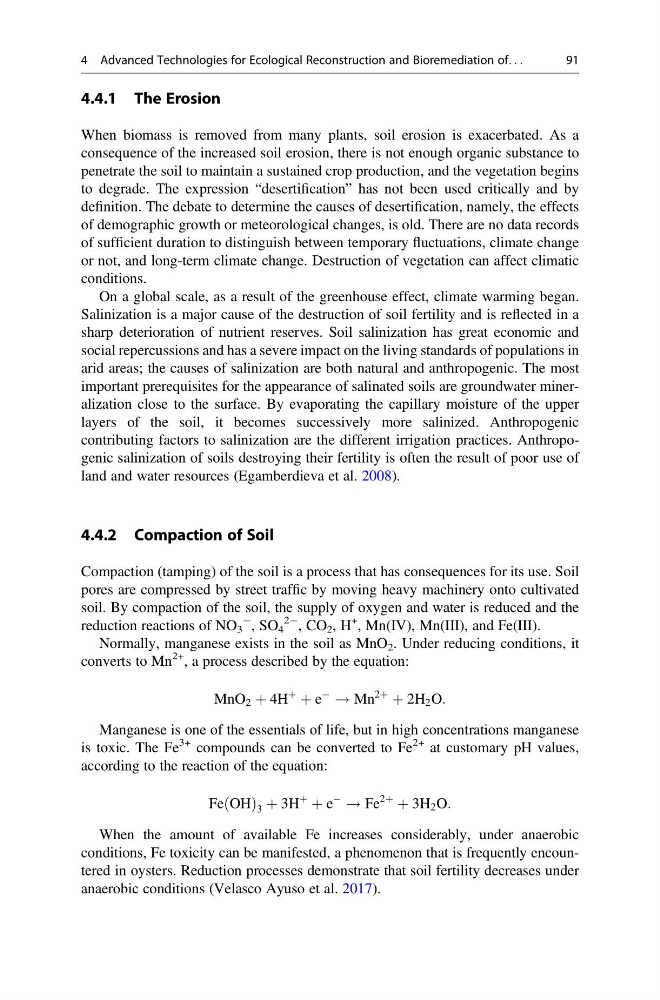
Normally, manganese exists in the soil as MnO 2 . Under reducing conditions, it
converts to Mn
2+ , a process described by the equation:
MnO 2 þ 4H
þ
þ e
À
! Mn
2þ
þ 2H 2 O:
Manganese is one of the essentials of life, but in high concentrations manganese
is toxic. The Fe
3+ compounds can be converted to Fe
2+ at customary pH values,
according to the reaction of the equation:
Fe OH
ð Þ 3 þ 3H
þ
þ e
À
! Fe
2þ
þ 3H 2 O:
When the amount of available Fe increases considerably, under anaerobic
conditions, Fe toxicity can be manifested, a phenomenon that is frequently encountered in oysters. Reduction processes demonstrate that soil fertility decreases under
anaerobic conditions (Velasco Ayuso et al. 2017).
4 Advanced Technologies for Ecological Reconstruction and Bioremediation of. . .
91
When biomass is removed from many plants, soil erosion is exacerbated. As a
consequence of the increased soil erosion, there is not enough organic substance to
penetrate the soil to maintain a sustained crop production, and the vegetation begins
to degrade. The expression “desertification” has not been used critically and by
definition. The debate to determine the causes of desertification, namely, the effects
of demographic growth or meteorological changes, is old. There are no data records
of sufficient duration to distinguish between temporary fluctuations, climate change
or not, and long-term climate change. Destruction of vegetation can affect climatic
conditions.
On a global scale, as a result of the greenhouse effect, climate warming began.
Salinization is a major cause of the destruction of soil fertility and is reflected in a
sharp deterioration of nutrient reserves. Soil salinization has great economic and
social repercussions and has a severe impact on the living standards of populations in
arid areas; the causes of salinization are both natural and anthropogenic. The most
important prerequisites for the appearance of salinated soils are groundwater mineralization close to the surface. By evaporating the capillary moisture of the upper
layers of the soil, it becomes successively more salinized. Anthropogenic
contributing factors to salinization are the different irrigation practices. Anthropogenic salinization of soils destroying their fertility is often the result of poor use of
land and water resources (Egamberdieva et al. 2008).
4.4.2 Compaction of Soil
Compaction (tamping) of the soil is a process that has consequences for its use. Soil
pores are compressed by street traffic by moving heavy machinery onto cultivated
soil. By compaction of the soil, the supply of oxygen and water is reduced and the
reduction reactions of NO 3
À , SO 4
2À , CO 2 , H
+ , Mn(IV), Mn(III), and Fe(III).
Normally, manganese exists in the soil as MnO 2 . Under reducing conditions, it
converts to Mn
2+ , a process described by the equation:
MnO 2 þ 4H
þ
þ e
À
! Mn
2þ
þ 2H 2 O:
Manganese is one of the essentials of life, but in high concentrations manganese
is toxic. The Fe
3+ compounds can be converted to Fe
2+ at customary pH values,
according to the reaction of the equation:
Fe OH
ð Þ 3 þ 3H
þ
þ e
À
! Fe
2þ
þ 3H 2 O:
When the amount of available Fe increases considerably, under anaerobic
conditions, Fe toxicity can be manifested, a phenomenon that is frequently encountered in oysters. Reduction processes demonstrate that soil fertility decreases under
anaerobic conditions (Velasco Ayuso et al. 2017).
4 Advanced Technologies for Ecological Reconstruction and Bioremediation of. . .
91