

is one more imperative issue for the adverse effects of nanoparticles (Lin and Xing
2007; Ma et al. 2010). The evaluation of risk factors after the use of zero-valent Fe
and Fe 2 O 3 nanoparticles has also been demonstrated in many reports regarding their
seed germination and phytotoxicity (Grieger et al. 2010). Surface oxidation of zerovalent Fe nanoparticles is a significant factor for the tendency of agglomeration and
toxicity.
Investigation of the effect of released nanoparticles on various environmental
species and their fate after being released to the environment is an active research
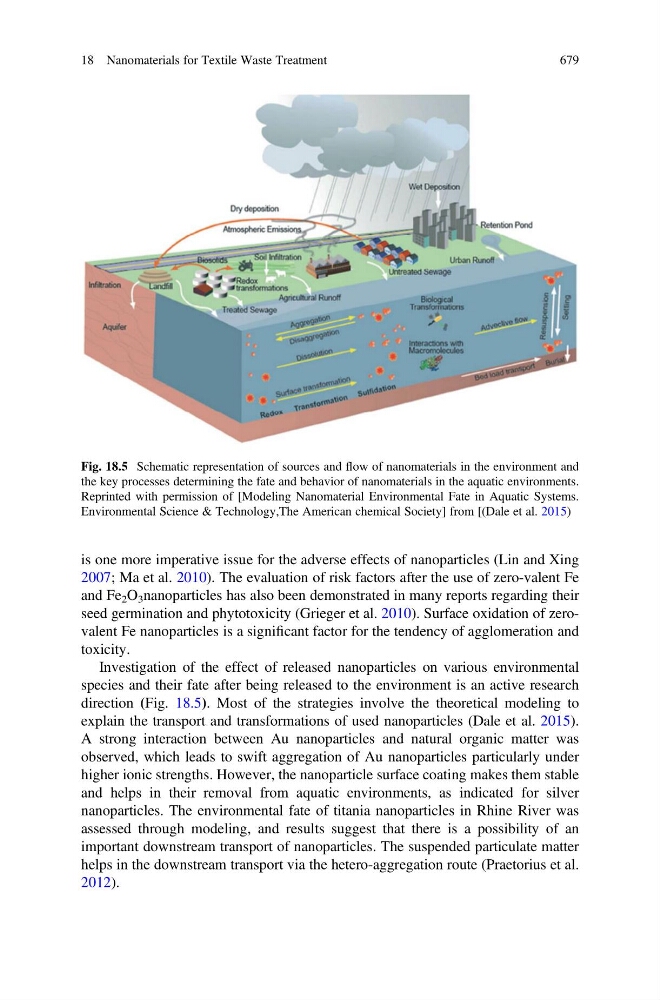
direction (Fig. 18.5). Most of the strategies involve the theoretical modeling to
explain the transport and transformations of used nanoparticles (Dale et al. 2015).
A strong interaction between Au nanoparticles and natural organic matter was
observed, which leads to swift aggregation of Au nanoparticles particularly under
higher ionic strengths. However, the nanoparticle surface coating makes them stable
and helps in their removal from aquatic environments, as indicated for silver
nanoparticles. The environmental fate of titania nanoparticles in Rhine River was
assessed through modeling, and results suggest that there is a possibility of an
important downstream transport of nanoparticles. The suspended particulate matter
helps in the downstream transport via the hetero-aggregation route (Praetorius et al.
2012).
Fig. 18.5 Schematic representation of sources and flow of nanomaterials in the environment and
the key processes determining the fate and behavior of nanomaterials in the aquatic environments.
Reprinted with permission of [Modeling Nanomaterial Environmental Fate in Aquatic Systems.
Environmental Science & Technology,The American chemical Society] from [(Dale et al. 2015)
18 Nanomaterials for Textile Waste Treatment
679
2007; Ma et al. 2010). The evaluation of risk factors after the use of zero-valent Fe
and Fe 2 O 3 nanoparticles has also been demonstrated in many reports regarding their
seed germination and phytotoxicity (Grieger et al. 2010). Surface oxidation of zerovalent Fe nanoparticles is a significant factor for the tendency of agglomeration and
toxicity.
Investigation of the effect of released nanoparticles on various environmental
species and their fate after being released to the environment is an active research
direction (Fig. 18.5). Most of the strategies involve the theoretical modeling to
explain the transport and transformations of used nanoparticles (Dale et al. 2015).
A strong interaction between Au nanoparticles and natural organic matter was
observed, which leads to swift aggregation of Au nanoparticles particularly under
higher ionic strengths. However, the nanoparticle surface coating makes them stable
and helps in their removal from aquatic environments, as indicated for silver
nanoparticles. The environmental fate of titania nanoparticles in Rhine River was
assessed through modeling, and results suggest that there is a possibility of an
important downstream transport of nanoparticles. The suspended particulate matter
helps in the downstream transport via the hetero-aggregation route (Praetorius et al.
2012).
Fig. 18.5 Schematic representation of sources and flow of nanomaterials in the environment and
the key processes determining the fate and behavior of nanomaterials in the aquatic environments.
Reprinted with permission of [Modeling Nanomaterial Environmental Fate in Aquatic Systems.
Environmental Science & Technology,The American chemical Society] from [(Dale et al. 2015)
18 Nanomaterials for Textile Waste Treatment
679