

During the last few years, a lot of semiconductor photocatalysts have been
designed for the treatment of wastewater, such as metal oxides; ZnO, TiO 2 , and
Fe 2 O 3 and metal sulfides; and CdS and SnS 2 . Among these, TiO 2 has engrossed
considerable interest for photocatalytic water treatment owing to its thermal and
chemical stability and remarkable mechanical characteristics. The photocatalytic
activity of TiO 2 nanoparticles was first demonstrated by Fujishima and Honda
(Fujishima and Honda 1972). Since then, the use of TiO 2 photocatalysts for the
treatment of wastewater and degradation of several hazardous organic compounds
has been broadly investigated. TiO 2 photocatalyst mostly works in the limited range
of photon energy, i.e., from 300 nm to 390 nm. Moreover, electron–hole recombination in the absence of appropriate electron acceptors still confines its large-scale
use since it leads to wastage of energy.
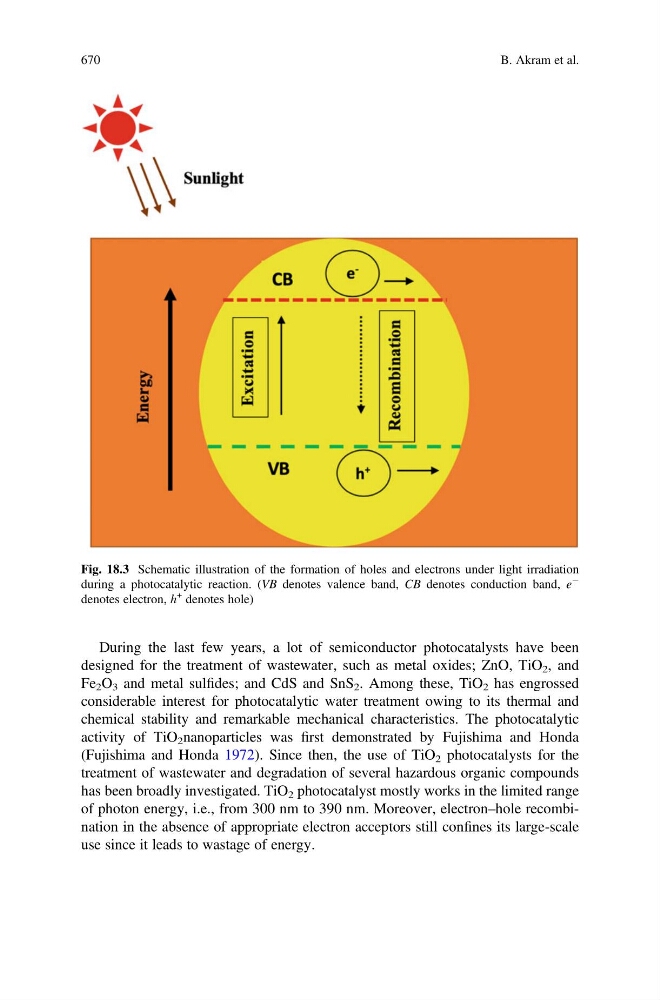
Fig. 18.3 Schematic illustration of the formation of holes and electrons under light irradiation
during a photocatalytic reaction. (VB denotes valence band, CB denotes conduction band, e
À
denotes electron, h
+ denotes hole)
670
B. Akram et al.
designed for the treatment of wastewater, such as metal oxides; ZnO, TiO 2 , and
Fe 2 O 3 and metal sulfides; and CdS and SnS 2 . Among these, TiO 2 has engrossed
considerable interest for photocatalytic water treatment owing to its thermal and
chemical stability and remarkable mechanical characteristics. The photocatalytic
activity of TiO 2 nanoparticles was first demonstrated by Fujishima and Honda
(Fujishima and Honda 1972). Since then, the use of TiO 2 photocatalysts for the
treatment of wastewater and degradation of several hazardous organic compounds
has been broadly investigated. TiO 2 photocatalyst mostly works in the limited range
of photon energy, i.e., from 300 nm to 390 nm. Moreover, electron–hole recombination in the absence of appropriate electron acceptors still confines its large-scale
use since it leads to wastage of energy.
Fig. 18.3 Schematic illustration of the formation of holes and electrons under light irradiation
during a photocatalytic reaction. (VB denotes valence band, CB denotes conduction band, e
À
denotes electron, h
+ denotes hole)
670
B. Akram et al.