

iron (Tang et al. 2013). The easy separation of such nanomaterials using an externally applied magnetic field further favors their use at an industrial scale.
Contaminantsadsorption may occur via surface exchange reactions until full occupation of all surface functional sites. Pollutants may also diffuse into the magnetic
adsorbent material through interactions with surface functionalities. Therefore, surface modification of magnetic nanomaterials with small organic functional groups
results in enhanced adsorption capacity by binding through surface site, electrostatic
interactions, magnetic selective adsorption, and tailored ligand blend. Additionally,
surface modifications of Fe 3 O 4 nanoparticles with other inorganic materials stabilize
the nanoparticles (NPs) and ultimately control their oxidation. This strategy also
improves their adsorption capability owing to the larger specific surface area. For
instance, carbon coated Fe 3 O 4 nanoparticles have been synthesized to absorb
multiring aromatic compounds from wastewater (Wang et al. 2013). The experimental findings demonstrated that their adsorption tendency is greatly improved than
plain Fe 3 O 4 nanoparticles. Surface coating of Fe 3 O 4 nanoparticles with silica imparts
enhanced surface area and magnetic sensitivity, which results in improved capacity
for the removal of microcystins from aqueous solution. This material could be reused
eight times with the same efficiency, and the recovery percentage of the adsorbent is
higher than 90% (Deng et al. 2008).
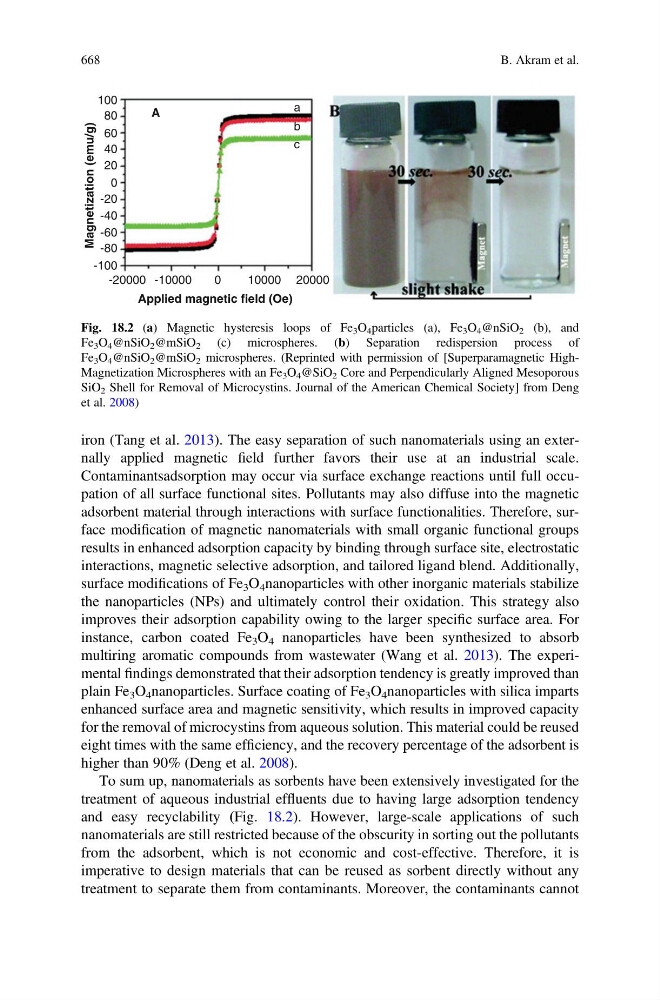
To sum up, nanomaterials as sorbents have been extensively investigated for the
treatment of aqueous industrial effluents due to having large adsorption tendency
and easy recyclability (Fig. 18.2). However, large-scale applications of such
nanomaterials are still restricted because of the obscurity in sorting out the pollutants
from the adsorbent, which is not economic and cost-effective. Therefore, it is
imperative to design materials that can be reused as sorbent directly without any
treatment to separate them from contaminants. Moreover, the contaminants cannot
100
-100
80
60
40
20
-20
-40
-60
-80
0
-20000
20000
-10000
Applied magnetic field (Oe)
10000
0
Magnetization (emu/g)
A
a
b
c
Fig. 18.2 (a) Magnetic hysteresis loops of Fe 3 O 4 particles (a), Fe 3 O 4 @nSiO 2 (b), and
Fe 3 O 4 @nSiO 2 @mSiO 2 (c) microspheres. (b) Separation redispersion process of
Fe 3 O 4 @nSiO 2 @mSiO 2 microspheres. (Reprinted with permission of [Superparamagnetic HighMagnetization Microspheres with an Fe 3 O 4 @SiO 2 Core and Perpendicularly Aligned Mesoporous
SiO 2 Shell for Removal of Microcystins. Journal of the American Chemical Society] from Deng
et al. 2008)
668
B. Akram et al.
Contaminantsadsorption may occur via surface exchange reactions until full occupation of all surface functional sites. Pollutants may also diffuse into the magnetic
adsorbent material through interactions with surface functionalities. Therefore, surface modification of magnetic nanomaterials with small organic functional groups
results in enhanced adsorption capacity by binding through surface site, electrostatic
interactions, magnetic selective adsorption, and tailored ligand blend. Additionally,
surface modifications of Fe 3 O 4 nanoparticles with other inorganic materials stabilize
the nanoparticles (NPs) and ultimately control their oxidation. This strategy also
improves their adsorption capability owing to the larger specific surface area. For
instance, carbon coated Fe 3 O 4 nanoparticles have been synthesized to absorb
multiring aromatic compounds from wastewater (Wang et al. 2013). The experimental findings demonstrated that their adsorption tendency is greatly improved than
plain Fe 3 O 4 nanoparticles. Surface coating of Fe 3 O 4 nanoparticles with silica imparts
enhanced surface area and magnetic sensitivity, which results in improved capacity
for the removal of microcystins from aqueous solution. This material could be reused
eight times with the same efficiency, and the recovery percentage of the adsorbent is
higher than 90% (Deng et al. 2008).
To sum up, nanomaterials as sorbents have been extensively investigated for the
treatment of aqueous industrial effluents due to having large adsorption tendency
and easy recyclability (Fig. 18.2). However, large-scale applications of such
nanomaterials are still restricted because of the obscurity in sorting out the pollutants
from the adsorbent, which is not economic and cost-effective. Therefore, it is
imperative to design materials that can be reused as sorbent directly without any
treatment to separate them from contaminants. Moreover, the contaminants cannot
100
-100
80
60
40
20
-20
-40
-60
-80
0
-20000
20000
-10000
Applied magnetic field (Oe)
10000
0
Magnetization (emu/g)
A
a
b
c
Fig. 18.2 (a) Magnetic hysteresis loops of Fe 3 O 4 particles (a), Fe 3 O 4 @nSiO 2 (b), and
Fe 3 O 4 @nSiO 2 @mSiO 2 (c) microspheres. (b) Separation redispersion process of
Fe 3 O 4 @nSiO 2 @mSiO 2 microspheres. (Reprinted with permission of [Superparamagnetic HighMagnetization Microspheres with an Fe 3 O 4 @SiO 2 Core and Perpendicularly Aligned Mesoporous
SiO 2 Shell for Removal of Microcystins. Journal of the American Chemical Society] from Deng
et al. 2008)
668
B. Akram et al.