

pseudo-second-order kinetics (Dahri et al. 2013). Potential of Casuarina
equisetifolia needle against 1 and 2 was also according to Langmuir adsorption
isotherm model with q max values of over 110 and 77 mg/g, respectively, under
optimum conditions (Dahri et al. 2015b).
9 was removed using adsorbent Casuarina equisetifolia cone in a batch process
and considering the same experimental parameters. Adsorption data correlated
completely with Langmuir adsorption isotherm model showcasing pseudo-secondorder kinetics, Casuarina equisetifolia cone q max value as 49.5 mg g
À1 , and endothermic nature (Dahri et al. 2016). The Casuarina equisetifolia needle was also
employed in a study to remove 9 using a similar process resulting in q max value of
82.34 mgg
À1 (Kooh et al. 2016).
Industrial Waste as Adsorbent
Activated carbon and multiwalled carbon nanotubes were employed to remove
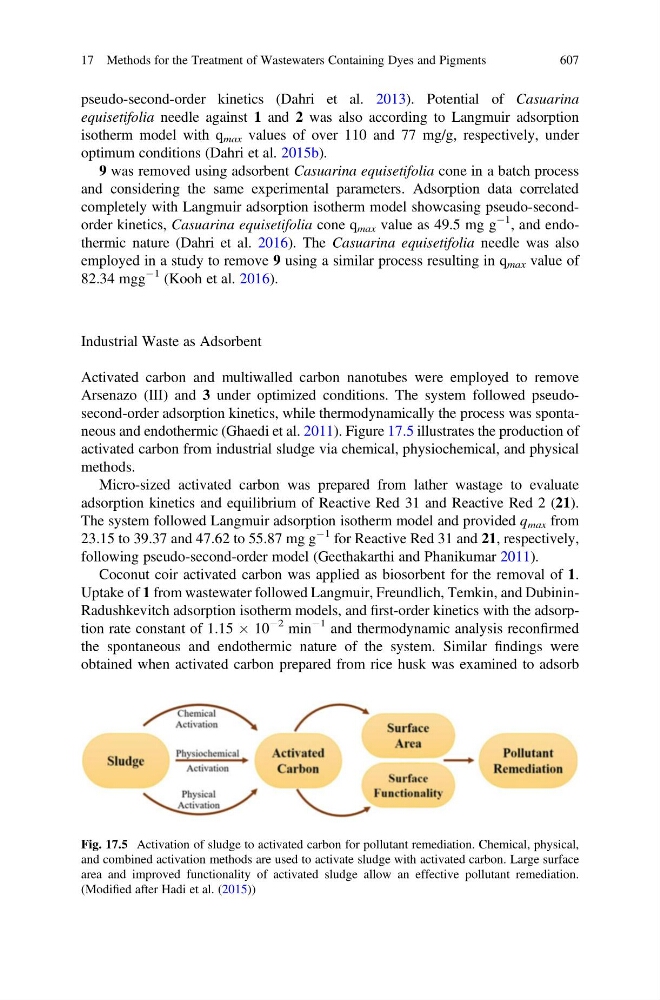
Arsenazo (III) and 3 under optimized conditions. The system followed pseudosecond-order adsorption kinetics, while thermodynamically the process was spontaneous and endothermic (Ghaedi et al. 2011). Figure 17.5 illustrates the production of
activated carbon from industrial sludge via chemical, physiochemical, and physical
methods.
Micro-sized activated carbon was prepared from lather wastage to evaluate
adsorption kinetics and equilibrium of Reactive Red 31 and Reactive Red 2 (21).
The system followed Langmuir adsorption isotherm model and provided q max from
23.15 to 39.37 and 47.62 to 55.87 mg g
À1 for Reactive Red 31 and 21, respectively,
following pseudo-second-order model (Geethakarthi and Phanikumar 2011).
Coconut coir activated carbon was applied as biosorbent for the removal of 1.
Uptake of 1 from wastewater followed Langmuir, Freundlich, Temkin, and DubininRadushkevitch adsorption isotherm models, and first-order kinetics with the adsorption rate constant of 1.15 Â 10
À2 min
À1 and thermodynamic analysis reconfirmed
the spontaneous and endothermic nature of the system. Similar findings were
obtained when activated carbon prepared from rice husk was examined to adsorb
Fig. 17.5 Activation of sludge to activated carbon for pollutant remediation. Chemical, physical,
and combined activation methods are used to activate sludge with activated carbon. Large surface
area and improved functionality of activated sludge allow an effective pollutant remediation.
(Modified after Hadi et al. (2015))
17 Methods for the Treatment of Wastewaters Containing Dyes and Pigments
607
equisetifolia needle against 1 and 2 was also according to Langmuir adsorption
isotherm model with q max values of over 110 and 77 mg/g, respectively, under
optimum conditions (Dahri et al. 2015b).
9 was removed using adsorbent Casuarina equisetifolia cone in a batch process
and considering the same experimental parameters. Adsorption data correlated
completely with Langmuir adsorption isotherm model showcasing pseudo-secondorder kinetics, Casuarina equisetifolia cone q max value as 49.5 mg g
À1 , and endothermic nature (Dahri et al. 2016). The Casuarina equisetifolia needle was also
employed in a study to remove 9 using a similar process resulting in q max value of
82.34 mgg
À1 (Kooh et al. 2016).
Industrial Waste as Adsorbent
Activated carbon and multiwalled carbon nanotubes were employed to remove
Arsenazo (III) and 3 under optimized conditions. The system followed pseudosecond-order adsorption kinetics, while thermodynamically the process was spontaneous and endothermic (Ghaedi et al. 2011). Figure 17.5 illustrates the production of
activated carbon from industrial sludge via chemical, physiochemical, and physical
methods.
Micro-sized activated carbon was prepared from lather wastage to evaluate
adsorption kinetics and equilibrium of Reactive Red 31 and Reactive Red 2 (21).
The system followed Langmuir adsorption isotherm model and provided q max from
23.15 to 39.37 and 47.62 to 55.87 mg g
À1 for Reactive Red 31 and 21, respectively,
following pseudo-second-order model (Geethakarthi and Phanikumar 2011).
Coconut coir activated carbon was applied as biosorbent for the removal of 1.
Uptake of 1 from wastewater followed Langmuir, Freundlich, Temkin, and DubininRadushkevitch adsorption isotherm models, and first-order kinetics with the adsorption rate constant of 1.15 Â 10
À2 min
À1 and thermodynamic analysis reconfirmed
the spontaneous and endothermic nature of the system. Similar findings were
obtained when activated carbon prepared from rice husk was examined to adsorb
Fig. 17.5 Activation of sludge to activated carbon for pollutant remediation. Chemical, physical,
and combined activation methods are used to activate sludge with activated carbon. Large surface
area and improved functionality of activated sludge allow an effective pollutant remediation.
(Modified after Hadi et al. (2015))
17 Methods for the Treatment of Wastewaters Containing Dyes and Pigments
607