

phthalate exposure was positively correlated with airway hyperresponsiveness,
airway remodeling, and eosinophil infiltration in mice, suggesting that phthalates
may be related to asthma. Wang (2002) studied the mutagenicity of di(2-ethylhexyl)
phthalate by Ames test, micronucleus test of mouse bone marrow polychromatic
erythrocytes, and chromosome aberration test in mouse bone marrow cells. The
results showed that di(2-ethylhexyl) phthalate had micronucleus and chromosome
effects. Zhu et al. (2006) found that dibutyl phthalate exposure had a significant
inhibitory effect on the proliferation of nerve cell line PC12 cells and had a toxic
effect mainly on apoptosis under the condition of low dose chronic exposure.
At room temperature, the majority of phthalates are colorless oily liquids with
distinctive odors. Their boiling points vary greatly within the range of 190–530
C
with the melting points below 10
C. But some of them have higher melting points,
like dibenzyl phthalate (+40–42
C), dicyclohexyl phthalate (+63–67
C), dimethyl
terephthalate (+141
C), and diphenyl phthalate (+73
C), so they exist in solid form
at room temperature (Yang et al. 2015). Most of the phthalates display stable
chemical properties in the natural environment. Low molecular weight phthalates
are slightly soluble in water, whereas high molecular weight phthalates are insoluble
in water, but easily soluble in most organic solvents (Yu et al. 2015). For low
molecular weight phthalates, the water solubility decreases with the increase of the
number of carbon atoms in the alkyl chain. The relationship between the water
solubility of high molecular weight phthalates and their number of carbon atoms is
not conclusive. Phthalates can be hydrolyzed in alkaline medium to form phthalic
acids and alcohols, but almost do not hydrolyze in water. Figure 15.1 is the general
chemical structure of phthalates. Table 15.1 is the physicochemical properties of the
common phthalates.
15.1.2 The Contamination Level of Phthalates in Water
Since phthalates are not covalently bonded to the polymeric matrix, such as soft
polyvinyl chloride plastic, and exist in a leachable form, they can migrate into the
environment easily upon disposal through the plastic aging and decomposition (Gao
et al. 2018) and lead to their ubiquitous occurrence in environmental matrices. These
chemicals have been detected in drinking water and many environmental water
samples, including wastewater, surface water, seawater, rainwater, tap water, and
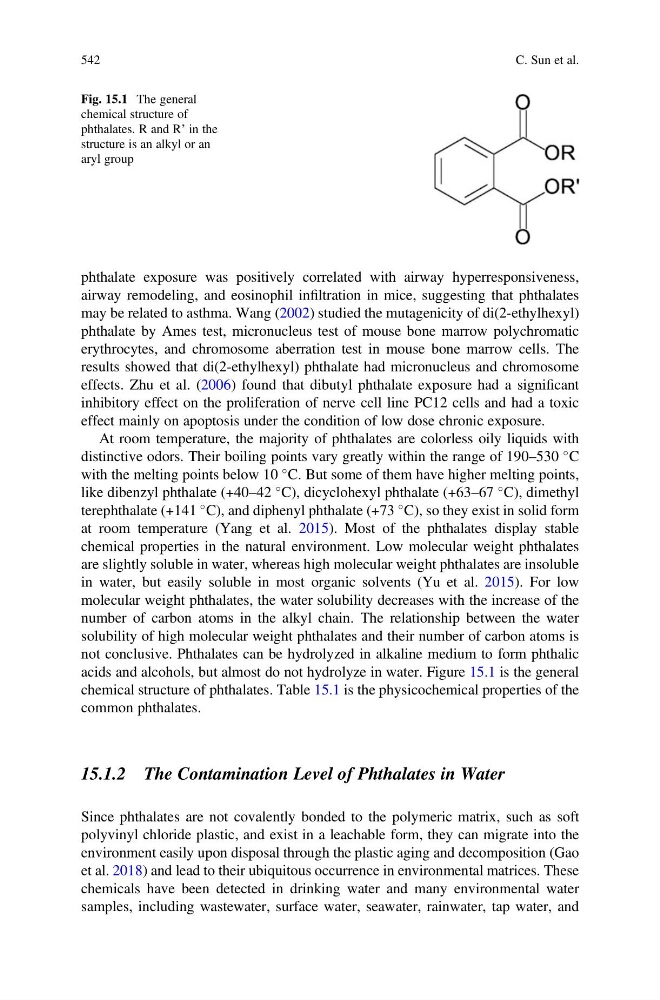
Fig. 15.1 The general
chemical structure of
phthalates. R and R’ in the
structure is an alkyl or an
aryl group
542
C. Sun et al.
airway remodeling, and eosinophil infiltration in mice, suggesting that phthalates
may be related to asthma. Wang (2002) studied the mutagenicity of di(2-ethylhexyl)
phthalate by Ames test, micronucleus test of mouse bone marrow polychromatic
erythrocytes, and chromosome aberration test in mouse bone marrow cells. The
results showed that di(2-ethylhexyl) phthalate had micronucleus and chromosome
effects. Zhu et al. (2006) found that dibutyl phthalate exposure had a significant
inhibitory effect on the proliferation of nerve cell line PC12 cells and had a toxic
effect mainly on apoptosis under the condition of low dose chronic exposure.
At room temperature, the majority of phthalates are colorless oily liquids with
distinctive odors. Their boiling points vary greatly within the range of 190–530
C
with the melting points below 10
C. But some of them have higher melting points,
like dibenzyl phthalate (+40–42
C), dicyclohexyl phthalate (+63–67
C), dimethyl
terephthalate (+141
C), and diphenyl phthalate (+73
C), so they exist in solid form
at room temperature (Yang et al. 2015). Most of the phthalates display stable
chemical properties in the natural environment. Low molecular weight phthalates
are slightly soluble in water, whereas high molecular weight phthalates are insoluble
in water, but easily soluble in most organic solvents (Yu et al. 2015). For low
molecular weight phthalates, the water solubility decreases with the increase of the
number of carbon atoms in the alkyl chain. The relationship between the water
solubility of high molecular weight phthalates and their number of carbon atoms is
not conclusive. Phthalates can be hydrolyzed in alkaline medium to form phthalic
acids and alcohols, but almost do not hydrolyze in water. Figure 15.1 is the general
chemical structure of phthalates. Table 15.1 is the physicochemical properties of the
common phthalates.
15.1.2 The Contamination Level of Phthalates in Water
Since phthalates are not covalently bonded to the polymeric matrix, such as soft
polyvinyl chloride plastic, and exist in a leachable form, they can migrate into the
environment easily upon disposal through the plastic aging and decomposition (Gao
et al. 2018) and lead to their ubiquitous occurrence in environmental matrices. These
chemicals have been detected in drinking water and many environmental water
samples, including wastewater, surface water, seawater, rainwater, tap water, and
Fig. 15.1 The general
chemical structure of
phthalates. R and R’ in the
structure is an alkyl or an
aryl group
542
C. Sun et al.