

14.3.1 Laterite Soil
Laterite soil is abundant in the earth crust and is found in different parts of the world.
This soil can be employed as a heterogeneous Fenton catalyst, as it is rich in iron
oxides and other minerals. Typical laterite soil contains 38–43% silicon dioxide,
26–30% ferric oxide, 25–28% aluminium oxide, 3–4% titanium dioxide, 1–2%
potassium oxide, 0.5% calcium oxide, and 0.2% carbon (Khataee and Pakdehi
2014). This soil is effective to decompose hydrogen peroxide in water medium
and subsequently produce hydroxyl radicals by means of Fenton reactions. Such
heterogeneous Fenton process is able to degrade 4-nitroaniline (Amritha and Manu
2018), 2-Aminopyridine (Karale et al. 2014), 2-nitroaniline (Amritha and Manu
2018), 3-nitroaniline (Amritha and Manu 2018), fluoroquinolone antibiotics
(Kamagate et al. 2018), acid red 17 (Khataee et al. 2016), acetaminophen (Koottatep
et al. 2017), sodium azide (Khataee and Pakdehi 2014), and methylene blue
(Kpinsoton et al. 2018).
The dye degradation efficiency of laterite is quite higher in the presence of
ultraviolet irradiation (photo-Fenton process) than in heterogeneous Fenton process
(Khataee et al. 2016). After 120 min of reaction, the photo-Fenton process with 2 g/L
laterite as the iron source was able to remove 94.7% of acid red 17 dye from its initial
concentration of 20 mg/L. Meanwhile, the Fenton process can remove 49% of the
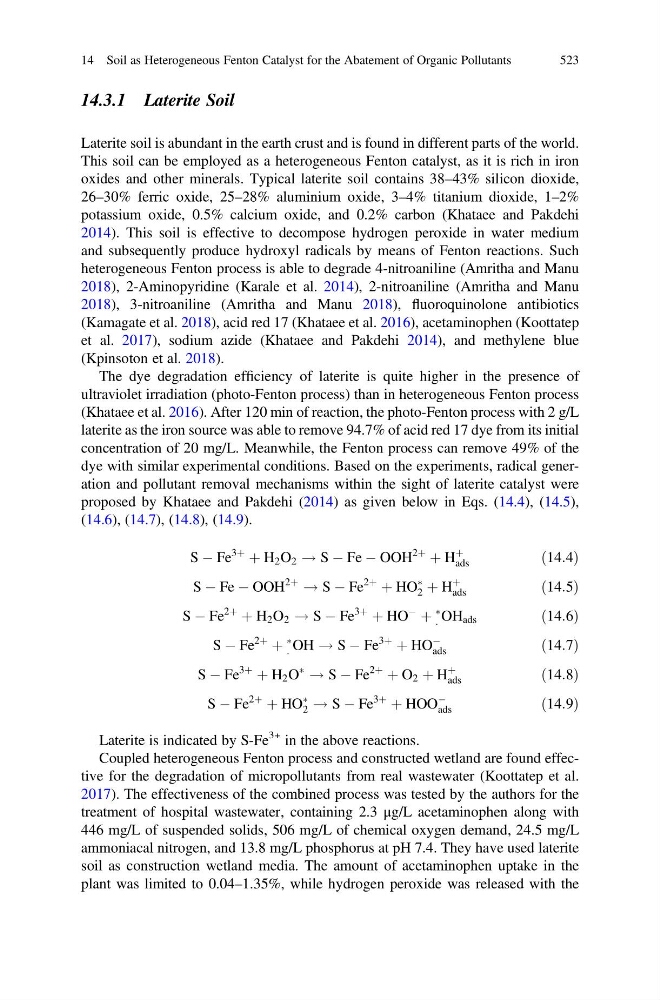
dye with similar experimental conditions. Based on the experiments, radical generation and pollutant removal mechanisms within the sight of laterite catalyst were
proposed by Khataee and Pakdehi (2014) as given below in Eqs. (14.4), (14.5),
(14.6), (14.7), (14.8), (14.9).
S À Fe
3þ
þ H 2 O 2 ! S À Fe À OOH
2þ
þ H
þ
ads
ð14:4Þ
S À Fe À OOH
2þ
! S À Fe
2þ
þ HO
Ã
2 þ H
þ
ads
ð14:5Þ
S À Fe
2þ
þ H 2 O 2 ! S À Fe
3þ
þ HO
À
þ
Ã
: OH ads
ð14:6Þ
S À Fe
2þ
þ
Ã
: OH ! S À Fe
3þ
þ HO
À
ads
ð14:7Þ
S À Fe
3þ
þ H 2 O
Ã
! S À Fe
2þ
þ O 2 þ H
þ
ads
ð14:8Þ
S À Fe
2þ
þ HO
Ã
2 ! S À Fe
3þ
þ HOO
À
ads
ð14:9Þ
Laterite is indicated by S-Fe
3+ in the above reactions.
Coupled heterogeneous Fenton process and constructed wetland are found effective for the degradation of micropollutants from real wastewater (Koottatep et al.
2017). The effectiveness of the combined process was tested by the authors for the
treatment of hospital wastewater, containing 2.3 μg/L acetaminophen along with
446 mg/L of suspended solids, 506 mg/L of chemical oxygen demand, 24.5 mg/L
ammoniacal nitrogen, and 13.8 mg/L phosphorus at pH 7.4. They have used laterite
soil as construction wetland media. The amount of acetaminophen uptake in the
plant was limited to 0.04–1.35%, while hydrogen peroxide was released with the
14 Soil as Heterogeneous Fenton Catalyst for the Abatement of Organic Pollutants
523
Laterite soil is abundant in the earth crust and is found in different parts of the world.
This soil can be employed as a heterogeneous Fenton catalyst, as it is rich in iron
oxides and other minerals. Typical laterite soil contains 38–43% silicon dioxide,
26–30% ferric oxide, 25–28% aluminium oxide, 3–4% titanium dioxide, 1–2%
potassium oxide, 0.5% calcium oxide, and 0.2% carbon (Khataee and Pakdehi
2014). This soil is effective to decompose hydrogen peroxide in water medium
and subsequently produce hydroxyl radicals by means of Fenton reactions. Such
heterogeneous Fenton process is able to degrade 4-nitroaniline (Amritha and Manu
2018), 2-Aminopyridine (Karale et al. 2014), 2-nitroaniline (Amritha and Manu
2018), 3-nitroaniline (Amritha and Manu 2018), fluoroquinolone antibiotics
(Kamagate et al. 2018), acid red 17 (Khataee et al. 2016), acetaminophen (Koottatep
et al. 2017), sodium azide (Khataee and Pakdehi 2014), and methylene blue
(Kpinsoton et al. 2018).
The dye degradation efficiency of laterite is quite higher in the presence of
ultraviolet irradiation (photo-Fenton process) than in heterogeneous Fenton process
(Khataee et al. 2016). After 120 min of reaction, the photo-Fenton process with 2 g/L
laterite as the iron source was able to remove 94.7% of acid red 17 dye from its initial
concentration of 20 mg/L. Meanwhile, the Fenton process can remove 49% of the
dye with similar experimental conditions. Based on the experiments, radical generation and pollutant removal mechanisms within the sight of laterite catalyst were
proposed by Khataee and Pakdehi (2014) as given below in Eqs. (14.4), (14.5),
(14.6), (14.7), (14.8), (14.9).
S À Fe
3þ
þ H 2 O 2 ! S À Fe À OOH
2þ
þ H
þ
ads
ð14:4Þ
S À Fe À OOH
2þ
! S À Fe
2þ
þ HO
Ã
2 þ H
þ
ads
ð14:5Þ
S À Fe
2þ
þ H 2 O 2 ! S À Fe
3þ
þ HO
À
þ
Ã
: OH ads
ð14:6Þ
S À Fe
2þ
þ
Ã
: OH ! S À Fe
3þ
þ HO
À
ads
ð14:7Þ
S À Fe
3þ
þ H 2 O
Ã
! S À Fe
2þ
þ O 2 þ H
þ
ads
ð14:8Þ
S À Fe
2þ
þ HO
Ã
2 ! S À Fe
3þ
þ HOO
À
ads
ð14:9Þ
Laterite is indicated by S-Fe
3+ in the above reactions.
Coupled heterogeneous Fenton process and constructed wetland are found effective for the degradation of micropollutants from real wastewater (Koottatep et al.
2017). The effectiveness of the combined process was tested by the authors for the
treatment of hospital wastewater, containing 2.3 μg/L acetaminophen along with
446 mg/L of suspended solids, 506 mg/L of chemical oxygen demand, 24.5 mg/L
ammoniacal nitrogen, and 13.8 mg/L phosphorus at pH 7.4. They have used laterite
soil as construction wetland media. The amount of acetaminophen uptake in the
plant was limited to 0.04–1.35%, while hydrogen peroxide was released with the
14 Soil as Heterogeneous Fenton Catalyst for the Abatement of Organic Pollutants
523