

While the hydrophobic tail (C 16 H 33 ) of modified fly ash causes it to sorb oil and
enhances the oilsorption capacity, the oilsorption capacity of wood shavings was
greater than that of the modified fly ash. But the oilsorption capacity of modified fly
ash increased by partition mechanism; whereas wood shavings very quickly sorbed
water and severely decreased its oil uptake. In addition, the contact time impact on
the oil uptake of fly ash and modified fly ash was demonstrated. It was revealed that
the highest oilsorption capacity was observed in the first 5 min, which reduced the
possibility of oil dispersal into sea.
To study the impact of light oil fraction in crude oil, samples were selected with
various ratios of kerosene to crude oil (1:4, 3:2, and 4:1). The crude oilsorption
capacity of modified fly ash increased from 1550 to 1690 mg/g by increasing the
amount of kerosene in crude oil, while the crude oilsorption capacity of fly ash
decreased (515 to 480 mg/g). This is due to increased water insolubility in kerosene
as compared to crude oil.
Weathered oil-contaminated seawater was obtained during the stimulation of
photooxidation and microbial degradation process of 100 ml crude oil in 10 L of
seawater. The sorption results of dissolved organic carbon from weathered
oil-contaminated seawatersorption by use of fly ash and modified fly ash showed a
higher dissolved organic carbon sorption capacity for modified fly ash compared to
fly ash. When the dissolved organic carbon concentration (mg/L) was increased, the
amount of sorbed dissolved organic carbon was enhanced; While, the polypropylene
sorbent does not have satisfactory performance for weathered oil-contaminated
seawatersorption.
They also suggested the Freundlich sorption model in the following form,
according to the crude oil and dissolved organic carbon sorption results of fly ash
and modified fly ash:
C s ¼ KC
1=n
e
ð12:2Þ
where C s and C e are the equilibrium-sorbed concentration of the solute (mg/g) and
the equilibrium aqueous concentration of the solute (mg/L), respectively. Also, K
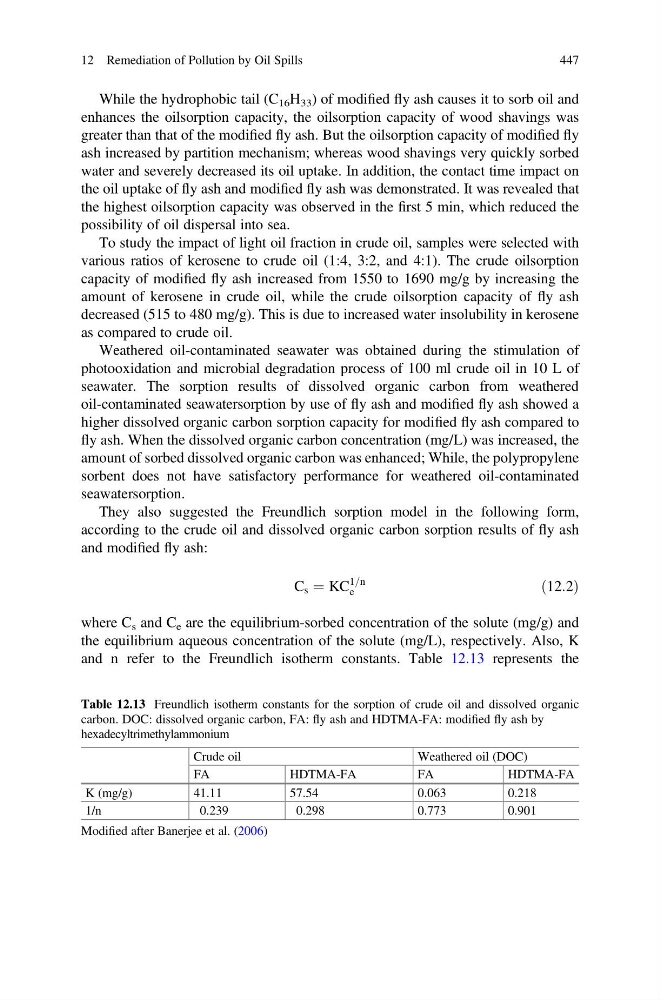
and n refer to the Freundlich isotherm constants. Table 12.13 represents the
Table 12.13 Freundlich isotherm constants for the sorption of crude oil and dissolved organic
carbon. DOC: dissolved organic carbon, FA: fly ash and HDTMA-FA: modified fly ash by
hexadecyltrimethylammonium
Crude oil
Weathered oil (DOC)
FA
HDTMA-FA
FA
HDTMA-FA
K (mg/g)
41.11
57.54
0.063
0.218
1/n
0.239
0.298
0.773
0.901
Modified after Banerjee et al. (2006)
12 Remediation of Pollution by Oil Spills
447
enhances the oilsorption capacity, the oilsorption capacity of wood shavings was
greater than that of the modified fly ash. But the oilsorption capacity of modified fly
ash increased by partition mechanism; whereas wood shavings very quickly sorbed
water and severely decreased its oil uptake. In addition, the contact time impact on
the oil uptake of fly ash and modified fly ash was demonstrated. It was revealed that
the highest oilsorption capacity was observed in the first 5 min, which reduced the
possibility of oil dispersal into sea.
To study the impact of light oil fraction in crude oil, samples were selected with
various ratios of kerosene to crude oil (1:4, 3:2, and 4:1). The crude oilsorption
capacity of modified fly ash increased from 1550 to 1690 mg/g by increasing the
amount of kerosene in crude oil, while the crude oilsorption capacity of fly ash
decreased (515 to 480 mg/g). This is due to increased water insolubility in kerosene
as compared to crude oil.
Weathered oil-contaminated seawater was obtained during the stimulation of
photooxidation and microbial degradation process of 100 ml crude oil in 10 L of
seawater. The sorption results of dissolved organic carbon from weathered
oil-contaminated seawatersorption by use of fly ash and modified fly ash showed a
higher dissolved organic carbon sorption capacity for modified fly ash compared to
fly ash. When the dissolved organic carbon concentration (mg/L) was increased, the
amount of sorbed dissolved organic carbon was enhanced; While, the polypropylene
sorbent does not have satisfactory performance for weathered oil-contaminated
seawatersorption.
They also suggested the Freundlich sorption model in the following form,
according to the crude oil and dissolved organic carbon sorption results of fly ash
and modified fly ash:
C s ¼ KC
1=n
e
ð12:2Þ
where C s and C e are the equilibrium-sorbed concentration of the solute (mg/g) and
the equilibrium aqueous concentration of the solute (mg/L), respectively. Also, K
and n refer to the Freundlich isotherm constants. Table 12.13 represents the
Table 12.13 Freundlich isotherm constants for the sorption of crude oil and dissolved organic
carbon. DOC: dissolved organic carbon, FA: fly ash and HDTMA-FA: modified fly ash by
hexadecyltrimethylammonium
Crude oil
Weathered oil (DOC)
FA
HDTMA-FA
FA
HDTMA-FA
K (mg/g)
41.11
57.54
0.063
0.218
1/n
0.239
0.298
0.773
0.901
Modified after Banerjee et al. (2006)
12 Remediation of Pollution by Oil Spills
447