

in almost every reviewed study on every continent. Other components such as rayon
or polyether sulfone (PES) were also representative in certain sites such as Portuguese coast, sediments in South Carolina, or coast from Turkey, Greece, Iceland, or
France (Lots et al. 2017). These results agreed with the fact that PE, PP, and PS are
three polymers very common and account for approximately 90% of the 348 million
tons of plastics produced annually (Edo et al. 2019).
1.6 Interactions Among Microplastics and Other Pollutants
Presented in Aquatic Environments
Microplastics can adsorb and concentrate a significant number of environmental
toxins, which can be transferred to organisms (Mato et al. 2011; Leon et al. 2018).
Particles do not only adsorb, but they can also desorb emitting into the environment
toxic compounds such as additives or plasticizers, which negatively affect the
organisms exposed (Cole et al. 2011; Neves et al. 2015).
There are some environmental factors that affect the balance between chemicals
and microplastics as well as accumulation and transport of these pollutants (Murphy
et al. 2016). These factors are exposure to sunlight, pH, residence time, and
temperature, among others. Between pollutants that microplastics can accumulate,
metals are the most studied (Hodson et al. 2017; Brennecke et al. 2016). They are
frequently added as catalysts, pigments, and stabilizers during plastic manufacturing
(Fahrenfeld et al. 2019; Nakashima et al. 2012). They can also adsorb organic
pollutants, especially pharmaceuticals (Li et al. 2018; Llorca et al. 2018). This
accumulation of contaminants mainly occurs in freshwater systems, where the
concentrations of these chemicals are expected to be higher due to proximity to
the sources that produce and discharge them (Horton et al. 2017a, b).
As mentioned above, concentrations of metals in freshwater are generally higher
than in coastal areas. These concentrations depend mainly on location, sampling
time, and anthropogenic activities (Guo and Wang 2019). Some authors studied
the concentration of heavy metals in freshwater from the Beijing River, China
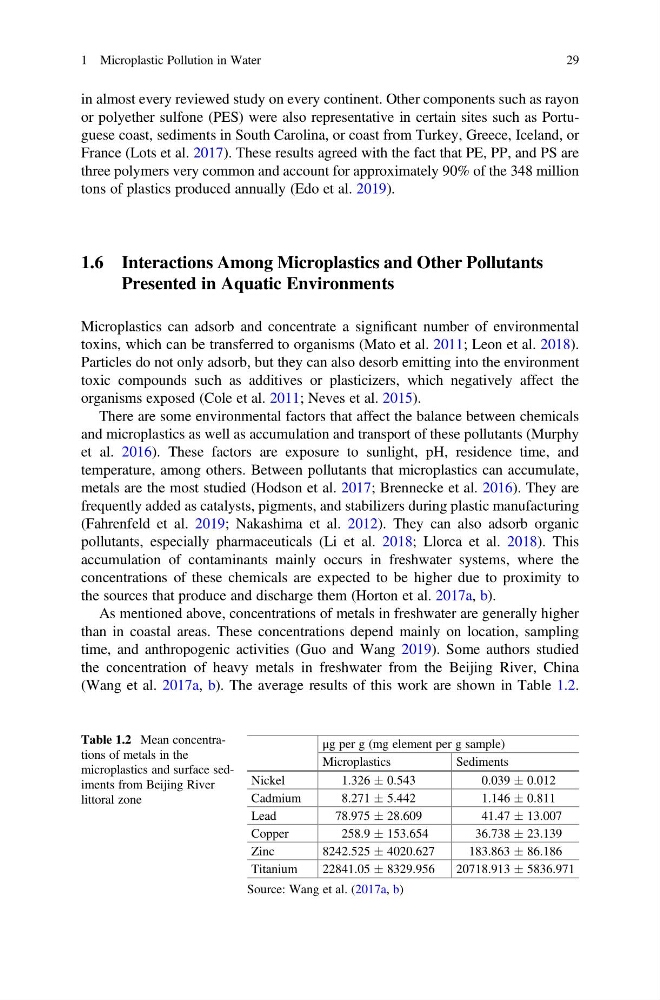
(Wang et al. 2017a, b). The average results of this work are shown in Table 1.2.
Table 1.2 Mean concentrations of metals in the
microplastics and surface sediments from Beijing River
littoral zone
μg per g (mg element per g sample)
Microplastics
Sediments
Nickel
1.326 Æ 0.543
0.039 Æ 0.012
Cadmium
8.271 Æ 5.442
1.146 Æ 0.811
Lead
78.975 Æ 28.609
41.47 Æ 13.007
Copper
258.9 Æ 153.654
36.738 Æ 23.139
Zinc
8242.525 Æ 4020.627
183.863 Æ 86.186
Titanium
22841.05 Æ 8329.956
20718.913 Æ 5836.971
Source: Wang et al. (2017a, b)
1 Microplastic Pollution in Water
29
or polyether sulfone (PES) were also representative in certain sites such as Portuguese coast, sediments in South Carolina, or coast from Turkey, Greece, Iceland, or
France (Lots et al. 2017). These results agreed with the fact that PE, PP, and PS are
three polymers very common and account for approximately 90% of the 348 million
tons of plastics produced annually (Edo et al. 2019).
1.6 Interactions Among Microplastics and Other Pollutants
Presented in Aquatic Environments
Microplastics can adsorb and concentrate a significant number of environmental
toxins, which can be transferred to organisms (Mato et al. 2011; Leon et al. 2018).
Particles do not only adsorb, but they can also desorb emitting into the environment
toxic compounds such as additives or plasticizers, which negatively affect the
organisms exposed (Cole et al. 2011; Neves et al. 2015).
There are some environmental factors that affect the balance between chemicals
and microplastics as well as accumulation and transport of these pollutants (Murphy
et al. 2016). These factors are exposure to sunlight, pH, residence time, and
temperature, among others. Between pollutants that microplastics can accumulate,
metals are the most studied (Hodson et al. 2017; Brennecke et al. 2016). They are
frequently added as catalysts, pigments, and stabilizers during plastic manufacturing
(Fahrenfeld et al. 2019; Nakashima et al. 2012). They can also adsorb organic
pollutants, especially pharmaceuticals (Li et al. 2018; Llorca et al. 2018). This
accumulation of contaminants mainly occurs in freshwater systems, where the
concentrations of these chemicals are expected to be higher due to proximity to
the sources that produce and discharge them (Horton et al. 2017a, b).
As mentioned above, concentrations of metals in freshwater are generally higher
than in coastal areas. These concentrations depend mainly on location, sampling
time, and anthropogenic activities (Guo and Wang 2019). Some authors studied
the concentration of heavy metals in freshwater from the Beijing River, China
(Wang et al. 2017a, b). The average results of this work are shown in Table 1.2.
Table 1.2 Mean concentrations of metals in the
microplastics and surface sediments from Beijing River
littoral zone
μg per g (mg element per g sample)
Microplastics
Sediments
Nickel
1.326 Æ 0.543
0.039 Æ 0.012
Cadmium
8.271 Æ 5.442
1.146 Æ 0.811
Lead
78.975 Æ 28.609
41.47 Æ 13.007
Copper
258.9 Æ 153.654
36.738 Æ 23.139
Zinc
8242.525 Æ 4020.627
183.863 Æ 86.186
Titanium
22841.05 Æ 8329.956
20718.913 Æ 5836.971
Source: Wang et al. (2017a, b)
1 Microplastic Pollution in Water
29