

1992). Microfiltration exhibits higher permeate flux compared to that of ultrafiltration, reverse osmosis, and nanofiltration due to the larger membrane pore size. The
separation occurs when the solution with smaller size passes through the membrane
pores, whereas the larger unwanted particles are refrained from passing through. It is
worth to mention that the entire microfiltration process greatly depends on the types
of the membrane used and the interactions of the solution composition with the
membrane (Cheryan 1998).
There are two types of operation modes for the microfiltration process, namely
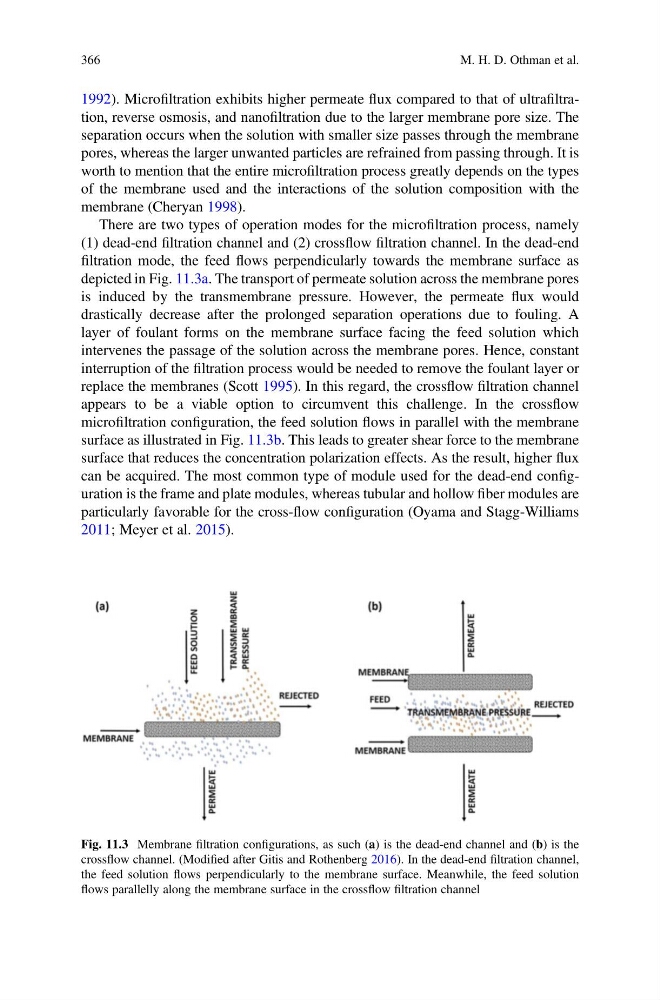
(1) dead-end filtration channel and (2) crossflow filtration channel. In the dead-end
filtration mode, the feed flows perpendicularly towards the membrane surface as
depicted in Fig. 11.3a. The transport of permeate solution across the membrane pores
is induced by the transmembrane pressure. However, the permeate flux would
drastically decrease after the prolonged separation operations due to fouling. A
layer of foulant forms on the membrane surface facing the feed solution which
intervenes the passage of the solution across the membrane pores. Hence, constant
interruption of the filtration process would be needed to remove the foulant layer or
replace the membranes (Scott 1995). In this regard, the crossflow filtration channel
appears to be a viable option to circumvent this challenge. In the crossflow
microfiltration configuration, the feed solution flows in parallel with the membrane
surface as illustrated in Fig. 11.3b. This leads to greater shear force to the membrane
surface that reduces the concentration polarization effects. As the result, higher flux
can be acquired. The most common type of module used for the dead-end configuration is the frame and plate modules, whereas tubular and hollow fiber modules are
particularly favorable for the cross-flow configuration (Oyama and Stagg-Williams
2011; Meyer et al. 2015).
Fig. 11.3 Membrane filtration configurations, as such (a) is the dead-end channel and (b) is the
crossflow channel. (Modified after Gitis and Rothenberg 2016). In the dead-end filtration channel,
the feed solution flows perpendicularly to the membrane surface. Meanwhile, the feed solution
flows parallelly along the membrane surface in the crossflow filtration channel
366
M. H. D. Othman et al.
separation occurs when the solution with smaller size passes through the membrane
pores, whereas the larger unwanted particles are refrained from passing through. It is
worth to mention that the entire microfiltration process greatly depends on the types
of the membrane used and the interactions of the solution composition with the
membrane (Cheryan 1998).
There are two types of operation modes for the microfiltration process, namely
(1) dead-end filtration channel and (2) crossflow filtration channel. In the dead-end
filtration mode, the feed flows perpendicularly towards the membrane surface as
depicted in Fig. 11.3a. The transport of permeate solution across the membrane pores
is induced by the transmembrane pressure. However, the permeate flux would
drastically decrease after the prolonged separation operations due to fouling. A
layer of foulant forms on the membrane surface facing the feed solution which
intervenes the passage of the solution across the membrane pores. Hence, constant
interruption of the filtration process would be needed to remove the foulant layer or
replace the membranes (Scott 1995). In this regard, the crossflow filtration channel
appears to be a viable option to circumvent this challenge. In the crossflow
microfiltration configuration, the feed solution flows in parallel with the membrane
surface as illustrated in Fig. 11.3b. This leads to greater shear force to the membrane
surface that reduces the concentration polarization effects. As the result, higher flux
can be acquired. The most common type of module used for the dead-end configuration is the frame and plate modules, whereas tubular and hollow fiber modules are
particularly favorable for the cross-flow configuration (Oyama and Stagg-Williams
2011; Meyer et al. 2015).
Fig. 11.3 Membrane filtration configurations, as such (a) is the dead-end channel and (b) is the
crossflow channel. (Modified after Gitis and Rothenberg 2016). In the dead-end filtration channel,
the feed solution flows perpendicularly to the membrane surface. Meanwhile, the feed solution
flows parallelly along the membrane surface in the crossflow filtration channel
366
M. H. D. Othman et al.