

Activated Carbon Adsorption
Activated carbon adsorption is applied for eliminating the dissolved and refractory
organics from wastewater after secondary treatment process. It is widely used
because of its (activated carbon) small pore size, large surface area, bulk density
and high adsorption capacity. In this step, the activated carbon in the form of
granular activated carbon, bentonite, powdered activated carbon and deposited
carbon is used as adsorbent for oil removal from oil-water emulsion by adsorption.
The adsorption capability is higher for deposited carbon and bentonite than powdered activated carbon. The activated carbon bed is either fixed or moving in
parallel. For moving activated carbon adsorption bed, carbon is moved from
adsorbers to regenerator and back continuously. These activated carbon beds are
costly. When high-quality effluent is needed, then activated carbon adsorption is
used for treatment of wastes. The operating parameters such as flow rate, depth and
contact time of an activated carbon adsorption system are 3.42–6.9 Â 10
À3 m
3 /s/m
2 ,
3.048 m minimum and 15–38 min, respectively. The biochemical oxygen demand,
oil and phenol content of effluents can be reduced to 3–10 mg/L, less than 1 mg/L
and approximately ‘0’, respectively, by applying this process. The removal efficiency of the activated bed generally increases with increased contact time and
amount of adsorbents and decreases when concentration of adsorbate (effluent) is
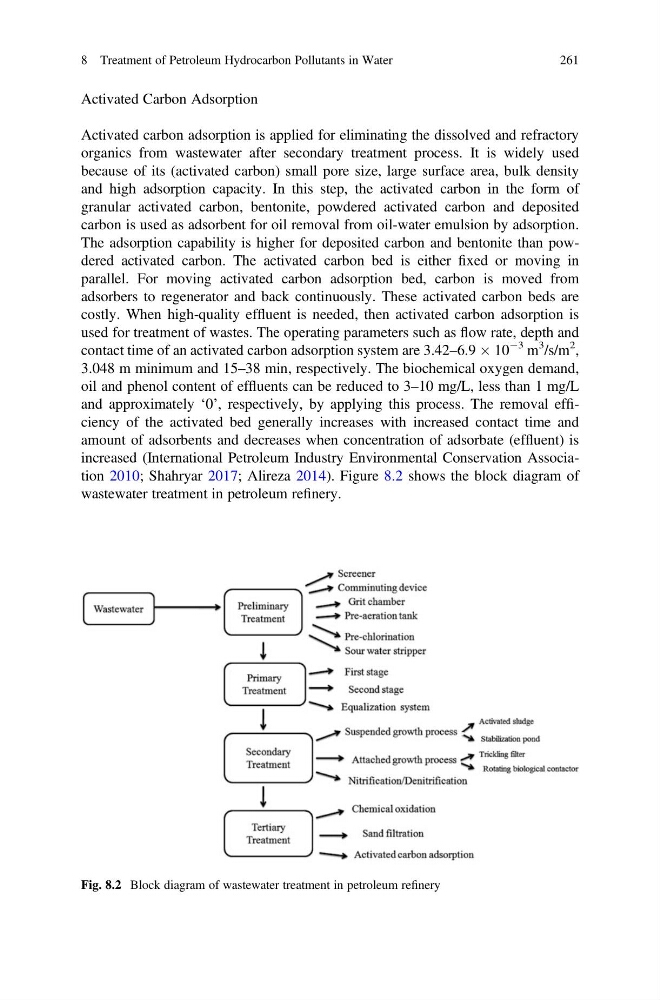
increased (International Petroleum Industry Environmental Conservation Association 2010; Shahryar 2017; Alireza 2014). Figure 8.2 shows the block diagram of
wastewater treatment in petroleum refinery.
Fig. 8.2 Block diagram of wastewater treatment in petroleum refinery
8 Treatment of Petroleum Hydrocarbon Pollutants in Water
261
Activated carbon adsorption is applied for eliminating the dissolved and refractory
organics from wastewater after secondary treatment process. It is widely used
because of its (activated carbon) small pore size, large surface area, bulk density
and high adsorption capacity. In this step, the activated carbon in the form of
granular activated carbon, bentonite, powdered activated carbon and deposited
carbon is used as adsorbent for oil removal from oil-water emulsion by adsorption.
The adsorption capability is higher for deposited carbon and bentonite than powdered activated carbon. The activated carbon bed is either fixed or moving in
parallel. For moving activated carbon adsorption bed, carbon is moved from
adsorbers to regenerator and back continuously. These activated carbon beds are
costly. When high-quality effluent is needed, then activated carbon adsorption is
used for treatment of wastes. The operating parameters such as flow rate, depth and
contact time of an activated carbon adsorption system are 3.42–6.9 Â 10
À3 m
3 /s/m
2 ,
3.048 m minimum and 15–38 min, respectively. The biochemical oxygen demand,
oil and phenol content of effluents can be reduced to 3–10 mg/L, less than 1 mg/L
and approximately ‘0’, respectively, by applying this process. The removal efficiency of the activated bed generally increases with increased contact time and
amount of adsorbents and decreases when concentration of adsorbate (effluent) is
increased (International Petroleum Industry Environmental Conservation Association 2010; Shahryar 2017; Alireza 2014). Figure 8.2 shows the block diagram of
wastewater treatment in petroleum refinery.
Fig. 8.2 Block diagram of wastewater treatment in petroleum refinery
8 Treatment of Petroleum Hydrocarbon Pollutants in Water
261