

discharge or reuse. In petroleum industries, laboratory sink water is also treated as
wastewater, because this water is already mixed with different types of impurities
(International Petroleum Industry Environmental Conservation Association 2010).
During crude oil processing, the water gets contaminated by different aromatic
compounds such as benzene, toluene, xylene, polyaromatic hydrocarbons and also
organometallic compounds. From different petrochemical industries, water pollutants, like soaps, detergents, dyes, spent solvents, resins, packaging wastes, fabric
scraps and waxes, are ejected during washing and purification of products. Some
toxic water pollutants from petrochemical industries include acetic acid, benzene,
ethyl-benzene, phenol, formaldehyde, urea, naphthenic acids etc. (Sharma et al.
2017; Vineta et al. 2014; Sengupta 2019; Porwal 2015; Sher et al. 2013). The
presence of such pollutants is distinguished by offensive odours and accumulation
of debris.
Water is essential for healthy growth of life. However, when water gets polluted,
then the health of humans, animals and plants is threatened by the usage of such
contaminated water and also results in shortage of usable water. Hence, in order to
save water or in other words to save life on earth, some rules and regulations must be
followed by the petroleum industries. Several acts, like clean water act of 1972, safe
drinking water act of 1974, oil pollution act of 1990 and spill prevention control and
countermeasure plans of 2010, have been implemented for the purpose of protecting
the environment (Department of energy, United States 1998; Speight 2014; Environmental Protection Agency, United States 2004; Environmental Protection
Agency, United States 2010; Environmental Protection Agency, United States
2017; Environmental Update #12, 2003).
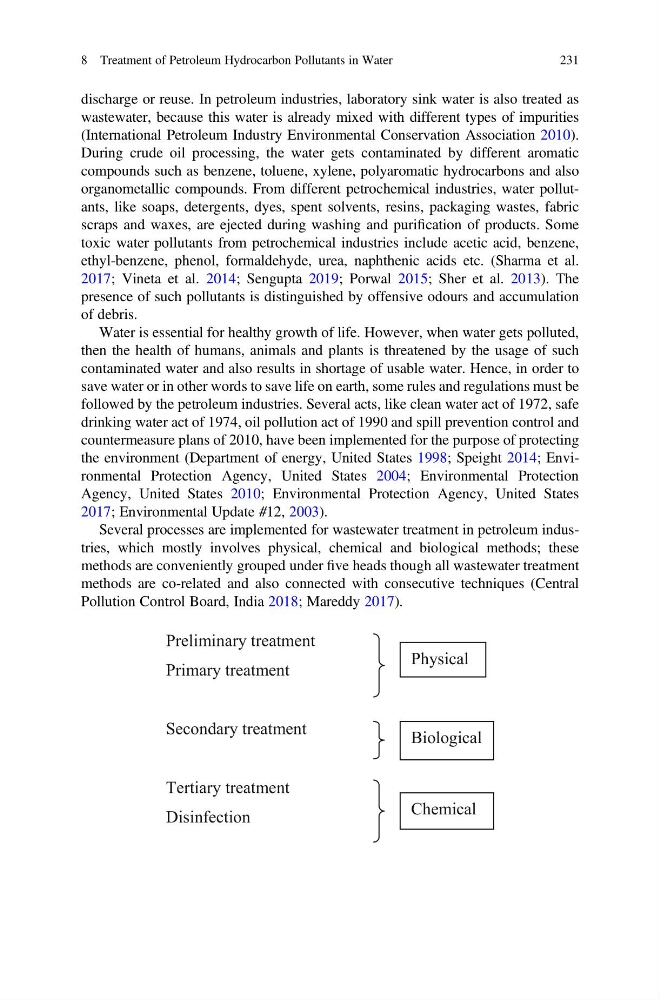
Several processes are implemented for wastewater treatment in petroleum industries, which mostly involves physical, chemical and biological methods; these
methods are conveniently grouped under five heads though all wastewater treatment
methods are co-related and also connected with consecutive techniques (Central
Pollution Control Board, India 2018; Mareddy 2017).
Preliminary treatment
Primary treatment
Secondary treatment
Tertiary treatment
Disinfection
Physical
Biological
Chemical
8 Treatment of Petroleum Hydrocarbon Pollutants in Water
231
wastewater, because this water is already mixed with different types of impurities
(International Petroleum Industry Environmental Conservation Association 2010).
During crude oil processing, the water gets contaminated by different aromatic
compounds such as benzene, toluene, xylene, polyaromatic hydrocarbons and also
organometallic compounds. From different petrochemical industries, water pollutants, like soaps, detergents, dyes, spent solvents, resins, packaging wastes, fabric
scraps and waxes, are ejected during washing and purification of products. Some
toxic water pollutants from petrochemical industries include acetic acid, benzene,
ethyl-benzene, phenol, formaldehyde, urea, naphthenic acids etc. (Sharma et al.
2017; Vineta et al. 2014; Sengupta 2019; Porwal 2015; Sher et al. 2013). The
presence of such pollutants is distinguished by offensive odours and accumulation
of debris.
Water is essential for healthy growth of life. However, when water gets polluted,
then the health of humans, animals and plants is threatened by the usage of such
contaminated water and also results in shortage of usable water. Hence, in order to
save water or in other words to save life on earth, some rules and regulations must be
followed by the petroleum industries. Several acts, like clean water act of 1972, safe
drinking water act of 1974, oil pollution act of 1990 and spill prevention control and
countermeasure plans of 2010, have been implemented for the purpose of protecting
the environment (Department of energy, United States 1998; Speight 2014; Environmental Protection Agency, United States 2004; Environmental Protection
Agency, United States 2010; Environmental Protection Agency, United States
2017; Environmental Update #12, 2003).
Several processes are implemented for wastewater treatment in petroleum industries, which mostly involves physical, chemical and biological methods; these
methods are conveniently grouped under five heads though all wastewater treatment
methods are co-related and also connected with consecutive techniques (Central
Pollution Control Board, India 2018; Mareddy 2017).
Preliminary treatment
Primary treatment
Secondary treatment
Tertiary treatment
Disinfection
Physical
Biological
Chemical
8 Treatment of Petroleum Hydrocarbon Pollutants in Water
231