

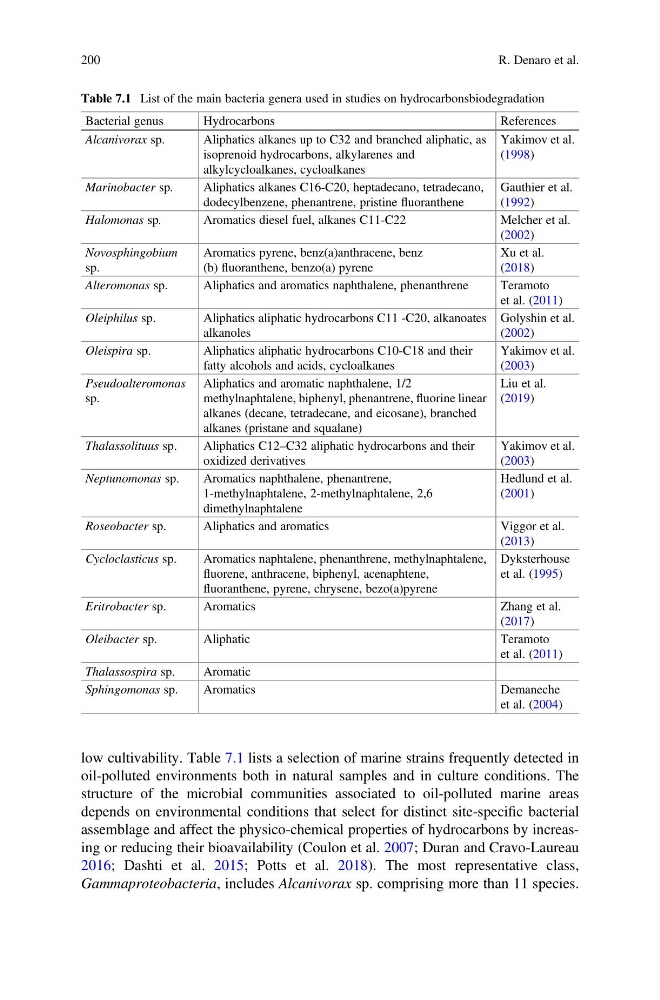
low cultivability. Table 7.1 lists a selection of marine strains frequently detected in
oil-polluted environments both in natural samples and in culture conditions. The
structure of the microbial communities associated to oil-polluted marine areas
depends on environmental conditions that select for distinct site-specific bacterial
assemblage and affect the physico-chemical properties of hydrocarbons by increasing or reducing their bioavailability (Coulon et al. 2007; Duran and Cravo-Laureau
2016; Dashti et al. 2015; Potts et al. 2018). The most representative class,
Gammaproteobacteria, includes Alcanivorax sp. comprising more than 11 species.
Table 7.1 List of the main bacteria genera used in studies on hydrocarbonsbiodegradation
Bacterial genus
Hydrocarbons
References
Alcanivorax sp.
Aliphatics alkanes up to C32 and branched aliphatic, as
isoprenoid hydrocarbons, alkylarenes and
alkylcycloalkanes, cycloalkanes
Yakimov et al.
(1998)
Marinobacter sp.
Aliphatics alkanes C16-C20, heptadecano, tetradecano,
dodecylbenzene, phenantrene, pristine fluoranthene
Gauthier et al.
(1992)
Halomonas sp.
Aromatics diesel fuel, alkanes C11-C22
Melcher et al.
(2002)
Novosphingobium
sp.
Aromatics pyrene, benz(a)anthracene, benz
(b) fluoranthene, benzo(a) pyrene
Xu et al.
(2018)
Alteromonas sp.
Aliphatics and aromatics naphthalene, phenanthrene
Teramoto
et al. (2011)
Oleiphilus sp.
Aliphatics aliphatic hydrocarbons C11 -C20, alkanoates
alkanoles
Golyshin et al.
(2002)
Oleispira sp.
Aliphatics aliphatic hydrocarbons C10-C18 and their
fatty alcohols and acids, cycloalkanes
Yakimov et al.
(2003)
Pseudoalteromonas
sp.
Aliphatics and aromatic naphthalene, 1/2
methylnaphtalene, biphenyl, phenantrene, fluorine linear
alkanes (decane, tetradecane, and eicosane), branched
alkanes (pristane and squalane)
Liu et al.
(2019)
Thalassolituus sp.
Aliphatics C12–C32 aliphatic hydrocarbons and their
oxidized derivatives
Yakimov et al.
(2003)
Neptunomonas sp.
Aromatics naphthalene, phenantrene,
1-methylnaphtalene, 2-methylnaphtalene, 2,6
dimethylnaphtalene
Hedlund et al.
(2001)
Roseobacter sp.
Aliphatics and aromatics
Viggor et al.
(2013)
Cycloclasticus sp.
Aromatics naphtalene, phenanthrene, methylnaphtalene,
fluorene, anthracene, biphenyl, acenaphtene,
fluoranthene, pyrene, chrysene, bezo(a)pyrene
Dyksterhouse
et al. (1995)
Eritrobacter sp.
Aromatics
Zhang et al.
(2017)
Oleibacter sp.
Aliphatic
Teramoto
et al. (2011)
Thalassospira sp.
Aromatic
Sphingomonas sp.
Aromatics
Demaneche
et al. (2004)
200
R. Denaro et al.
oil-polluted environments both in natural samples and in culture conditions. The
structure of the microbial communities associated to oil-polluted marine areas
depends on environmental conditions that select for distinct site-specific bacterial
assemblage and affect the physico-chemical properties of hydrocarbons by increasing or reducing their bioavailability (Coulon et al. 2007; Duran and Cravo-Laureau
2016; Dashti et al. 2015; Potts et al. 2018). The most representative class,
Gammaproteobacteria, includes Alcanivorax sp. comprising more than 11 species.
Table 7.1 List of the main bacteria genera used in studies on hydrocarbonsbiodegradation
Bacterial genus
Hydrocarbons
References
Alcanivorax sp.
Aliphatics alkanes up to C32 and branched aliphatic, as
isoprenoid hydrocarbons, alkylarenes and
alkylcycloalkanes, cycloalkanes
Yakimov et al.
(1998)
Marinobacter sp.
Aliphatics alkanes C16-C20, heptadecano, tetradecano,
dodecylbenzene, phenantrene, pristine fluoranthene
Gauthier et al.
(1992)
Halomonas sp.
Aromatics diesel fuel, alkanes C11-C22
Melcher et al.
(2002)
Novosphingobium
sp.
Aromatics pyrene, benz(a)anthracene, benz
(b) fluoranthene, benzo(a) pyrene
Xu et al.
(2018)
Alteromonas sp.
Aliphatics and aromatics naphthalene, phenanthrene
Teramoto
et al. (2011)
Oleiphilus sp.
Aliphatics aliphatic hydrocarbons C11 -C20, alkanoates
alkanoles
Golyshin et al.
(2002)
Oleispira sp.
Aliphatics aliphatic hydrocarbons C10-C18 and their
fatty alcohols and acids, cycloalkanes
Yakimov et al.
(2003)
Pseudoalteromonas
sp.
Aliphatics and aromatic naphthalene, 1/2
methylnaphtalene, biphenyl, phenantrene, fluorine linear
alkanes (decane, tetradecane, and eicosane), branched
alkanes (pristane and squalane)
Liu et al.
(2019)
Thalassolituus sp.
Aliphatics C12–C32 aliphatic hydrocarbons and their
oxidized derivatives
Yakimov et al.
(2003)
Neptunomonas sp.
Aromatics naphthalene, phenantrene,
1-methylnaphtalene, 2-methylnaphtalene, 2,6
dimethylnaphtalene
Hedlund et al.
(2001)
Roseobacter sp.
Aliphatics and aromatics
Viggor et al.
(2013)
Cycloclasticus sp.
Aromatics naphtalene, phenanthrene, methylnaphtalene,
fluorene, anthracene, biphenyl, acenaphtene,
fluoranthene, pyrene, chrysene, bezo(a)pyrene
Dyksterhouse
et al. (1995)
Eritrobacter sp.
Aromatics
Zhang et al.
(2017)
Oleibacter sp.
Aliphatic
Teramoto
et al. (2011)
Thalassospira sp.
Aromatic
Sphingomonas sp.
Aromatics
Demaneche
et al. (2004)
200
R. Denaro et al.