

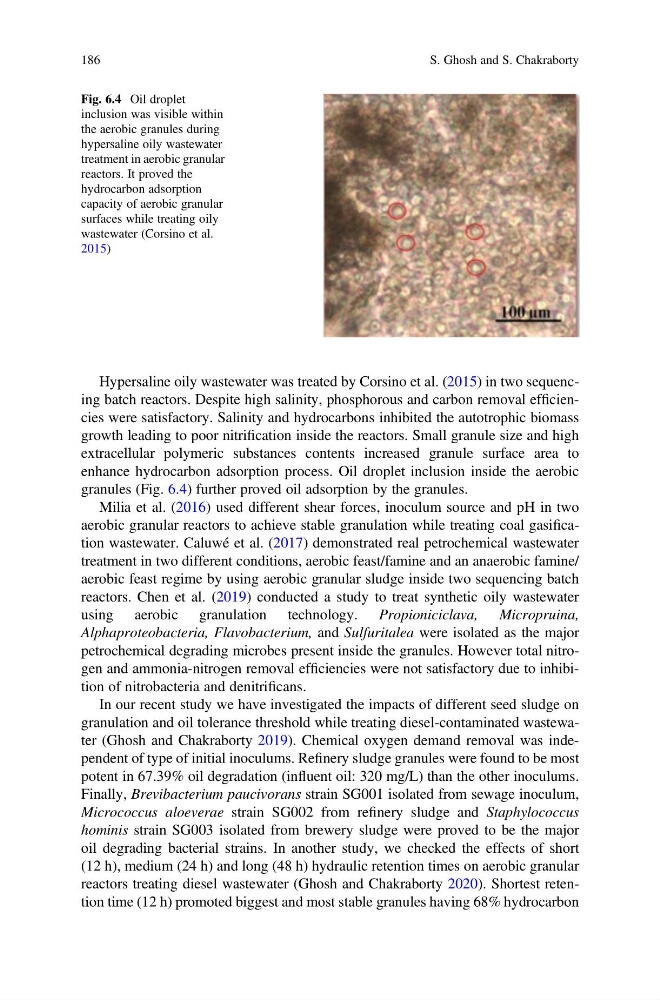
Hypersaline oily wastewater was treated by Corsino et al. (2015) in two sequencing batch reactors. Despite high salinity, phosphorous and carbon removal efficiencies were satisfactory. Salinity and hydrocarbons inhibited the autotrophic biomass
growth leading to poor nitrification inside the reactors. Small granule size and high
extracellular polymeric substances contents increased granule surface area to
enhance hydrocarbon adsorption process. Oil droplet inclusion inside the aerobic
granules (Fig. 6.4) further proved oil adsorption by the granules.
Milia et al. (2016) used different shear forces, inoculum source and pH in two
aerobic granular reactors to achieve stable granulation while treating coal gasification wastewater. Caluwé et al. (2017) demonstrated real petrochemical wastewater
treatment in two different conditions, aerobic feast/famine and an anaerobic famine/
aerobic feast regime by using aerobic granular sludge inside two sequencing batch
reactors. Chen et al. (2019) conducted a study to treat synthetic oily wastewater
using aerobic granulation technology. Propioniciclava, Micropruina,
Alphaproteobacteria, Flavobacterium, and Sulfuritalea were isolated as the major
petrochemical degrading microbes present inside the granules. However total nitrogen and ammonia-nitrogen removal efficiencies were not satisfactory due to inhibition of nitrobacteria and denitrificans.
In our recent study we have investigated the impacts of different seed sludge on
granulation and oil tolerance threshold while treating diesel-contaminated wastewater (Ghosh and Chakraborty 2019). Chemical oxygen demand removal was independent of type of initial inoculums. Refinery sludge granules were found to be most
potent in 67.39% oil degradation (influent oil: 320 mg/L) than the other inoculums.
Finally, Brevibacterium paucivorans strain SG001 isolated from sewage inoculum,
Micrococcus aloeverae strain SG002 from refinery sludge and Staphylococcus
hominis strain SG003 isolated from brewery sludge were proved to be the major
oil degrading bacterial strains. In another study, we checked the effects of short
(12 h), medium (24 h) and long (48 h) hydraulic retention times on aerobic granular
reactors treating diesel wastewater (Ghosh and Chakraborty 2020). Shortest retention time (12 h) promoted biggest and most stable granules having 68% hydrocarbon
Fig. 6.4 Oil droplet
inclusion was visible within
the aerobic granules during
hypersaline oily wastewater
treatment in aerobic granular
reactors. It proved the
hydrocarbon adsorption
capacity of aerobic granular
surfaces while treating oily
wastewater (Corsino et al.
2015)
186
S. Ghosh and S. Chakraborty
growth leading to poor nitrification inside the reactors. Small granule size and high
extracellular polymeric substances contents increased granule surface area to
enhance hydrocarbon adsorption process. Oil droplet inclusion inside the aerobic
granules (Fig. 6.4) further proved oil adsorption by the granules.
Milia et al. (2016) used different shear forces, inoculum source and pH in two
aerobic granular reactors to achieve stable granulation while treating coal gasification wastewater. Caluwé et al. (2017) demonstrated real petrochemical wastewater
treatment in two different conditions, aerobic feast/famine and an anaerobic famine/
aerobic feast regime by using aerobic granular sludge inside two sequencing batch
reactors. Chen et al. (2019) conducted a study to treat synthetic oily wastewater
using aerobic granulation technology. Propioniciclava, Micropruina,
Alphaproteobacteria, Flavobacterium, and Sulfuritalea were isolated as the major
petrochemical degrading microbes present inside the granules. However total nitrogen and ammonia-nitrogen removal efficiencies were not satisfactory due to inhibition of nitrobacteria and denitrificans.
In our recent study we have investigated the impacts of different seed sludge on
granulation and oil tolerance threshold while treating diesel-contaminated wastewater (Ghosh and Chakraborty 2019). Chemical oxygen demand removal was independent of type of initial inoculums. Refinery sludge granules were found to be most
potent in 67.39% oil degradation (influent oil: 320 mg/L) than the other inoculums.
Finally, Brevibacterium paucivorans strain SG001 isolated from sewage inoculum,
Micrococcus aloeverae strain SG002 from refinery sludge and Staphylococcus
hominis strain SG003 isolated from brewery sludge were proved to be the major
oil degrading bacterial strains. In another study, we checked the effects of short
(12 h), medium (24 h) and long (48 h) hydraulic retention times on aerobic granular
reactors treating diesel wastewater (Ghosh and Chakraborty 2020). Shortest retention time (12 h) promoted biggest and most stable granules having 68% hydrocarbon
Fig. 6.4 Oil droplet
inclusion was visible within
the aerobic granules during
hypersaline oily wastewater
treatment in aerobic granular
reactors. It proved the
hydrocarbon adsorption
capacity of aerobic granular
surfaces while treating oily
wastewater (Corsino et al.
2015)
186
S. Ghosh and S. Chakraborty