

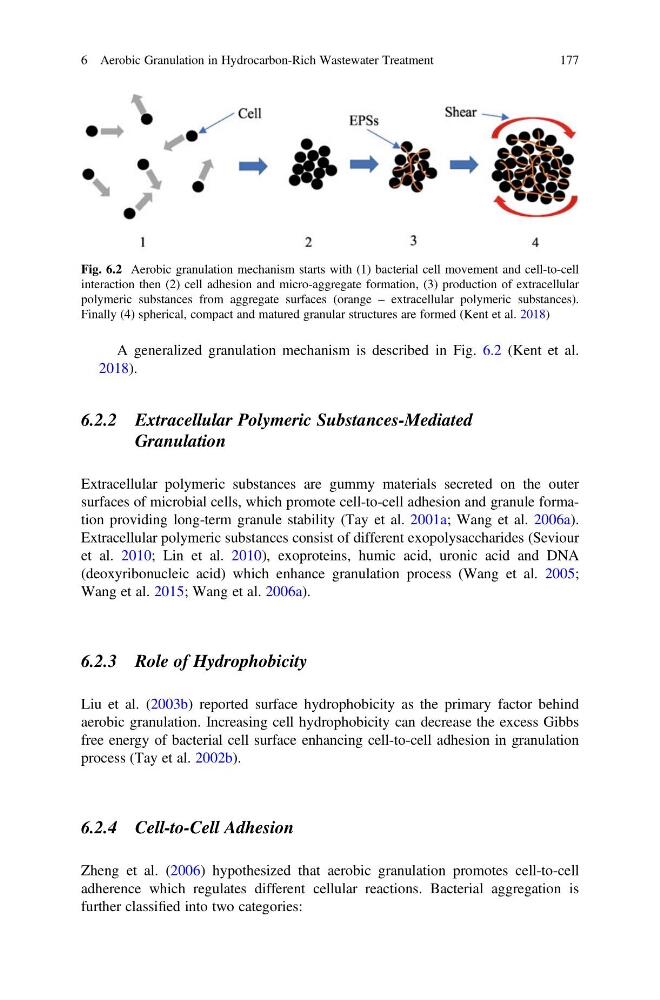
A generalized granulation mechanism is described in Fig. 6.2 (Kent et al.
2018).
6.2.2 Extracellular Polymeric Substances-Mediated
Granulation
Extracellular polymeric substances are gummy materials secreted on the outer
surfaces of microbial cells, which promote cell-to-cell adhesion and granule formation providing long-term granule stability (Tay et al. 2001a; Wang et al. 2006a).
Extracellular polymeric substances consist of different exopolysaccharides (Seviour
et al. 2010; Lin et al. 2010), exoproteins, humic acid, uronic acid and DNA
(deoxyribonucleic acid) which enhance granulation process (Wang et al. 2005;
Wang et al. 2015; Wang et al. 2006a).
6.2.3 Role of Hydrophobicity
Liu et al. (2003b) reported surface hydrophobicity as the primary factor behind
aerobic granulation. Increasing cell hydrophobicity can decrease the excess Gibbs
free energy of bacterial cell surface enhancing cell-to-cell adhesion in granulation
process (Tay et al. 2002b).
6.2.4 Cell-to-Cell Adhesion
Zheng et al. (2006) hypothesized that aerobic granulation promotes cell-to-cell
adherence which regulates different cellular reactions. Bacterial aggregation is
further classified into two categories:
Fig. 6.2 Aerobic granulation mechanism starts with (1) bacterial cell movement and cell-to-cell
interaction then (2) cell adhesion and micro-aggregate formation, (3) production of extracellular
polymeric substances from aggregate surfaces (orange – extracellular polymeric substances).
Finally (4) spherical, compact and matured granular structures are formed (Kent et al. 2018)
6 Aerobic Granulation in Hydrocarbon-Rich Wastewater Treatment
177
2018).
6.2.2 Extracellular Polymeric Substances-Mediated
Granulation
Extracellular polymeric substances are gummy materials secreted on the outer
surfaces of microbial cells, which promote cell-to-cell adhesion and granule formation providing long-term granule stability (Tay et al. 2001a; Wang et al. 2006a).
Extracellular polymeric substances consist of different exopolysaccharides (Seviour
et al. 2010; Lin et al. 2010), exoproteins, humic acid, uronic acid and DNA
(deoxyribonucleic acid) which enhance granulation process (Wang et al. 2005;
Wang et al. 2015; Wang et al. 2006a).
6.2.3 Role of Hydrophobicity
Liu et al. (2003b) reported surface hydrophobicity as the primary factor behind
aerobic granulation. Increasing cell hydrophobicity can decrease the excess Gibbs
free energy of bacterial cell surface enhancing cell-to-cell adhesion in granulation
process (Tay et al. 2002b).
6.2.4 Cell-to-Cell Adhesion
Zheng et al. (2006) hypothesized that aerobic granulation promotes cell-to-cell
adherence which regulates different cellular reactions. Bacterial aggregation is
further classified into two categories:
Fig. 6.2 Aerobic granulation mechanism starts with (1) bacterial cell movement and cell-to-cell
interaction then (2) cell adhesion and micro-aggregate formation, (3) production of extracellular
polymeric substances from aggregate surfaces (orange – extracellular polymeric substances).
Finally (4) spherical, compact and matured granular structures are formed (Kent et al. 2018)
6 Aerobic Granulation in Hydrocarbon-Rich Wastewater Treatment
177