

drinking water standards, in drinking water it is 0.2 mg/L. Petrochemical wastewater
is produced in large volume which has poor biodegradability due to the recalcitrant
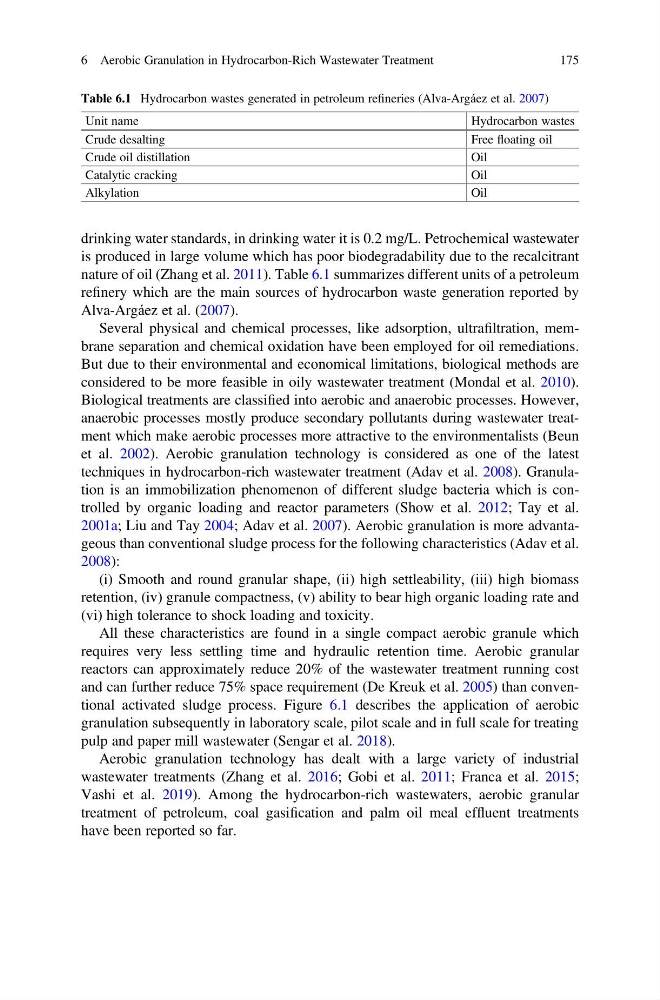
nature of oil (Zhang et al. 2011). Table 6.1 summarizes different units of a petroleum
refinery which are the main sources of hydrocarbon waste generation reported by
Alva-Argáez et al. (2007).
Several physical and chemical processes, like adsorption, ultrafiltration, membrane separation and chemical oxidation have been employed for oil remediations.
But due to their environmental and economical limitations, biological methods are
considered to be more feasible in oily wastewater treatment (Mondal et al. 2010).
Biological treatments are classified into aerobic and anaerobic processes. However,
anaerobic processes mostly produce secondary pollutants during wastewater treatment which make aerobic processes more attractive to the environmentalists (Beun
et al. 2002). Aerobic granulation technology is considered as one of the latest
techniques in hydrocarbon-rich wastewater treatment (Adav et al. 2008). Granulation is an immobilization phenomenon of different sludge bacteria which is controlled by organic loading and reactor parameters (Show et al. 2012; Tay et al.
2001a; Liu and Tay 2004; Adav et al. 2007). Aerobic granulation is more advantageous than conventional sludge process for the following characteristics (Adav et al.
2008):
(i) Smooth and round granular shape, (ii) high settleability, (iii) high biomass
retention, (iv) granule compactness, (v) ability to bear high organic loading rate and
(vi) high tolerance to shock loading and toxicity.
All these characteristics are found in a single compact aerobic granule which
requires very less settling time and hydraulic retention time. Aerobic granular
reactors can approximately reduce 20% of the wastewater treatment running cost
and can further reduce 75% space requirement (De Kreuk et al. 2005) than conventional activated sludge process. Figure 6.1 describes the application of aerobic
granulation subsequently in laboratory scale, pilot scale and in full scale for treating
pulp and paper mill wastewater (Sengar et al. 2018).
Aerobic granulation technology has dealt with a large variety of industrial
wastewater treatments (Zhang et al. 2016; Gobi et al. 2011; Franca et al. 2015;
Vashi et al. 2019). Among the hydrocarbon-rich wastewaters, aerobic granular
treatment of petroleum, coal gasification and palm oil meal effluent treatments
have been reported so far.
Table 6.1 Hydrocarbon wastes generated in petroleum refineries (Alva-Argáez et al. 2007)
Unit name
Hydrocarbon wastes
Crude desalting
Free floating oil
Crude oil distillation
Oil
Catalytic cracking
Oil
Alkylation
Oil
6 Aerobic Granulation in Hydrocarbon-Rich Wastewater Treatment
175
is produced in large volume which has poor biodegradability due to the recalcitrant
nature of oil (Zhang et al. 2011). Table 6.1 summarizes different units of a petroleum
refinery which are the main sources of hydrocarbon waste generation reported by
Alva-Argáez et al. (2007).
Several physical and chemical processes, like adsorption, ultrafiltration, membrane separation and chemical oxidation have been employed for oil remediations.
But due to their environmental and economical limitations, biological methods are
considered to be more feasible in oily wastewater treatment (Mondal et al. 2010).
Biological treatments are classified into aerobic and anaerobic processes. However,
anaerobic processes mostly produce secondary pollutants during wastewater treatment which make aerobic processes more attractive to the environmentalists (Beun
et al. 2002). Aerobic granulation technology is considered as one of the latest
techniques in hydrocarbon-rich wastewater treatment (Adav et al. 2008). Granulation is an immobilization phenomenon of different sludge bacteria which is controlled by organic loading and reactor parameters (Show et al. 2012; Tay et al.
2001a; Liu and Tay 2004; Adav et al. 2007). Aerobic granulation is more advantageous than conventional sludge process for the following characteristics (Adav et al.
2008):
(i) Smooth and round granular shape, (ii) high settleability, (iii) high biomass
retention, (iv) granule compactness, (v) ability to bear high organic loading rate and
(vi) high tolerance to shock loading and toxicity.
All these characteristics are found in a single compact aerobic granule which
requires very less settling time and hydraulic retention time. Aerobic granular
reactors can approximately reduce 20% of the wastewater treatment running cost
and can further reduce 75% space requirement (De Kreuk et al. 2005) than conventional activated sludge process. Figure 6.1 describes the application of aerobic
granulation subsequently in laboratory scale, pilot scale and in full scale for treating
pulp and paper mill wastewater (Sengar et al. 2018).
Aerobic granulation technology has dealt with a large variety of industrial
wastewater treatments (Zhang et al. 2016; Gobi et al. 2011; Franca et al. 2015;
Vashi et al. 2019). Among the hydrocarbon-rich wastewaters, aerobic granular
treatment of petroleum, coal gasification and palm oil meal effluent treatments
have been reported so far.
Table 6.1 Hydrocarbon wastes generated in petroleum refineries (Alva-Argáez et al. 2007)
Unit name
Hydrocarbon wastes
Crude desalting
Free floating oil
Crude oil distillation
Oil
Catalytic cracking
Oil
Alkylation
Oil
6 Aerobic Granulation in Hydrocarbon-Rich Wastewater Treatment
175