

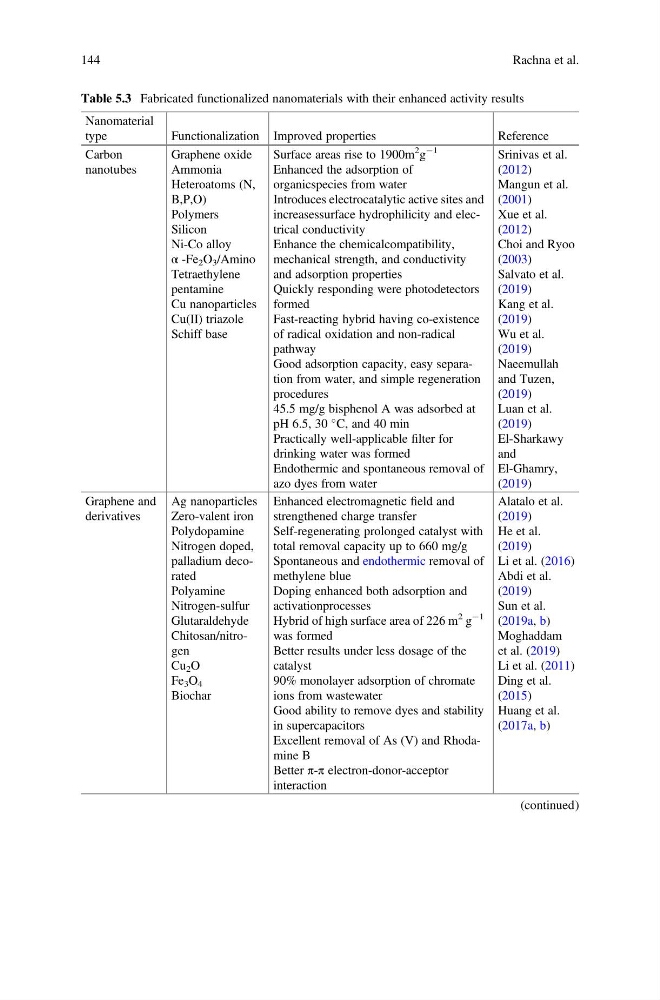
Table 5.3 Fabricated functionalized nanomaterials with their enhanced activity results
Nanomaterial
type
Functionalization Improved properties
Reference
Carbon
nanotubes
Graphene oxide
Ammonia
Heteroatoms (N,
B,P,O)
Polymers
Silicon
Ni-Co alloy
α -Fe 2 O 3 /Amino
Tetraethylene
pentamine
Cu nanoparticles
Cu(II) triazole
Schiff base
Surface areas rise to 1900m
2
g
À1
Enhanced the adsorption of
organicspecies from water
Introduces electrocatalytic active sites and
increasessurface hydrophilicity and electrical conductivity
Enhance the chemicalcompatibility,
mechanical strength, and conductivity
and adsorption properties
Quickly responding were photodetectors
formed
Fast-reacting hybrid having co-existence
of radical oxidation and non-radical
pathway
Good adsorption capacity, easy separation from water, and simple regeneration
procedures
45.5 mg/g bisphenol A was adsorbed at
pH 6.5, 30
C, and 40 min
Practically well-applicable filter for
drinking water was formed
Endothermic and spontaneous removal of
azo dyes from water
Srinivas et al.
(2012)
Mangun et al.
(2001)
Xue et al.
(2012)
Choi and Ryoo
(2003)
Salvato et al.
(2019)
Kang et al.
(2019)
Wu et al.
(2019)
Naeemullah
and Tuzen,
(2019)
Luan et al.
(2019)
El-Sharkawy
and
El-Ghamry,
(2019)
Graphene and
derivatives
Ag nanoparticles
Zero-valent iron
Polydopamine
Nitrogen doped,
palladium decorated
Polyamine
Nitrogen-sulfur
Glutaraldehyde
Chitosan/nitrogen
Cu 2 O
Fe 3 O 4
Biochar
Enhanced electromagnetic field and
strengthened charge transfer
Self-regenerating prolonged catalyst with
total removal capacity up to 660 mg/g
Spontaneous and endothermic removal of
methylene blue
Doping enhanced both adsorption and
activationprocesses
Hybrid of high surface area of 226 m
2 g
À1
was formed
Better results under less dosage of the
catalyst
90% monolayer adsorption of chromate
ions from wastewater
Good ability to remove dyes and stability
in supercapacitors
Excellent removal of As (V) and Rhodamine B
Better π-π electron-donor-acceptor
interaction
Alatalo et al.
(2019)
He et al.
(2019)
Li et al. (2016)
Abdi et al.
(2019)
Sun et al.
(2019a, b)
Moghaddam
et al. (2019)
Li et al. (2011)
Ding et al.
(2015)
Huang et al.
(2017a, b)
(continued)
144
Rachna et al.
Nanomaterial
type
Functionalization Improved properties
Reference
Carbon
nanotubes
Graphene oxide
Ammonia
Heteroatoms (N,
B,P,O)
Polymers
Silicon
Ni-Co alloy
α -Fe 2 O 3 /Amino
Tetraethylene
pentamine
Cu nanoparticles
Cu(II) triazole
Schiff base
Surface areas rise to 1900m
2
g
À1
Enhanced the adsorption of
organicspecies from water
Introduces electrocatalytic active sites and
increasessurface hydrophilicity and electrical conductivity
Enhance the chemicalcompatibility,
mechanical strength, and conductivity
and adsorption properties
Quickly responding were photodetectors
formed
Fast-reacting hybrid having co-existence
of radical oxidation and non-radical
pathway
Good adsorption capacity, easy separation from water, and simple regeneration
procedures
45.5 mg/g bisphenol A was adsorbed at
pH 6.5, 30
C, and 40 min
Practically well-applicable filter for
drinking water was formed
Endothermic and spontaneous removal of
azo dyes from water
Srinivas et al.
(2012)
Mangun et al.
(2001)
Xue et al.
(2012)
Choi and Ryoo
(2003)
Salvato et al.
(2019)
Kang et al.
(2019)
Wu et al.
(2019)
Naeemullah
and Tuzen,
(2019)
Luan et al.
(2019)
El-Sharkawy
and
El-Ghamry,
(2019)
Graphene and
derivatives
Ag nanoparticles
Zero-valent iron
Polydopamine
Nitrogen doped,
palladium decorated
Polyamine
Nitrogen-sulfur
Glutaraldehyde
Chitosan/nitrogen
Cu 2 O
Fe 3 O 4
Biochar
Enhanced electromagnetic field and
strengthened charge transfer
Self-regenerating prolonged catalyst with
total removal capacity up to 660 mg/g
Spontaneous and endothermic removal of
methylene blue
Doping enhanced both adsorption and
activationprocesses
Hybrid of high surface area of 226 m
2 g
À1
was formed
Better results under less dosage of the
catalyst
90% monolayer adsorption of chromate
ions from wastewater
Good ability to remove dyes and stability
in supercapacitors
Excellent removal of As (V) and Rhodamine B
Better π-π electron-donor-acceptor
interaction
Alatalo et al.
(2019)
He et al.
(2019)
Li et al. (2016)
Abdi et al.
(2019)
Sun et al.
(2019a, b)
Moghaddam
et al. (2019)
Li et al. (2011)
Ding et al.
(2015)
Huang et al.
(2017a, b)
(continued)
144
Rachna et al.