

a large number of plastic particles or even the whole plastic products into such
sources of water; all this happens mostly in underdeveloped or third-world countries
which have either poor or no sanitation system at all. The ocean is the ultimate sink
for all types of water pollutants that may be heavy metals, toxic chemical compounds, industrial waste, or plastics because almost all the major rivers empty in
oceans (Haward 2018). The ocean acts as a repository for increasing quantities of
plastics and microplastics. There is a widespread recognition of the fact that these
pollutants of the ocean must be addressed in a sustainable way (Avio et al. 2017). In
2010 alone the estimated plastic that entered oceans was somewhat between 4 to
13 million tons (Van Sebille et al. 2016). Plastic pollution has not only endangered
more than 250 marine species but it has also put the future of this planet at risk.
Marine litter ingestion by aquatic life has seriously affected the ocean biodiversity.
Therefore, there is a serious demand to tackle plastic pollution in oceans and seas.
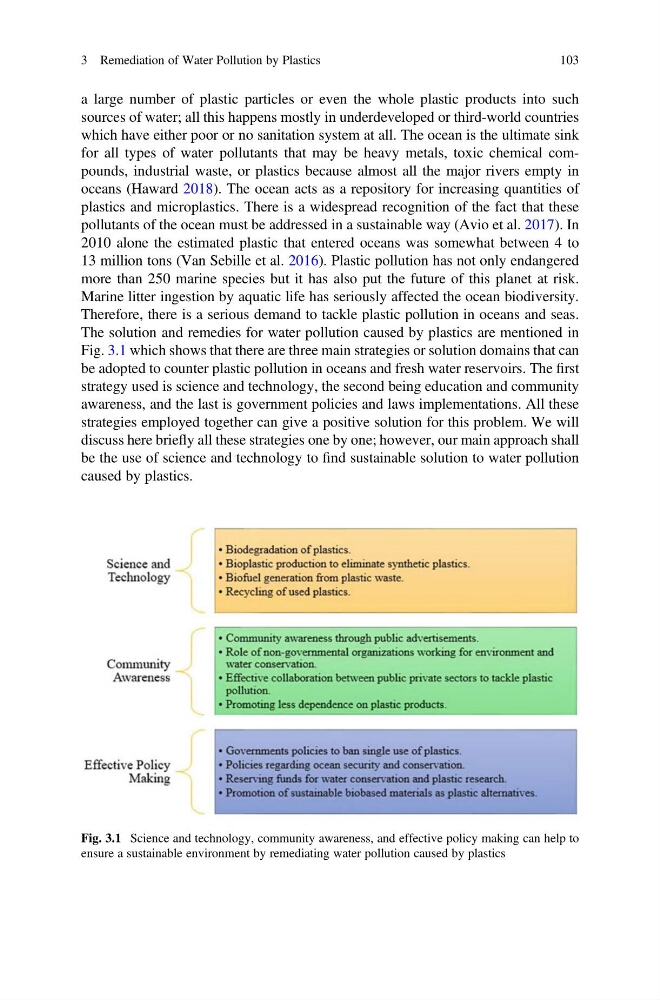
The solution and remedies for water pollution caused by plastics are mentioned in
Fig. 3.1 which shows that there are three main strategies or solution domains that can
be adopted to counter plastic pollution in oceans and fresh water reservoirs. The first
strategy used is science and technology, the second being education and community
awareness, and the last is government policies and laws implementations. All these
strategies employed together can give a positive solution for this problem. We will
discuss here briefly all these strategies one by one; however, our main approach shall
be the use of science and technology to find sustainable solution to water pollution
caused by plastics.
Fig. 3.1 Science and technology, community awareness, and effective policy making can help to
ensure a sustainable environment by remediating water pollution caused by plastics
3 Remediation of Water Pollution by Plastics
103
sources of water; all this happens mostly in underdeveloped or third-world countries
which have either poor or no sanitation system at all. The ocean is the ultimate sink
for all types of water pollutants that may be heavy metals, toxic chemical compounds, industrial waste, or plastics because almost all the major rivers empty in
oceans (Haward 2018). The ocean acts as a repository for increasing quantities of
plastics and microplastics. There is a widespread recognition of the fact that these
pollutants of the ocean must be addressed in a sustainable way (Avio et al. 2017). In
2010 alone the estimated plastic that entered oceans was somewhat between 4 to
13 million tons (Van Sebille et al. 2016). Plastic pollution has not only endangered
more than 250 marine species but it has also put the future of this planet at risk.
Marine litter ingestion by aquatic life has seriously affected the ocean biodiversity.
Therefore, there is a serious demand to tackle plastic pollution in oceans and seas.
The solution and remedies for water pollution caused by plastics are mentioned in
Fig. 3.1 which shows that there are three main strategies or solution domains that can
be adopted to counter plastic pollution in oceans and fresh water reservoirs. The first
strategy used is science and technology, the second being education and community
awareness, and the last is government policies and laws implementations. All these
strategies employed together can give a positive solution for this problem. We will
discuss here briefly all these strategies one by one; however, our main approach shall
be the use of science and technology to find sustainable solution to water pollution
caused by plastics.
Fig. 3.1 Science and technology, community awareness, and effective policy making can help to
ensure a sustainable environment by remediating water pollution caused by plastics
3 Remediation of Water Pollution by Plastics
103