

encourages new research not only to quantify plastic pollution and its economic,
ecological, biological, and social impacts but also to unmask its remedies. Urban
beaches and coastal waters can be seen full of plastic debris. Microplastics are found
in every habitat including surface waters, beaches, the deep seafloor and the water
column. Impacts of plastic on the environment include habitat damage, health risks
and effect on aquatic life (Bråte et al. 2017).
Microplastics and Microorganisms
Microorganisms such as bacteria and archaea are natural biodegraders and recyclers;
they could also play a role in breaking down chemical residues of plastics (Yu et al.
2018). Microorganisms can break down plastics by converting the carbon that
constitutes the plastics into carbon dioxide (CO 2 ), water, and biomass. Microplastics
floating on water have the capability of providing raft substrates for various epifauna
and microbes i.e., bacteria, algae, and diatoms and moving them to zones where they
were not present before; this in turn can change the marine ecosystem by disturbing
the natural habitat of these microbes which eventually effects food chain (Mrowiec
2017).
3.4 Plastic Pollution in Oceans
Coastlines of some developed countries like China and the United States are
responsible for the most of plastic pollution. Nearly one-third of the plastic waste
is mishandled, as a result of which its movement into the oceans becomes feasible. It
is estimated that approximately 90% of this plastic waste came only from 10 rivers in
the world out of which 8 rivers, i.e. the Yangtze, Yellow, Mekong, Indus, Ganges,
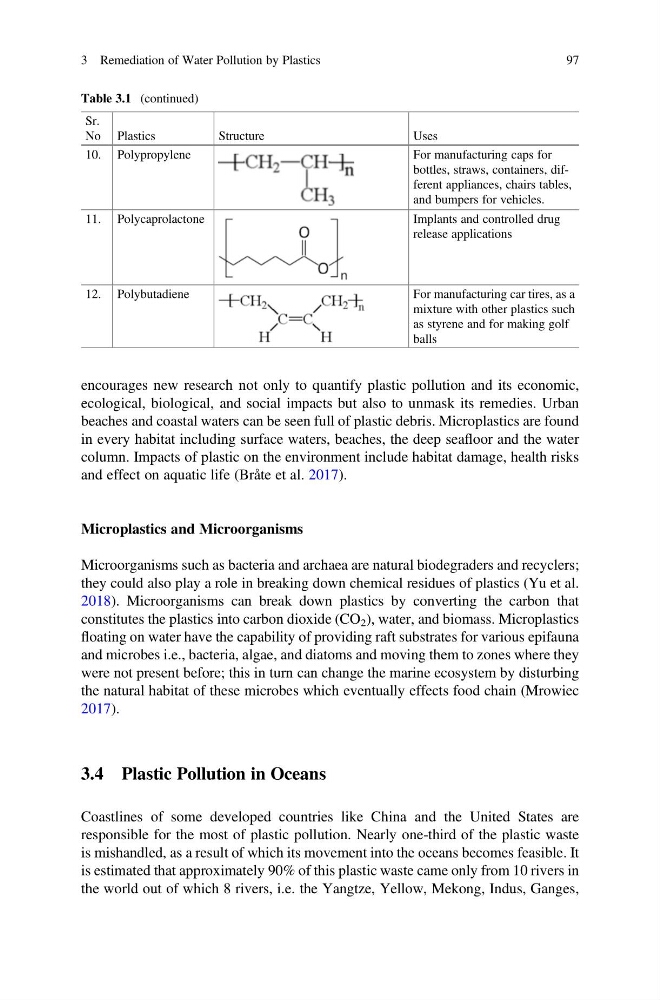
Table 3.1 (continued)
Sr.
No Plastics
Structure
Uses
10. Polypropylene
For manufacturing caps for
bottles, straws, containers, different appliances, chairs tables,
and bumpers for vehicles.
11. Polycaprolactone
Implants and controlled drug
release applications
12. Polybutadiene
For manufacturing car tires, as a
mixture with other plastics such
as styrene and for making golf
balls
3 Remediation of Water Pollution by Plastics
97
ecological, biological, and social impacts but also to unmask its remedies. Urban
beaches and coastal waters can be seen full of plastic debris. Microplastics are found
in every habitat including surface waters, beaches, the deep seafloor and the water
column. Impacts of plastic on the environment include habitat damage, health risks
and effect on aquatic life (Bråte et al. 2017).
Microplastics and Microorganisms
Microorganisms such as bacteria and archaea are natural biodegraders and recyclers;
they could also play a role in breaking down chemical residues of plastics (Yu et al.
2018). Microorganisms can break down plastics by converting the carbon that
constitutes the plastics into carbon dioxide (CO 2 ), water, and biomass. Microplastics
floating on water have the capability of providing raft substrates for various epifauna
and microbes i.e., bacteria, algae, and diatoms and moving them to zones where they
were not present before; this in turn can change the marine ecosystem by disturbing
the natural habitat of these microbes which eventually effects food chain (Mrowiec
2017).
3.4 Plastic Pollution in Oceans
Coastlines of some developed countries like China and the United States are
responsible for the most of plastic pollution. Nearly one-third of the plastic waste
is mishandled, as a result of which its movement into the oceans becomes feasible. It
is estimated that approximately 90% of this plastic waste came only from 10 rivers in
the world out of which 8 rivers, i.e. the Yangtze, Yellow, Mekong, Indus, Ganges,
Table 3.1 (continued)
Sr.
No Plastics
Structure
Uses
10. Polypropylene
For manufacturing caps for
bottles, straws, containers, different appliances, chairs tables,
and bumpers for vehicles.
11. Polycaprolactone
Implants and controlled drug
release applications
12. Polybutadiene
For manufacturing car tires, as a
mixture with other plastics such
as styrene and for making golf
balls
3 Remediation of Water Pollution by Plastics
97