

66
T. A. Aragaw and B. A. Mekonnen
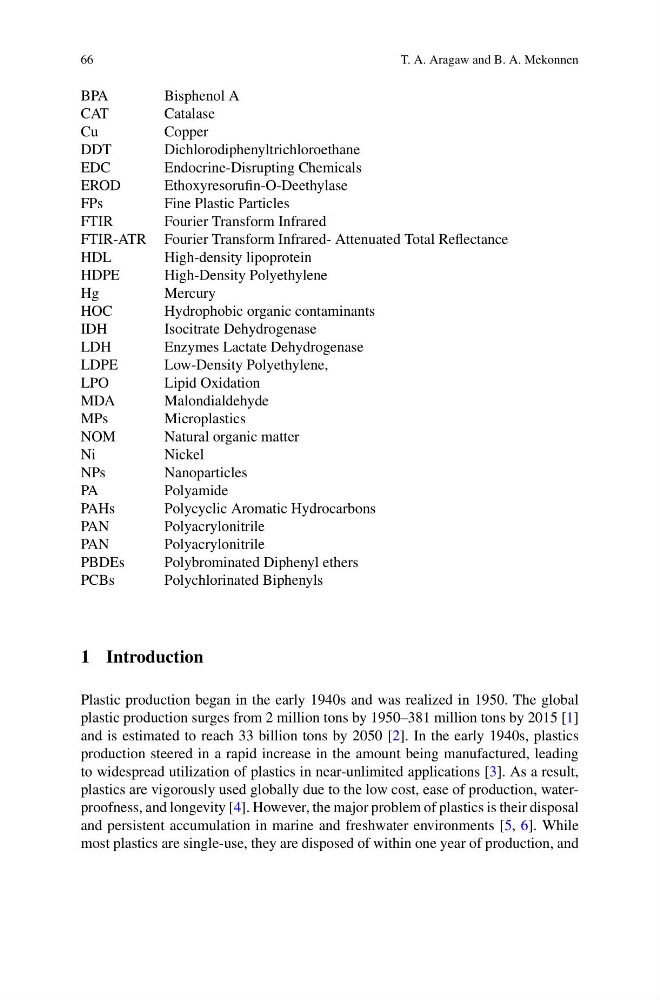
BPA
Bisphenol A
CAT
Catalase
Cu
Copper
DDT
Dichlorodiphenyltrichloroethane
EDC
Endocrine-Disrupting Chemicals
EROD
Ethoxyresorufin-O-Deethylase
FPs
Fine Plastic Particles
FTIR
Fourier Transform Infrared
FTIR-ATR Fourier Transform Infrared- Attenuated Total Reflectance
HDL
High-density lipoprotein
HDPE
High-Density Polyethylene
Hg
Mercury
HOC
Hydrophobic organic contaminants
IDH
Isocitrate Dehydrogenase
LDH
Enzymes Lactate Dehydrogenase
LDPE
Low-Density Polyethylene,
LPO
Lipid Oxidation
MDA
Malondialdehyde
MPs
Microplastics
NOM
Natural organic matter
Ni
Nickel
NPs
Nanoparticles
PA
Polyamide
PAHs
Polycyclic Aromatic Hydrocarbons
PAN
Polyacrylonitrile
PAN
Polyacrylonitrile
PBDEs
Polybrominated Diphenyl ethers
PCBs
Polychlorinated Biphenyls
1 Introduction
Plastic production began in the early 1940s and was realized in 1950. The global
plastic production surges from 2 million tons by 1950–381 million tons by 2015 [1]
and is estimated to reach 33 billion tons by 2050 [2]. In the early 1940s, plastics
production steered in a rapid increase in the amount being manufactured, leading
to widespread utilization of plastics in near-unlimited applications [3]. As a result,
plastics are vigorously used globally due to the low cost, ease of production, waterproofness, and longevity [4]. However, the major problem of plastics is their disposal
and persistent accumulation in marine and freshwater environments [5, 6]. While
most plastics are single-use, they are disposed of within one year of production, and
T. A. Aragaw and B. A. Mekonnen
BPA
Bisphenol A
CAT
Catalase
Cu
Copper
DDT
Dichlorodiphenyltrichloroethane
EDC
Endocrine-Disrupting Chemicals
EROD
Ethoxyresorufin-O-Deethylase
FPs
Fine Plastic Particles
FTIR
Fourier Transform Infrared
FTIR-ATR Fourier Transform Infrared- Attenuated Total Reflectance
HDL
High-density lipoprotein
HDPE
High-Density Polyethylene
Hg
Mercury
HOC
Hydrophobic organic contaminants
IDH
Isocitrate Dehydrogenase
LDH
Enzymes Lactate Dehydrogenase
LDPE
Low-Density Polyethylene,
LPO
Lipid Oxidation
MDA
Malondialdehyde
MPs
Microplastics
NOM
Natural organic matter
Ni
Nickel
NPs
Nanoparticles
PA
Polyamide
PAHs
Polycyclic Aromatic Hydrocarbons
PAN
Polyacrylonitrile
PAN
Polyacrylonitrile
PBDEs
Polybrominated Diphenyl ethers
PCBs
Polychlorinated Biphenyls
1 Introduction
Plastic production began in the early 1940s and was realized in 1950. The global
plastic production surges from 2 million tons by 1950–381 million tons by 2015 [1]
and is estimated to reach 33 billion tons by 2050 [2]. In the early 1940s, plastics
production steered in a rapid increase in the amount being manufactured, leading
to widespread utilization of plastics in near-unlimited applications [3]. As a result,
plastics are vigorously used globally due to the low cost, ease of production, waterproofness, and longevity [4]. However, the major problem of plastics is their disposal
and persistent accumulation in marine and freshwater environments [5, 6]. While
most plastics are single-use, they are disposed of within one year of production, and