

Effect of Textile Parameters on Microfiber Shedding …
21
by simulating aged effect by repolishing. They have noted higher shedding for repolished fabrics than the non-repolished fabrics indicating higher shedding for used or
worn garments. The repolishing of fabrics can affect the surface and cause damage
to the yarns. The damaged yarns with cut edges increase the fiber release [9].
Bruce et al. have analyzed the shedding of new and aged jackets. The statistical
analysis of the fiber mass released from the aged and new jackets shown a significant
difference. They have noticed 60% more fibers from aged jackets. They have also
suggested that the reason for higher shedding in the aged garments might be the
weakened fibers which are resulted out of wear. Moreover, they have also noticed
that the fibers shed from the aged garments were larger than the fibers from new
jackets. They have also added that the aging nature of the fiber will differ from one
to another and the studies should be made to assess the effect of aging of different
materials like nylon, acrylic, rayon, and others on the microfiber shedding [60]. The
other researchers studied the effect of aging effect on shedding by analyzing different
fabrics including polyester knit, polyester fleece, nylon, and acrylic fabrics. For the
simulation of aging, repolishing is done. As similar to previous researches, higher
shedding is noted in the repolished fabrics than the untreated ones indicating higher
shedding with aging. They have noted that in the case of polyester knits, with aging,
the fibers released were longer whereas in the case of nylon and acrylic the length
of the fibers was small [21]. The other researcher has studied the effect of aging by
comparing the fibers shed from 1st to 5th washes with that of 11th to 15th washes. The
higher level of microfiber release is noted in 11th to 15th washes (0.0046% w/w) and
it is almost twice the quantity of fibers released in the initial washes (0.0024% w/w)
[28]. The study made by Ganesh Lamichchane to evaluate the shedding behavior of
new and old polyester jackets also reported a similar result. The old jackets had shed
a greater number of fibers than the new jackets. It has to be noted that the shedding of
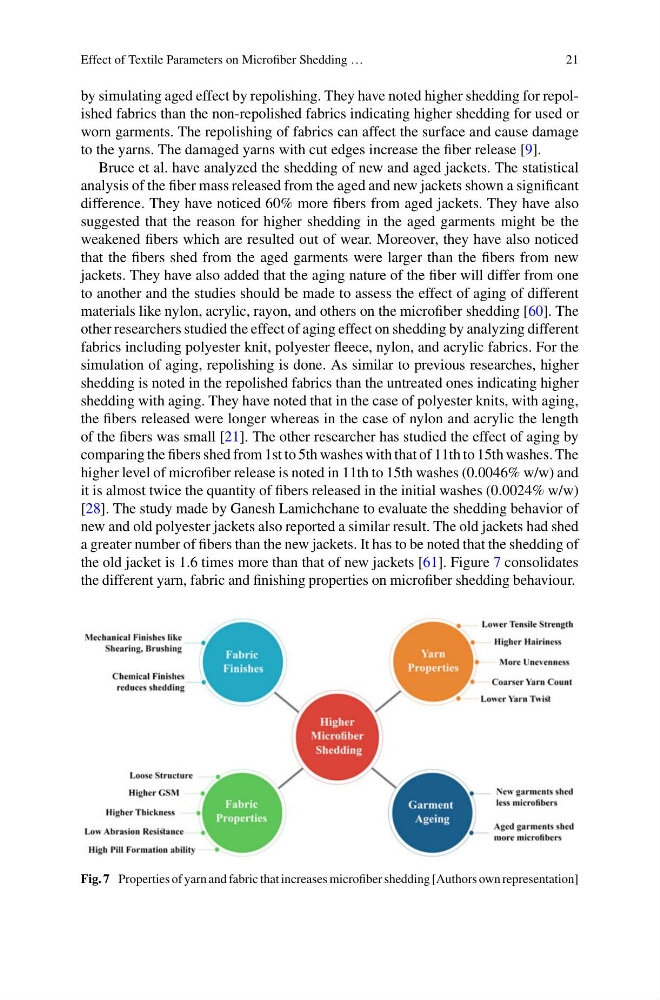
the old jacket is 1.6 times more than that of new jackets [61]. Figure 7 consolidates
the different yarn, fabric and finishing properties on microfiber shedding behaviour.
Fig. 7 Properties of yarn and fabric that increases microfiber shedding [Authors own representation]
21
by simulating aged effect by repolishing. They have noted higher shedding for repolished fabrics than the non-repolished fabrics indicating higher shedding for used or
worn garments. The repolishing of fabrics can affect the surface and cause damage
to the yarns. The damaged yarns with cut edges increase the fiber release [9].
Bruce et al. have analyzed the shedding of new and aged jackets. The statistical
analysis of the fiber mass released from the aged and new jackets shown a significant
difference. They have noticed 60% more fibers from aged jackets. They have also
suggested that the reason for higher shedding in the aged garments might be the
weakened fibers which are resulted out of wear. Moreover, they have also noticed
that the fibers shed from the aged garments were larger than the fibers from new
jackets. They have also added that the aging nature of the fiber will differ from one
to another and the studies should be made to assess the effect of aging of different
materials like nylon, acrylic, rayon, and others on the microfiber shedding [60]. The
other researchers studied the effect of aging effect on shedding by analyzing different
fabrics including polyester knit, polyester fleece, nylon, and acrylic fabrics. For the
simulation of aging, repolishing is done. As similar to previous researches, higher
shedding is noted in the repolished fabrics than the untreated ones indicating higher
shedding with aging. They have noted that in the case of polyester knits, with aging,
the fibers released were longer whereas in the case of nylon and acrylic the length
of the fibers was small [21]. The other researcher has studied the effect of aging by
comparing the fibers shed from 1st to 5th washes with that of 11th to 15th washes. The
higher level of microfiber release is noted in 11th to 15th washes (0.0046% w/w) and
it is almost twice the quantity of fibers released in the initial washes (0.0024% w/w)
[28]. The study made by Ganesh Lamichchane to evaluate the shedding behavior of
new and old polyester jackets also reported a similar result. The old jackets had shed
a greater number of fibers than the new jackets. It has to be noted that the shedding of
the old jacket is 1.6 times more than that of new jackets [61]. Figure 7 consolidates
the different yarn, fabric and finishing properties on microfiber shedding behaviour.
Fig. 7 Properties of yarn and fabric that increases microfiber shedding [Authors own representation]