

146
R. Rathinamoorthy and S. Raja Balasaraswathi
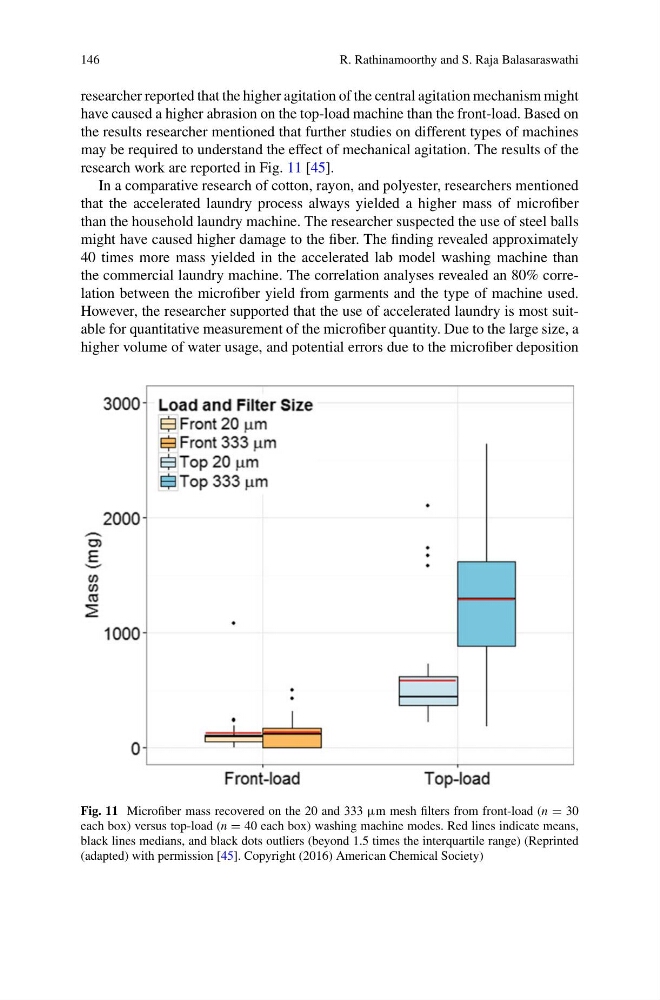
researcher reported that the higher agitation of the central agitation mechanism might
have caused a higher abrasion on the top-load machine than the front-load. Based on
the results researcher mentioned that further studies on different types of machines
may be required to understand the effect of mechanical agitation. The results of the
research work are reported in Fig. 11 [45].
In a comparative research of cotton, rayon, and polyester, researchers mentioned
that the accelerated laundry process always yielded a higher mass of microfiber
than the household laundry machine. The researcher suspected the use of steel balls
might have caused higher damage to the fiber. The finding revealed approximately
40 times more mass yielded in the accelerated lab model washing machine than
the commercial laundry machine. The correlation analyses revealed an 80% correlation between the microfiber yield from garments and the type of machine used.
However, the researcher supported that the use of accelerated laundry is most suitable for quantitative measurement of the microfiber quantity. Due to the large size, a
higher volume of water usage, and potential errors due to the microfiber deposition
Fig. 11 Microfiber mass recovered on the 20 and 333 µm mesh filters from front-load (n = 30
each box) versus top-load (n = 40 each box) washing machine modes. Red lines indicate means,
black lines medians, and black dots outliers (beyond 1.5 times the interquartile range) (Reprinted
(adapted) with permission [45]. Copyright (2016) American Chemical Society)
R. Rathinamoorthy and S. Raja Balasaraswathi
researcher reported that the higher agitation of the central agitation mechanism might
have caused a higher abrasion on the top-load machine than the front-load. Based on
the results researcher mentioned that further studies on different types of machines
may be required to understand the effect of mechanical agitation. The results of the
research work are reported in Fig. 11 [45].
In a comparative research of cotton, rayon, and polyester, researchers mentioned
that the accelerated laundry process always yielded a higher mass of microfiber
than the household laundry machine. The researcher suspected the use of steel balls
might have caused higher damage to the fiber. The finding revealed approximately
40 times more mass yielded in the accelerated lab model washing machine than
the commercial laundry machine. The correlation analyses revealed an 80% correlation between the microfiber yield from garments and the type of machine used.
However, the researcher supported that the use of accelerated laundry is most suitable for quantitative measurement of the microfiber quantity. Due to the large size, a
higher volume of water usage, and potential errors due to the microfiber deposition
Fig. 11 Microfiber mass recovered on the 20 and 333 µm mesh filters from front-load (n = 30
each box) versus top-load (n = 40 each box) washing machine modes. Red lines indicate means,
black lines medians, and black dots outliers (beyond 1.5 times the interquartile range) (Reprinted
(adapted) with permission [45]. Copyright (2016) American Chemical Society)