

112
B. Yan et al.
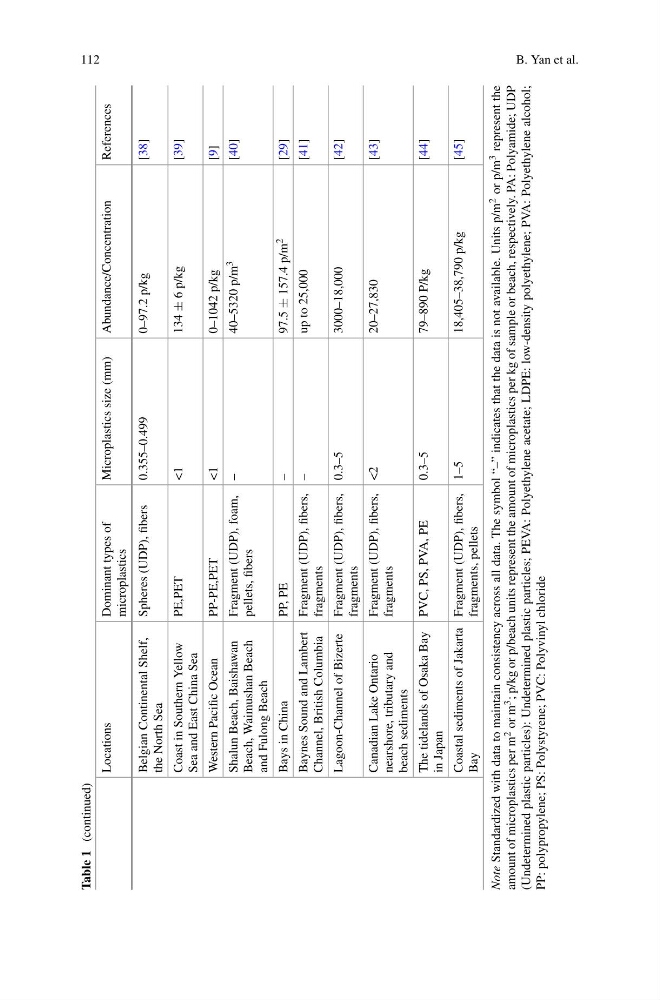
Table 1
(continued)
Locations
Dominant types of
microplastics
Microplastics size (mm)
Abundance/Concentration
References
Belgian Continental Shelf,
the North Sea
Spheres (UDP), fibers
0.355–0.499
0–97.2 p/kg
[38]
Coast in Southern Yellow
Sea and East China Sea
PE,PET
<1
134
± 6 p/kg
[39]
Western Pacific Ocean
PP-PE,PET
<1
0–1042 p/kg
[9]
Shalun Beach, Baishawan
Beach, Waimushan Beach
and Fulong Beach
Fragment (UDP), foam,
pellets, fibers
–
40–5320 p/m 3
[40]
Bays in China
PP, PE
–
97.5
± 157.4 p/m 2
[29]
Baynes Sound and Lambert
Channel, British Columbia
Fragment (UDP), fibers,
fragments
–
up to 25,000
[41]
Lagoon-Channel of Bizerte Fragment (UDP), fibers,
fragments
0.3–5
3000–18,000
[42]
Canadian Lake Ontario
nearshore, tributary and
beach sediments
Fragment (UDP), fibers,
fragments
<2
20–27,830
[43]
The tidelands of Osaka Bay
in Japan
PVC, PS, PVA, PE
0.3–5
79–890 P/kg
[44]
Coastal sediments of Jakarta
Bay
Fragment (UDP), fibers,
fragments, pellets
1–5
18,405–38,790 p/kg
[45]
Note
Standardized with data to maintain consistency across all data. The symbol “–” indicates that the data is not available. Units p/m 2
or p/m 3
represent the
amount of microplastics per m 2
or m 3
; p/kg or p/beach units represent the amount of microplastics per kg of sample or beach, respectively. PA: Polyamide; UDP
(Undetermined plastic particles): Undetermined plastic particles; PEVA: Polyethylene acetate; LDPE: low-density polyethylene; PVA: Polyethylene alcohol;
PP: polypropylene; PS: Polystyrene; PVC: Polyvinyl chloride
B. Yan et al.
Table 1
(continued)
Locations
Dominant types of
microplastics
Microplastics size (mm)
Abundance/Concentration
References
Belgian Continental Shelf,
the North Sea
Spheres (UDP), fibers
0.355–0.499
0–97.2 p/kg
[38]
Coast in Southern Yellow
Sea and East China Sea
PE,PET
<1
134
± 6 p/kg
[39]
Western Pacific Ocean
PP-PE,PET
<1
0–1042 p/kg
[9]
Shalun Beach, Baishawan
Beach, Waimushan Beach
and Fulong Beach
Fragment (UDP), foam,
pellets, fibers
–
40–5320 p/m 3
[40]
Bays in China
PP, PE
–
97.5
± 157.4 p/m 2
[29]
Baynes Sound and Lambert
Channel, British Columbia
Fragment (UDP), fibers,
fragments
–
up to 25,000
[41]
Lagoon-Channel of Bizerte Fragment (UDP), fibers,
fragments
0.3–5
3000–18,000
[42]
Canadian Lake Ontario
nearshore, tributary and
beach sediments
Fragment (UDP), fibers,
fragments
<2
20–27,830
[43]
The tidelands of Osaka Bay
in Japan
PVC, PS, PVA, PE
0.3–5
79–890 P/kg
[44]
Coastal sediments of Jakarta
Bay
Fragment (UDP), fibers,
fragments, pellets
1–5
18,405–38,790 p/kg
[45]
Note
Standardized with data to maintain consistency across all data. The symbol “–” indicates that the data is not available. Units p/m 2
or p/m 3
represent the
amount of microplastics per m 2
or m 3
; p/kg or p/beach units represent the amount of microplastics per kg of sample or beach, respectively. PA: Polyamide; UDP
(Undetermined plastic particles): Undetermined plastic particles; PEVA: Polyethylene acetate; LDPE: low-density polyethylene; PVA: Polyethylene alcohol;
PP: polypropylene; PS: Polystyrene; PVC: Polyvinyl chloride