

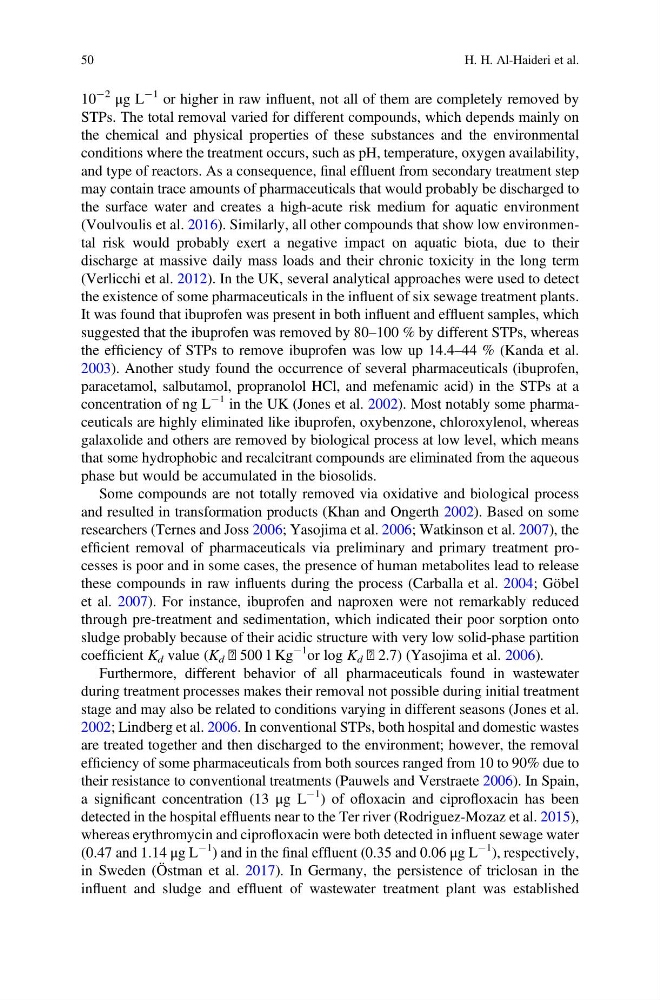
10
À2
μg L
À1 or higher in raw influent, not all of them are completely removed by
STPs. The total removal varied for different compounds, which depends mainly on
the chemical and physical properties of these substances and the environmental
conditions where the treatment occurs, such as pH, temperature, oxygen availability,
and type of reactors. As a consequence, final effluent from secondary treatment step
may contain trace amounts of pharmaceuticals that would probably be discharged to
the surface water and creates a high-acute risk medium for aquatic environment
(Voulvoulis et al. 2016). Similarly, all other compounds that show low environmental risk would probably exert a negative impact on aquatic biota, due to their
discharge at massive daily mass loads and their chronic toxicity in the long term
(Verlicchi et al. 2012). In the UK, several analytical approaches were used to detect
the existence of some pharmaceuticals in the influent of six sewage treatment plants.
It was found that ibuprofen was present in both influent and effluent samples, which
suggested that the ibuprofen was removed by 80–100 % by different STPs, whereas
the efficiency of STPs to remove ibuprofen was low up 14.4–44 % (Kanda et al.
2003). Another study found the occurrence of several pharmaceuticals (ibuprofen,
paracetamol, salbutamol, propranolol HCl, and mefenamic acid) in the STPs at a
concentration of ng L
À1 in the UK (Jones et al. 2002). Most notably some pharmaceuticals are highly eliminated like ibuprofen, oxybenzone, chloroxylenol, whereas
galaxolide and others are removed by biological process at low level, which means
that some hydrophobic and recalcitrant compounds are eliminated from the aqueous
phase but would be accumulated in the biosolids.
Some compounds are not totally removed via oxidative and biological process
and resulted in transformation products (Khan and Ongerth 2002). Based on some
researchers (Ternes and Joss 2006; Yasojima et al. 2006; Watkinson et al. 2007), the
efficient removal of pharmaceuticals via preliminary and primary treatment processes is poor and in some cases, the presence of human metabolites lead to release
these compounds in raw influents during the process (Carballa et al. 2004; Göbel
et al. 2007). For instance, ibuprofen and naproxen were not remarkably reduced
through pre-treatment and sedimentation, which indicated their poor sorption onto
sludge probably because of their acidic structure with very low solid-phase partition
coefficient K d value (K d ˂ 500 l Kg
À1 or log K d ˂ 2.7) (Yasojima et al. 2006).
Furthermore, different behavior of all pharmaceuticals found in wastewater
during treatment processes makes their removal not possible during initial treatment
stage and may also be related to conditions varying in different seasons (Jones et al.
2002; Lindberg et al. 2006. In conventional STPs, both hospital and domestic wastes
are treated together and then discharged to the environment; however, the removal
efficiency of some pharmaceuticals from both sources ranged from 10 to 90% due to
their resistance to conventional treatments (Pauwels and Verstraete 2006). In Spain,
a significant concentration (13 μg L
À1 ) of ofloxacin and ciprofloxacin has been
detected in the hospital effluents near to the Ter river (Rodriguez-Mozaz et al. 2015),
whereas erythromycin and ciprofloxacin were both detected in influent sewage water
(0.47 and 1.14 μg L
À1 ) and in the final effluent (0.35 and 0.06 μg L
À1 ), respectively,
in Sweden (Östman et al. 2017). In Germany, the persistence of triclosan in the
influent and sludge and effluent of wastewater treatment plant was established
50
H. H. Al-Haideri et al.
À2
μg L
À1 or higher in raw influent, not all of them are completely removed by
STPs. The total removal varied for different compounds, which depends mainly on
the chemical and physical properties of these substances and the environmental
conditions where the treatment occurs, such as pH, temperature, oxygen availability,
and type of reactors. As a consequence, final effluent from secondary treatment step
may contain trace amounts of pharmaceuticals that would probably be discharged to
the surface water and creates a high-acute risk medium for aquatic environment
(Voulvoulis et al. 2016). Similarly, all other compounds that show low environmental risk would probably exert a negative impact on aquatic biota, due to their
discharge at massive daily mass loads and their chronic toxicity in the long term
(Verlicchi et al. 2012). In the UK, several analytical approaches were used to detect
the existence of some pharmaceuticals in the influent of six sewage treatment plants.
It was found that ibuprofen was present in both influent and effluent samples, which
suggested that the ibuprofen was removed by 80–100 % by different STPs, whereas
the efficiency of STPs to remove ibuprofen was low up 14.4–44 % (Kanda et al.
2003). Another study found the occurrence of several pharmaceuticals (ibuprofen,
paracetamol, salbutamol, propranolol HCl, and mefenamic acid) in the STPs at a
concentration of ng L
À1 in the UK (Jones et al. 2002). Most notably some pharmaceuticals are highly eliminated like ibuprofen, oxybenzone, chloroxylenol, whereas
galaxolide and others are removed by biological process at low level, which means
that some hydrophobic and recalcitrant compounds are eliminated from the aqueous
phase but would be accumulated in the biosolids.
Some compounds are not totally removed via oxidative and biological process
and resulted in transformation products (Khan and Ongerth 2002). Based on some
researchers (Ternes and Joss 2006; Yasojima et al. 2006; Watkinson et al. 2007), the
efficient removal of pharmaceuticals via preliminary and primary treatment processes is poor and in some cases, the presence of human metabolites lead to release
these compounds in raw influents during the process (Carballa et al. 2004; Göbel
et al. 2007). For instance, ibuprofen and naproxen were not remarkably reduced
through pre-treatment and sedimentation, which indicated their poor sorption onto
sludge probably because of their acidic structure with very low solid-phase partition
coefficient K d value (K d ˂ 500 l Kg
À1 or log K d ˂ 2.7) (Yasojima et al. 2006).
Furthermore, different behavior of all pharmaceuticals found in wastewater
during treatment processes makes their removal not possible during initial treatment
stage and may also be related to conditions varying in different seasons (Jones et al.
2002; Lindberg et al. 2006. In conventional STPs, both hospital and domestic wastes
are treated together and then discharged to the environment; however, the removal
efficiency of some pharmaceuticals from both sources ranged from 10 to 90% due to
their resistance to conventional treatments (Pauwels and Verstraete 2006). In Spain,
a significant concentration (13 μg L
À1 ) of ofloxacin and ciprofloxacin has been
detected in the hospital effluents near to the Ter river (Rodriguez-Mozaz et al. 2015),
whereas erythromycin and ciprofloxacin were both detected in influent sewage water
(0.47 and 1.14 μg L
À1 ) and in the final effluent (0.35 and 0.06 μg L
À1 ), respectively,
in Sweden (Östman et al. 2017). In Germany, the persistence of triclosan in the
influent and sludge and effluent of wastewater treatment plant was established
50
H. H. Al-Haideri et al.