

(Welham 2000). Among all classes of dyes, azo class of dyes is the most widely used
followed by anthraquinone and accounts for 65–75% of the total textile dye (Verma
et al. 2012). The azo dyes comprise of characteristic reactive groups such as –OH, –
NH or –SH that form covalent bonds with the fibres. These are commonly used for
yellow, orange or red colours. Apart from this, about 60–70% of azo dyes are toxic
and carcinogenic and are resistant to degradation. Due to this reason, in India, the
MoEF has announced that the handling of 112 dyes (including 42 benzidine-based
dyes and 70 azo dyes) that are capable of releasing harmful amines is prohibited
(Nadigera 2001). After azo, the second most important class of textile dyes is
anthraquinone group that are used for violet, blue and green colours mostly. Anthraquinone dyes are resistant to degradation due to fused aromatic ring structure
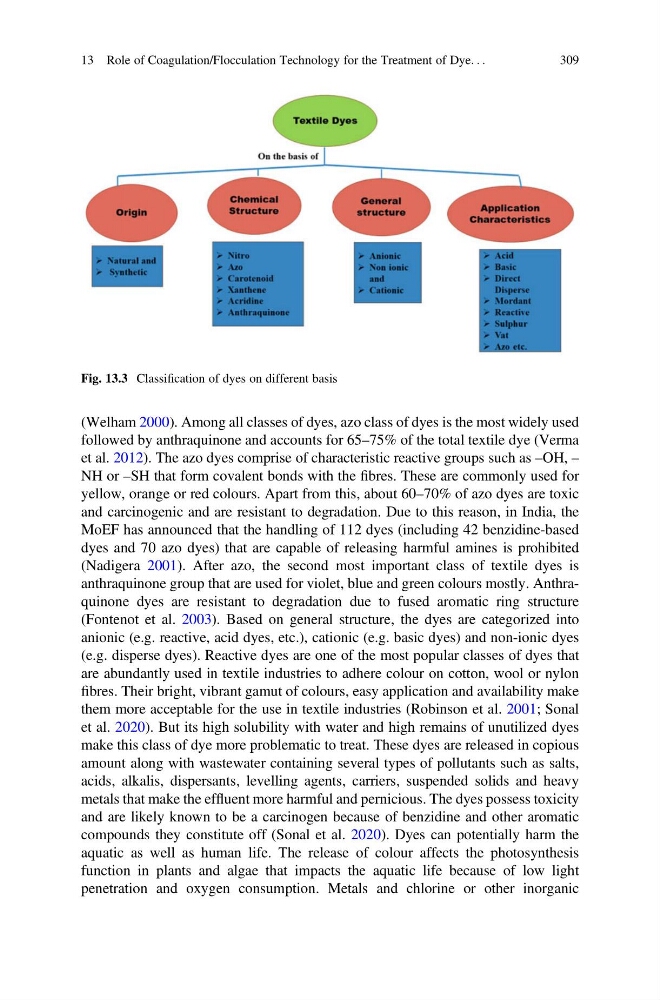
(Fontenot et al. 2003). Based on general structure, the dyes are categorized into
anionic (e.g. reactive, acid dyes, etc.), cationic (e.g. basic dyes) and non-ionic dyes
(e.g. disperse dyes). Reactive dyes are one of the most popular classes of dyes that
are abundantly used in textile industries to adhere colour on cotton, wool or nylon
fibres. Their bright, vibrant gamut of colours, easy application and availability make
them more acceptable for the use in textile industries (Robinson et al. 2001; Sonal
et al. 2020). But its high solubility with water and high remains of unutilized dyes
make this class of dye more problematic to treat. These dyes are released in copious
amount along with wastewater containing several types of pollutants such as salts,
acids, alkalis, dispersants, levelling agents, carriers, suspended solids and heavy
metals that make the effluent more harmful and pernicious. The dyes possess toxicity
and are likely known to be a carcinogen because of benzidine and other aromatic
compounds they constitute off (Sonal et al. 2020). Dyes can potentially harm the
aquatic as well as human life. The release of colour affects the photosynthesis
function in plants and algae that impacts the aquatic life because of low light
penetration and oxygen consumption. Metals and chlorine or other inorganic
Fig. 13.3 Classification of dyes on different basis
13 Role of Coagulation/Flocculation Technology for the Treatment of Dye. . .
309
followed by anthraquinone and accounts for 65–75% of the total textile dye (Verma
et al. 2012). The azo dyes comprise of characteristic reactive groups such as –OH, –
NH or –SH that form covalent bonds with the fibres. These are commonly used for
yellow, orange or red colours. Apart from this, about 60–70% of azo dyes are toxic
and carcinogenic and are resistant to degradation. Due to this reason, in India, the
MoEF has announced that the handling of 112 dyes (including 42 benzidine-based
dyes and 70 azo dyes) that are capable of releasing harmful amines is prohibited
(Nadigera 2001). After azo, the second most important class of textile dyes is
anthraquinone group that are used for violet, blue and green colours mostly. Anthraquinone dyes are resistant to degradation due to fused aromatic ring structure
(Fontenot et al. 2003). Based on general structure, the dyes are categorized into
anionic (e.g. reactive, acid dyes, etc.), cationic (e.g. basic dyes) and non-ionic dyes
(e.g. disperse dyes). Reactive dyes are one of the most popular classes of dyes that
are abundantly used in textile industries to adhere colour on cotton, wool or nylon
fibres. Their bright, vibrant gamut of colours, easy application and availability make
them more acceptable for the use in textile industries (Robinson et al. 2001; Sonal
et al. 2020). But its high solubility with water and high remains of unutilized dyes
make this class of dye more problematic to treat. These dyes are released in copious
amount along with wastewater containing several types of pollutants such as salts,
acids, alkalis, dispersants, levelling agents, carriers, suspended solids and heavy
metals that make the effluent more harmful and pernicious. The dyes possess toxicity
and are likely known to be a carcinogen because of benzidine and other aromatic
compounds they constitute off (Sonal et al. 2020). Dyes can potentially harm the
aquatic as well as human life. The release of colour affects the photosynthesis
function in plants and algae that impacts the aquatic life because of low light
penetration and oxygen consumption. Metals and chlorine or other inorganic
Fig. 13.3 Classification of dyes on different basis
13 Role of Coagulation/Flocculation Technology for the Treatment of Dye. . .
309