

formed of coarse-grained alluvial sediments, it allows complex microbial assemblage and metazoan biota (Huggenberger et al. 1998). It is the three processes, viz.
erosion, transportation and deposition, which determine the structure of fluvial forms
and hydrogeological properties, thus governing the connectivity between surrounding landscape to the drainage network (Huggenberger et al. 1998). The morphological attributes, viz. length, gradient and shape of the runoff area and that of upstream
of riparian ecotone, affect the pollutant removal capacity (Norris 1993). For example, in a convex slope, the upland flow is faster than the concave slope (Norris 1993).
Recently, Pinay et al. (2018) stated that along the river continuum, we could
determine three distinct geomorphic characteristics, viz. in the headwater, in the
middle reaches and in the lower reaches. These physical or geologic features control
the distribution of grain sizes as well as successional dynamics and structure of
vegetation communities along the river continuum (Gregory et al. 1991). The
headwaters, which are steep, have constrained valleys with high erosional rate and
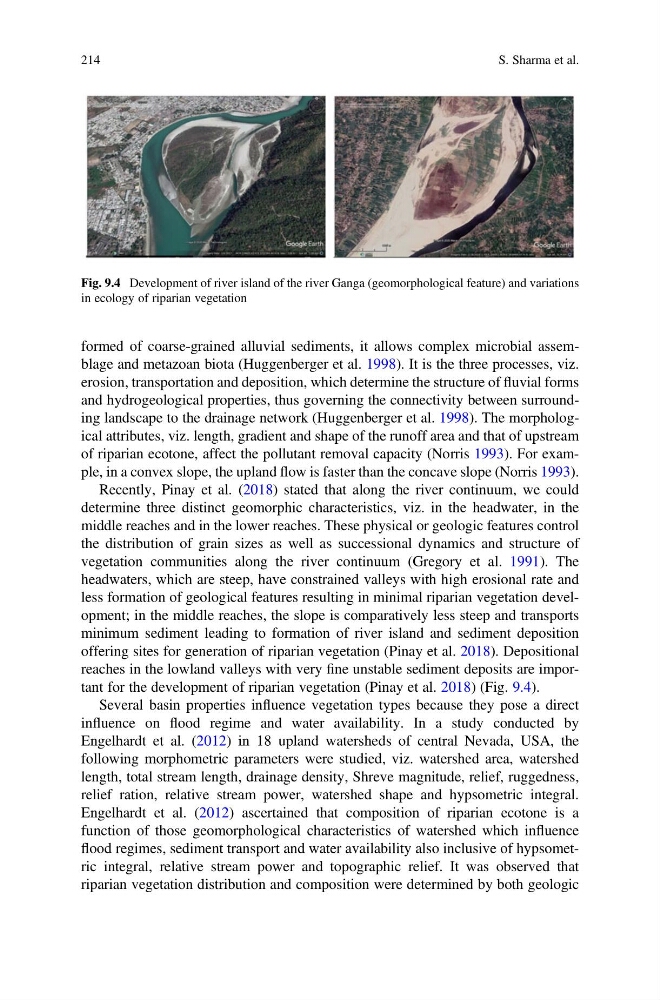
less formation of geological features resulting in minimal riparian vegetation development; in the middle reaches, the slope is comparatively less steep and transports
minimum sediment leading to formation of river island and sediment deposition
offering sites for generation of riparian vegetation (Pinay et al. 2018). Depositional
reaches in the lowland valleys with very fine unstable sediment deposits are important for the development of riparian vegetation (Pinay et al. 2018) (Fig. 9.4).
Several basin properties influence vegetation types because they pose a direct
influence on flood regime and water availability. In a study conducted by
Engelhardt et al. (2012) in 18 upland watersheds of central Nevada, USA, the
following morphometric parameters were studied, viz. watershed area, watershed
length, total stream length, drainage density, Shreve magnitude, relief, ruggedness,
relief ration, relative stream power, watershed shape and hypsometric integral.
Engelhardt et al. (2012) ascertained that composition of riparian ecotone is a
function of those geomorphological characteristics of watershed which influence
flood regimes, sediment transport and water availability also inclusive of hypsometric integral, relative stream power and topographic relief. It was observed that
riparian vegetation distribution and composition were determined by both geologic
Fig. 9.4 Development of river island of the river Ganga (geomorphological feature) and variations
in ecology of riparian vegetation
214
S. Sharma et al.
erosion, transportation and deposition, which determine the structure of fluvial forms
and hydrogeological properties, thus governing the connectivity between surrounding landscape to the drainage network (Huggenberger et al. 1998). The morphological attributes, viz. length, gradient and shape of the runoff area and that of upstream
of riparian ecotone, affect the pollutant removal capacity (Norris 1993). For example, in a convex slope, the upland flow is faster than the concave slope (Norris 1993).
Recently, Pinay et al. (2018) stated that along the river continuum, we could
determine three distinct geomorphic characteristics, viz. in the headwater, in the
middle reaches and in the lower reaches. These physical or geologic features control
the distribution of grain sizes as well as successional dynamics and structure of
vegetation communities along the river continuum (Gregory et al. 1991). The
headwaters, which are steep, have constrained valleys with high erosional rate and
less formation of geological features resulting in minimal riparian vegetation development; in the middle reaches, the slope is comparatively less steep and transports
minimum sediment leading to formation of river island and sediment deposition
offering sites for generation of riparian vegetation (Pinay et al. 2018). Depositional
reaches in the lowland valleys with very fine unstable sediment deposits are important for the development of riparian vegetation (Pinay et al. 2018) (Fig. 9.4).
Several basin properties influence vegetation types because they pose a direct
influence on flood regime and water availability. In a study conducted by
Engelhardt et al. (2012) in 18 upland watersheds of central Nevada, USA, the
following morphometric parameters were studied, viz. watershed area, watershed
length, total stream length, drainage density, Shreve magnitude, relief, ruggedness,
relief ration, relative stream power, watershed shape and hypsometric integral.
Engelhardt et al. (2012) ascertained that composition of riparian ecotone is a
function of those geomorphological characteristics of watershed which influence
flood regimes, sediment transport and water availability also inclusive of hypsometric integral, relative stream power and topographic relief. It was observed that
riparian vegetation distribution and composition were determined by both geologic
Fig. 9.4 Development of river island of the river Ganga (geomorphological feature) and variations
in ecology of riparian vegetation
214
S. Sharma et al.