

9.4.2 Filtration
The riparian ecotone acts as filter for the river; Pinay et al. (2018) have termed it as a
“skin for the river”. The water draining downwards via riparian ecotone undergoes
natural filtration process for the absorption and adsorption of sediments, pollutants,
etc. The process of filtration takes place by the vegetation (Luke et al. 2007) and
microbial fauna present in the riparian ecotone (Silvan et al. 2002; Palviainen et al.
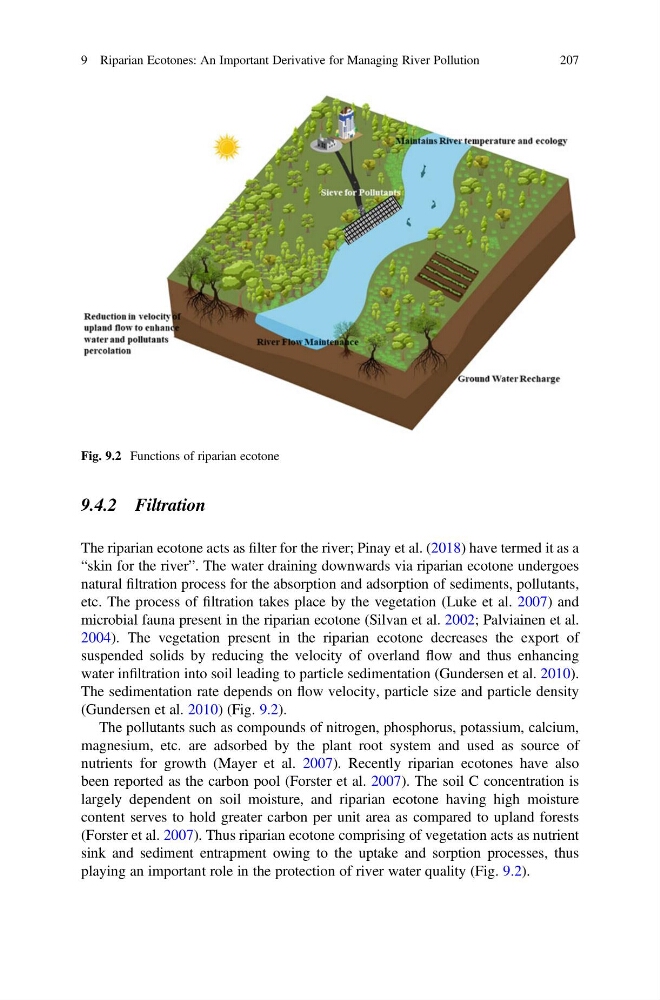
2004). The vegetation present in the riparian ecotone decreases the export of
suspended solids by reducing the velocity of overland flow and thus enhancing
water infiltration into soil leading to particle sedimentation (Gundersen et al. 2010).
The sedimentation rate depends on flow velocity, particle size and particle density
(Gundersen et al. 2010) (Fig. 9.2).
The pollutants such as compounds of nitrogen, phosphorus, potassium, calcium,
magnesium, etc. are adsorbed by the plant root system and used as source of
nutrients for growth (Mayer et al. 2007). Recently riparian ecotones have also
been reported as the carbon pool (Forster et al. 2007). The soil C concentration is
largely dependent on soil moisture, and riparian ecotone having high moisture
content serves to hold greater carbon per unit area as compared to upland forests
(Forster et al. 2007). Thus riparian ecotone comprising of vegetation acts as nutrient
sink and sediment entrapment owing to the uptake and sorption processes, thus
playing an important role in the protection of river water quality (Fig. 9.2).
Fig. 9.2 Functions of riparian ecotone
9 Riparian Ecotones: An Important Derivative for Managing River Pollution
207
The riparian ecotone acts as filter for the river; Pinay et al. (2018) have termed it as a
“skin for the river”. The water draining downwards via riparian ecotone undergoes
natural filtration process for the absorption and adsorption of sediments, pollutants,
etc. The process of filtration takes place by the vegetation (Luke et al. 2007) and
microbial fauna present in the riparian ecotone (Silvan et al. 2002; Palviainen et al.
2004). The vegetation present in the riparian ecotone decreases the export of
suspended solids by reducing the velocity of overland flow and thus enhancing
water infiltration into soil leading to particle sedimentation (Gundersen et al. 2010).
The sedimentation rate depends on flow velocity, particle size and particle density
(Gundersen et al. 2010) (Fig. 9.2).
The pollutants such as compounds of nitrogen, phosphorus, potassium, calcium,
magnesium, etc. are adsorbed by the plant root system and used as source of
nutrients for growth (Mayer et al. 2007). Recently riparian ecotones have also
been reported as the carbon pool (Forster et al. 2007). The soil C concentration is
largely dependent on soil moisture, and riparian ecotone having high moisture
content serves to hold greater carbon per unit area as compared to upland forests
(Forster et al. 2007). Thus riparian ecotone comprising of vegetation acts as nutrient
sink and sediment entrapment owing to the uptake and sorption processes, thus
playing an important role in the protection of river water quality (Fig. 9.2).
Fig. 9.2 Functions of riparian ecotone
9 Riparian Ecotones: An Important Derivative for Managing River Pollution
207