

However, in the literature, the riparian ecotone has mostly been discussed in terms of
vegetation type, and it is the vegetation which is of importance and mainly
researched and discussed. However, Zaimes et al. (2010) ascertain that the riparian
ecotone possesses the following common characteristics:
1. The land along the river or fluvial system comprising of distinct vegetation type
influencing and being influenced by the various physicochemical and biological
interactions between the vegetation, land and water.
2. This ecotone sometime is encompassed within the floodplain or sometime may
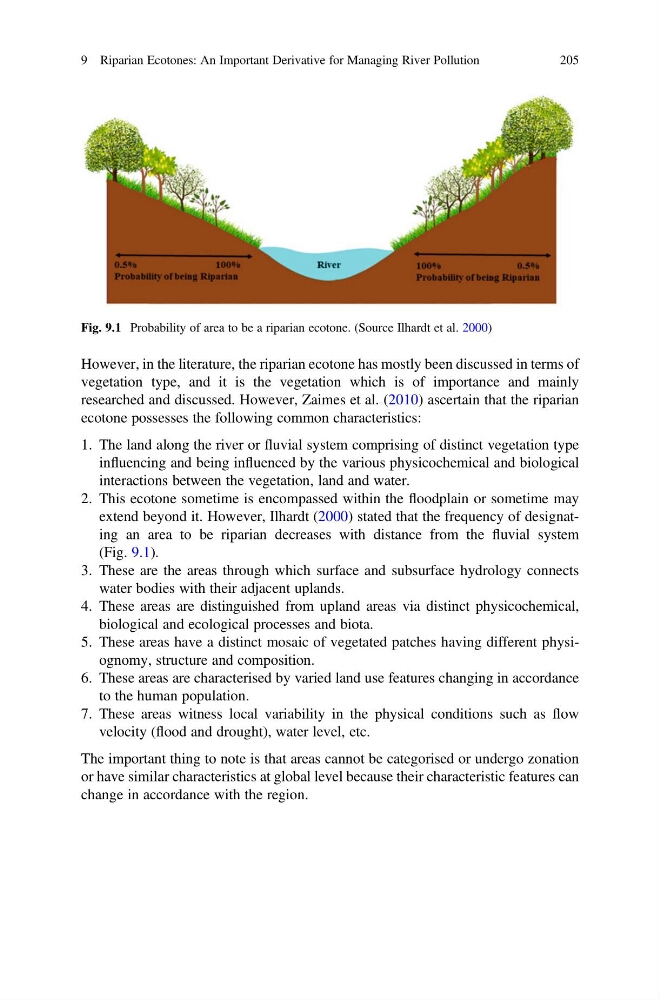
extend beyond it. However, Ilhardt (2000) stated that the frequency of designating an area to be riparian decreases with distance from the fluvial system
(Fig. 9.1).
3. These are the areas through which surface and subsurface hydrology connects
water bodies with their adjacent uplands.
4. These areas are distinguished from upland areas via distinct physicochemical,
biological and ecological processes and biota.
5. These areas have a distinct mosaic of vegetated patches having different physiognomy, structure and composition.
6. These areas are characterised by varied land use features changing in accordance
to the human population.
7. These areas witness local variability in the physical conditions such as flow
velocity (flood and drought), water level, etc.
The important thing to note is that areas cannot be categorised or undergo zonation
or have similar characteristics at global level because their characteristic features can
change in accordance with the region.
Fig. 9.1 Probability of area to be a riparian ecotone. (Source Ilhardt et al. 2000)
9 Riparian Ecotones: An Important Derivative for Managing River Pollution
205
vegetation type, and it is the vegetation which is of importance and mainly
researched and discussed. However, Zaimes et al. (2010) ascertain that the riparian
ecotone possesses the following common characteristics:
1. The land along the river or fluvial system comprising of distinct vegetation type
influencing and being influenced by the various physicochemical and biological
interactions between the vegetation, land and water.
2. This ecotone sometime is encompassed within the floodplain or sometime may
extend beyond it. However, Ilhardt (2000) stated that the frequency of designating an area to be riparian decreases with distance from the fluvial system
(Fig. 9.1).
3. These are the areas through which surface and subsurface hydrology connects
water bodies with their adjacent uplands.
4. These areas are distinguished from upland areas via distinct physicochemical,
biological and ecological processes and biota.
5. These areas have a distinct mosaic of vegetated patches having different physiognomy, structure and composition.
6. These areas are characterised by varied land use features changing in accordance
to the human population.
7. These areas witness local variability in the physical conditions such as flow
velocity (flood and drought), water level, etc.
The important thing to note is that areas cannot be categorised or undergo zonation
or have similar characteristics at global level because their characteristic features can
change in accordance with the region.
Fig. 9.1 Probability of area to be a riparian ecotone. (Source Ilhardt et al. 2000)
9 Riparian Ecotones: An Important Derivative for Managing River Pollution
205