

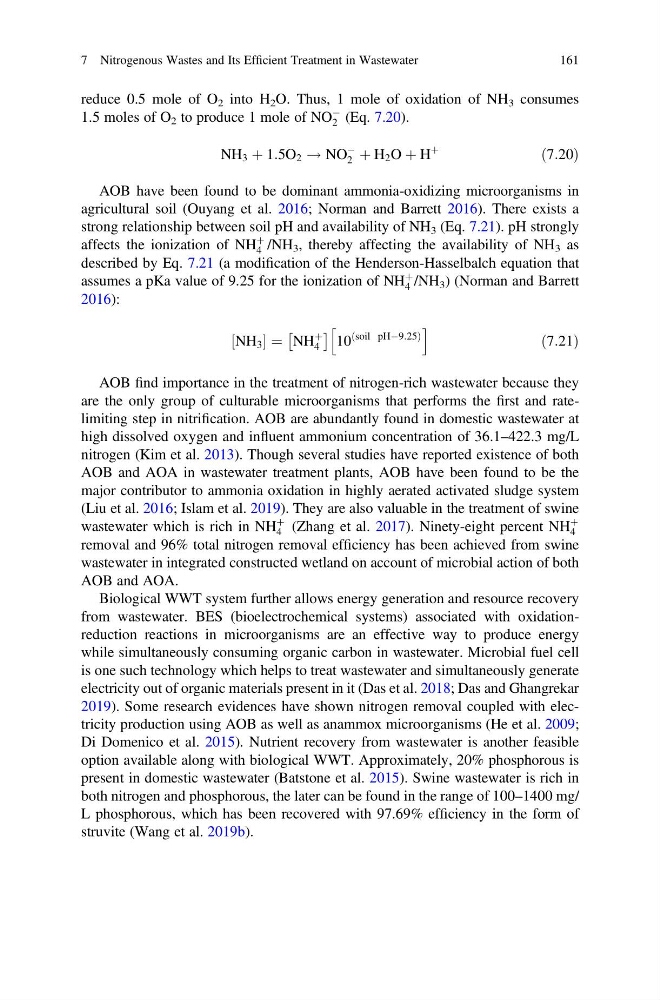
reduce 0.5 mole of O 2 into H 2 O. Thus, 1 mole of oxidation of NH 3 consumes
1.5 moles of O 2 to produce 1 mole of NO
À
2 (Eq. 7.20).
NH 3 þ 1:5O 2 ! NO
À
2 þ H 2 O þ H
þ
ð7:20Þ
AOB have been found to be dominant ammonia-oxidizing microorganisms in
agricultural soil (Ouyang et al. 2016; Norman and Barrett 2016). There exists a
strong relationship between soil pH and availability of NH 3 (Eq. 7.21). pH strongly
affects the ionization of NH
þ
4 /NH 3 , thereby affecting the availability of NH 3 as
described by Eq. 7.21 (a modification of the Henderson-Hasselbalch equation that
assumes a pKa value of 9.25 for the ionization of NH
þ
4 /NH 3 ) (Norman and Barrett
2016):
NH 3
½
¼ NH
þ
4
Â
Ã
10
soil pHÀ9:25
ð
Þ
h
i
ð7:21Þ
AOB find importance in the treatment of nitrogen-rich wastewater because they
are the only group of culturable microorganisms that performs the first and ratelimiting step in nitrification. AOB are abundantly found in domestic wastewater at
high dissolved oxygen and influent ammonium concentration of 36.1–422.3 mg/L
nitrogen (Kim et al. 2013). Though several studies have reported existence of both
AOB and AOA in wastewater treatment plants, AOB have been found to be the
major contributor to ammonia oxidation in highly aerated activated sludge system
(Liu et al. 2016; Islam et al. 2019). They are also valuable in the treatment of swine
wastewater which is rich in NH
þ
4 (Zhang et al. 2017). Ninety-eight percent NH
þ
4
removal and 96% total nitrogen removal efficiency has been achieved from swine
wastewater in integrated constructed wetland on account of microbial action of both
AOB and AOA.
Biological WWT system further allows energy generation and resource recovery
from wastewater. BES (bioelectrochemical systems) associated with oxidationreduction reactions in microorganisms are an effective way to produce energy
while simultaneously consuming organic carbon in wastewater. Microbial fuel cell
is one such technology which helps to treat wastewater and simultaneously generate
electricity out of organic materials present in it (Das et al. 2018; Das and Ghangrekar
2019). Some research evidences have shown nitrogen removal coupled with electricity production using AOB as well as anammox microorganisms (He et al. 2009;
Di Domenico et al. 2015). Nutrient recovery from wastewater is another feasible
option available along with biological WWT. Approximately, 20% phosphorous is
present in domestic wastewater (Batstone et al. 2015). Swine wastewater is rich in
both nitrogen and phosphorous, the later can be found in the range of 100–1400 mg/
L phosphorous, which has been recovered with 97.69% efficiency in the form of
struvite (Wang et al. 2019b).
7 Nitrogenous Wastes and Its Efficient Treatment in Wastewater
161
1.5 moles of O 2 to produce 1 mole of NO
À
2 (Eq. 7.20).
NH 3 þ 1:5O 2 ! NO
À
2 þ H 2 O þ H
þ
ð7:20Þ
AOB have been found to be dominant ammonia-oxidizing microorganisms in
agricultural soil (Ouyang et al. 2016; Norman and Barrett 2016). There exists a
strong relationship between soil pH and availability of NH 3 (Eq. 7.21). pH strongly
affects the ionization of NH
þ
4 /NH 3 , thereby affecting the availability of NH 3 as
described by Eq. 7.21 (a modification of the Henderson-Hasselbalch equation that
assumes a pKa value of 9.25 for the ionization of NH
þ
4 /NH 3 ) (Norman and Barrett
2016):
NH 3
½
¼ NH
þ
4
Â
Ã
10
soil pHÀ9:25
ð
Þ
h
i
ð7:21Þ
AOB find importance in the treatment of nitrogen-rich wastewater because they
are the only group of culturable microorganisms that performs the first and ratelimiting step in nitrification. AOB are abundantly found in domestic wastewater at
high dissolved oxygen and influent ammonium concentration of 36.1–422.3 mg/L
nitrogen (Kim et al. 2013). Though several studies have reported existence of both
AOB and AOA in wastewater treatment plants, AOB have been found to be the
major contributor to ammonia oxidation in highly aerated activated sludge system
(Liu et al. 2016; Islam et al. 2019). They are also valuable in the treatment of swine
wastewater which is rich in NH
þ
4 (Zhang et al. 2017). Ninety-eight percent NH
þ
4
removal and 96% total nitrogen removal efficiency has been achieved from swine
wastewater in integrated constructed wetland on account of microbial action of both
AOB and AOA.
Biological WWT system further allows energy generation and resource recovery
from wastewater. BES (bioelectrochemical systems) associated with oxidationreduction reactions in microorganisms are an effective way to produce energy
while simultaneously consuming organic carbon in wastewater. Microbial fuel cell
is one such technology which helps to treat wastewater and simultaneously generate
electricity out of organic materials present in it (Das et al. 2018; Das and Ghangrekar
2019). Some research evidences have shown nitrogen removal coupled with electricity production using AOB as well as anammox microorganisms (He et al. 2009;
Di Domenico et al. 2015). Nutrient recovery from wastewater is another feasible
option available along with biological WWT. Approximately, 20% phosphorous is
present in domestic wastewater (Batstone et al. 2015). Swine wastewater is rich in
both nitrogen and phosphorous, the later can be found in the range of 100–1400 mg/
L phosphorous, which has been recovered with 97.69% efficiency in the form of
struvite (Wang et al. 2019b).
7 Nitrogenous Wastes and Its Efficient Treatment in Wastewater
161