

sp. sativus) showed more accumulation of Cd, Cu, Zn, Co, and Mn in their leaves.
Treated wastewater irrigated soil showed variations in enrichment factors with
decreasing trend like Zn > Ni > Pb > Cr > Cu > Co > Mn > Cd (Hussain et al.
2019).
6.3 Composition of Wastewater
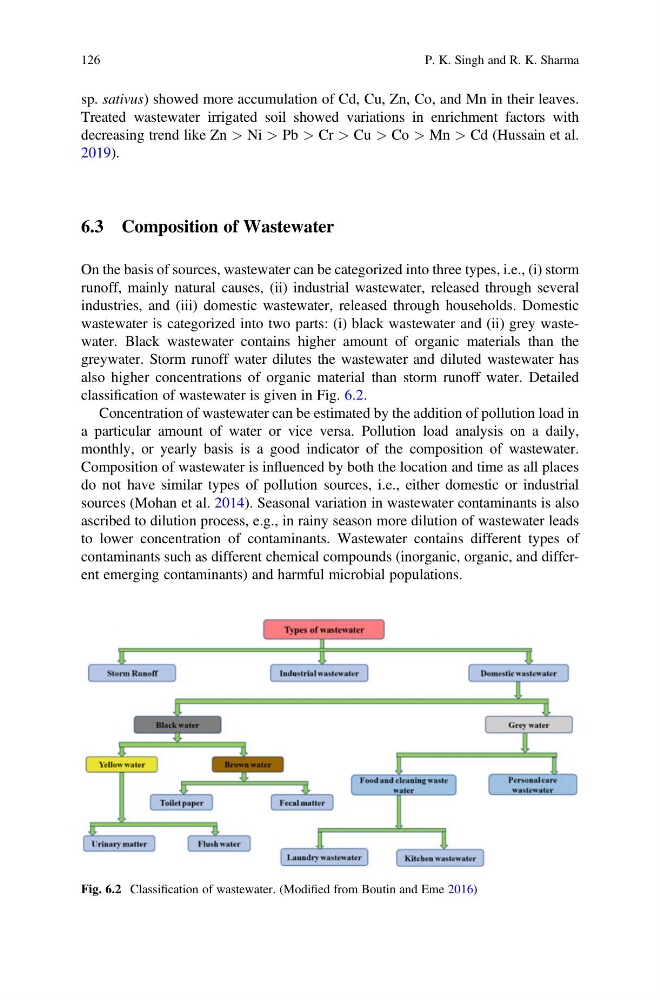
On the basis of sources, wastewater can be categorized into three types, i.e., (i) storm
runoff, mainly natural causes, (ii) industrial wastewater, released through several
industries, and (iii) domestic wastewater, released through households. Domestic
wastewater is categorized into two parts: (i) black wastewater and (ii) grey wastewater. Black wastewater contains higher amount of organic materials than the
greywater. Storm runoff water dilutes the wastewater and diluted wastewater has
also higher concentrations of organic material than storm runoff water. Detailed
classification of wastewater is given in Fig. 6.2.
Concentration of wastewater can be estimated by the addition of pollution load in
a particular amount of water or vice versa. Pollution load analysis on a daily,
monthly, or yearly basis is a good indicator of the composition of wastewater.
Composition of wastewater is influenced by both the location and time as all places
do not have similar types of pollution sources, i.e., either domestic or industrial
sources (Mohan et al. 2014). Seasonal variation in wastewater contaminants is also
ascribed to dilution process, e.g., in rainy season more dilution of wastewater leads
to lower concentration of contaminants. Wastewater contains different types of
contaminants such as different chemical compounds (inorganic, organic, and different emerging contaminants) and harmful microbial populations.
Fig. 6.2 Classification of wastewater. (Modified from Boutin and Eme 2016)
126
P. K. Singh and R. K. Sharma
Treated wastewater irrigated soil showed variations in enrichment factors with
decreasing trend like Zn > Ni > Pb > Cr > Cu > Co > Mn > Cd (Hussain et al.
2019).
6.3 Composition of Wastewater
On the basis of sources, wastewater can be categorized into three types, i.e., (i) storm
runoff, mainly natural causes, (ii) industrial wastewater, released through several
industries, and (iii) domestic wastewater, released through households. Domestic
wastewater is categorized into two parts: (i) black wastewater and (ii) grey wastewater. Black wastewater contains higher amount of organic materials than the
greywater. Storm runoff water dilutes the wastewater and diluted wastewater has
also higher concentrations of organic material than storm runoff water. Detailed
classification of wastewater is given in Fig. 6.2.
Concentration of wastewater can be estimated by the addition of pollution load in
a particular amount of water or vice versa. Pollution load analysis on a daily,
monthly, or yearly basis is a good indicator of the composition of wastewater.
Composition of wastewater is influenced by both the location and time as all places
do not have similar types of pollution sources, i.e., either domestic or industrial
sources (Mohan et al. 2014). Seasonal variation in wastewater contaminants is also
ascribed to dilution process, e.g., in rainy season more dilution of wastewater leads
to lower concentration of contaminants. Wastewater contains different types of
contaminants such as different chemical compounds (inorganic, organic, and different emerging contaminants) and harmful microbial populations.
Fig. 6.2 Classification of wastewater. (Modified from Boutin and Eme 2016)
126
P. K. Singh and R. K. Sharma