

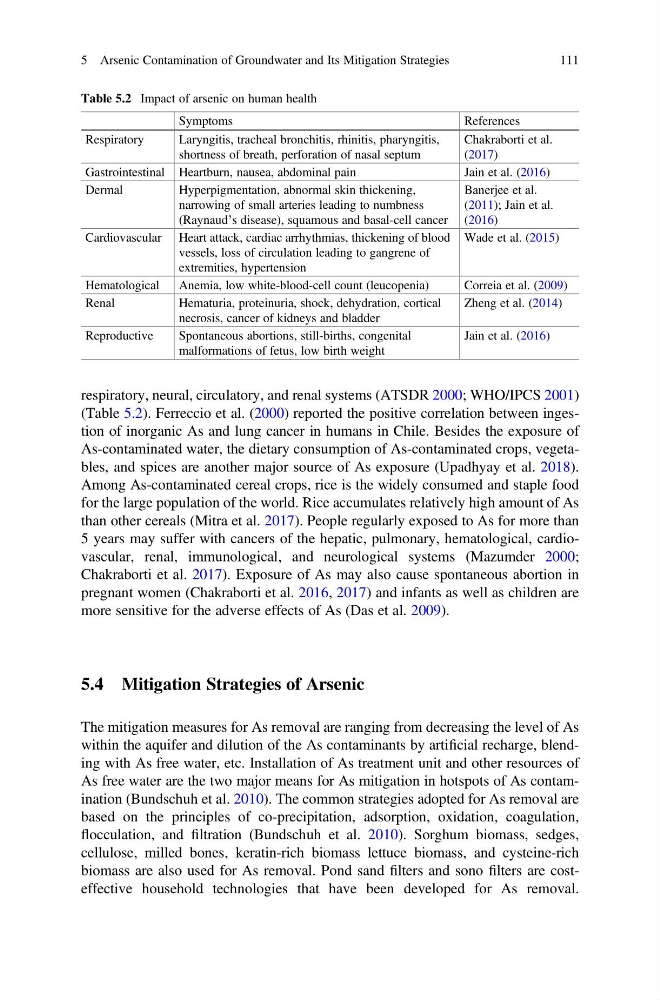
respiratory, neural, circulatory, and renal systems (ATSDR 2000; WHO/IPCS 2001)
(Table 5.2). Ferreccio et al. (2000) reported the positive correlation between ingestion of inorganic As and lung cancer in humans in Chile. Besides the exposure of
As-contaminated water, the dietary consumption of As-contaminated crops, vegetables, and spices are another major source of As exposure (Upadhyay et al. 2018).
Among As-contaminated cereal crops, rice is the widely consumed and staple food
for the large population of the world. Rice accumulates relatively high amount of As
than other cereals (Mitra et al. 2017). People regularly exposed to As for more than
5 years may suffer with cancers of the hepatic, pulmonary, hematological, cardiovascular, renal, immunological, and neurological systems (Mazumder 2000;
Chakraborti et al. 2017). Exposure of As may also cause spontaneous abortion in
pregnant women (Chakraborti et al. 2016, 2017) and infants as well as children are
more sensitive for the adverse effects of As (Das et al. 2009).
5.4 Mitigation Strategies of Arsenic
The mitigation measures for As removal are ranging from decreasing the level of As
within the aquifer and dilution of the As contaminants by artificial recharge, blending with As free water, etc. Installation of As treatment unit and other resources of
As free water are the two major means for As mitigation in hotspots of As contamination (Bundschuh et al. 2010). The common strategies adopted for As removal are
based on the principles of co-precipitation, adsorption, oxidation, coagulation,
flocculation, and filtration (Bundschuh et al. 2010). Sorghum biomass, sedges,
cellulose, milled bones, keratin-rich biomass lettuce biomass, and cysteine-rich
biomass are also used for As removal. Pond sand filters and sono filters are costeffective household technologies that have been developed for As removal.
Table 5.2 Impact of arsenic on human health
Symptoms
References
Respiratory
Laryngitis, tracheal bronchitis, rhinitis, pharyngitis,
shortness of breath, perforation of nasal septum
Chakraborti et al.
(2017)
Gastrointestinal Heartburn, nausea, abdominal pain
Jain et al. (2016)
Dermal
Hyperpigmentation, abnormal skin thickening,
narrowing of small arteries leading to numbness
(Raynaud’s disease), squamous and basal-cell cancer
Banerjee et al.
(2011); Jain et al.
(2016)
Cardiovascular Heart attack, cardiac arrhythmias, thickening of blood
vessels, loss of circulation leading to gangrene of
extremities, hypertension
Wade et al. (2015)
Hematological
Anemia, low white-blood-cell count (leucopenia)
Correia et al. (2009)
Renal
Hematuria, proteinuria, shock, dehydration, cortical
necrosis, cancer of kidneys and bladder
Zheng et al. (2014)
Reproductive
Spontaneous abortions, still-births, congenital
malformations of fetus, low birth weight
Jain et al. (2016)
5 Arsenic Contamination of Groundwater and Its Mitigation Strategies
111
(Table 5.2). Ferreccio et al. (2000) reported the positive correlation between ingestion of inorganic As and lung cancer in humans in Chile. Besides the exposure of
As-contaminated water, the dietary consumption of As-contaminated crops, vegetables, and spices are another major source of As exposure (Upadhyay et al. 2018).
Among As-contaminated cereal crops, rice is the widely consumed and staple food
for the large population of the world. Rice accumulates relatively high amount of As
than other cereals (Mitra et al. 2017). People regularly exposed to As for more than
5 years may suffer with cancers of the hepatic, pulmonary, hematological, cardiovascular, renal, immunological, and neurological systems (Mazumder 2000;
Chakraborti et al. 2017). Exposure of As may also cause spontaneous abortion in
pregnant women (Chakraborti et al. 2016, 2017) and infants as well as children are
more sensitive for the adverse effects of As (Das et al. 2009).
5.4 Mitigation Strategies of Arsenic
The mitigation measures for As removal are ranging from decreasing the level of As
within the aquifer and dilution of the As contaminants by artificial recharge, blending with As free water, etc. Installation of As treatment unit and other resources of
As free water are the two major means for As mitigation in hotspots of As contamination (Bundschuh et al. 2010). The common strategies adopted for As removal are
based on the principles of co-precipitation, adsorption, oxidation, coagulation,
flocculation, and filtration (Bundschuh et al. 2010). Sorghum biomass, sedges,
cellulose, milled bones, keratin-rich biomass lettuce biomass, and cysteine-rich
biomass are also used for As removal. Pond sand filters and sono filters are costeffective household technologies that have been developed for As removal.
Table 5.2 Impact of arsenic on human health
Symptoms
References
Respiratory
Laryngitis, tracheal bronchitis, rhinitis, pharyngitis,
shortness of breath, perforation of nasal septum
Chakraborti et al.
(2017)
Gastrointestinal Heartburn, nausea, abdominal pain
Jain et al. (2016)
Dermal
Hyperpigmentation, abnormal skin thickening,
narrowing of small arteries leading to numbness
(Raynaud’s disease), squamous and basal-cell cancer
Banerjee et al.
(2011); Jain et al.
(2016)
Cardiovascular Heart attack, cardiac arrhythmias, thickening of blood
vessels, loss of circulation leading to gangrene of
extremities, hypertension
Wade et al. (2015)
Hematological
Anemia, low white-blood-cell count (leucopenia)
Correia et al. (2009)
Renal
Hematuria, proteinuria, shock, dehydration, cortical
necrosis, cancer of kidneys and bladder
Zheng et al. (2014)
Reproductive
Spontaneous abortions, still-births, congenital
malformations of fetus, low birth weight
Jain et al. (2016)
5 Arsenic Contamination of Groundwater and Its Mitigation Strategies
111