

domestic and public supply data from 5219 water sources and incorporated 76 variables, including hydrologic, geologic, meteorological, geochemical, and land-use
factors (Ayotte et al. 2016). In a regional study in rural India, the authors developed a
simple regression model from 88 groundwater samples using hydrogeological and
topographic features (Singh et al. 2016). They found that the depth of tube wells,
flow direction of surface water, distance to rivers, and distance to drainage point
were the most important predictors of arsenic in groundwater (Singh et al. 2016).
The authors of another study developed a logistic regression model using ten
geohydrological and topographic features of 1498 water-sample collection points
in rural Burkina Faso (Bretzler et al. 2017). They found that volcanic-sedimentary
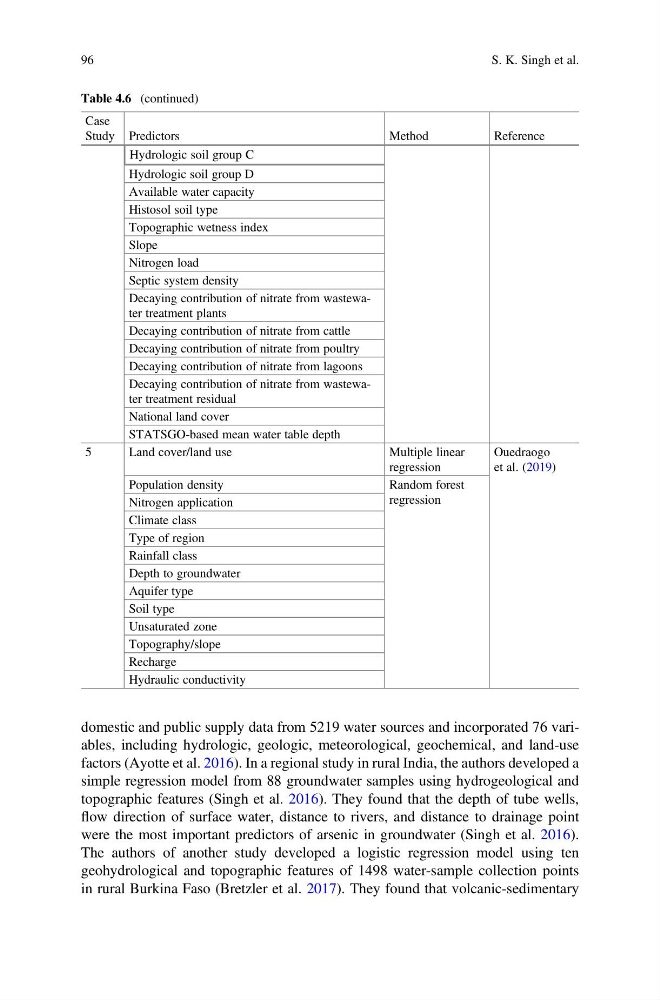
Table 4.6 (continued)
Case
Study Predictors
Method
Reference
Hydrologic soil group C
Hydrologic soil group D
Available water capacity
Histosol soil type
Topographic wetness index
Slope
Nitrogen load
Septic system density
Decaying contribution of nitrate from wastewater treatment plants
Decaying contribution of nitrate from cattle
Decaying contribution of nitrate from poultry
Decaying contribution of nitrate from lagoons
Decaying contribution of nitrate from wastewater treatment residual
National land cover
STATSGO-based mean water table depth
5
Land cover/land use
Multiple linear
regression
Ouedraogo
et al. (2019)
Population density
Random forest
regression
Nitrogen application
Climate class
Type of region
Rainfall class
Depth to groundwater
Aquifer type
Soil type
Unsaturated zone
Topography/slope
Recharge
Hydraulic conductivity
96
S. K. Singh et al.
factors (Ayotte et al. 2016). In a regional study in rural India, the authors developed a
simple regression model from 88 groundwater samples using hydrogeological and
topographic features (Singh et al. 2016). They found that the depth of tube wells,
flow direction of surface water, distance to rivers, and distance to drainage point
were the most important predictors of arsenic in groundwater (Singh et al. 2016).
The authors of another study developed a logistic regression model using ten
geohydrological and topographic features of 1498 water-sample collection points
in rural Burkina Faso (Bretzler et al. 2017). They found that volcanic-sedimentary
Table 4.6 (continued)
Case
Study Predictors
Method
Reference
Hydrologic soil group C
Hydrologic soil group D
Available water capacity
Histosol soil type
Topographic wetness index
Slope
Nitrogen load
Septic system density
Decaying contribution of nitrate from wastewater treatment plants
Decaying contribution of nitrate from cattle
Decaying contribution of nitrate from poultry
Decaying contribution of nitrate from lagoons
Decaying contribution of nitrate from wastewater treatment residual
National land cover
STATSGO-based mean water table depth
5
Land cover/land use
Multiple linear
regression
Ouedraogo
et al. (2019)
Population density
Random forest
regression
Nitrogen application
Climate class
Type of region
Rainfall class
Depth to groundwater
Aquifer type
Soil type
Unsaturated zone
Topography/slope
Recharge
Hydraulic conductivity
96
S. K. Singh et al.