

ratio, subsoil pH, topsoil clay content, and subsoil clay content were the strongest
predictors of arsenic in groundwater (Amini et al. 2008a). Cho et al. (2011) have
developed multiple linear regression, principal component regression, and artificial
neural network models, as well as models based on a combination of principal
components and artificial neural networks, using just 141 groundwater samples
collected from Cambodia, Laos, and Thailand. The significance of the geochemical
parameters used to develop these ML models varied between each model; however,
all variables were found to predict arsenic in the studied groundwater (Cho et al.
2011). In a relatively recent study, the authors utilized the conductivity, temperature,
redox, pH, well depth, and TDS of 350 groundwater samples collected from
Cambodia, Laos, and Thailand and to develop artificial neural network (ANN) and
support vector machine (SVM) ML models (Park et al. 2016). In another study, the
authors developed logistic regression and boosted regression tree models using
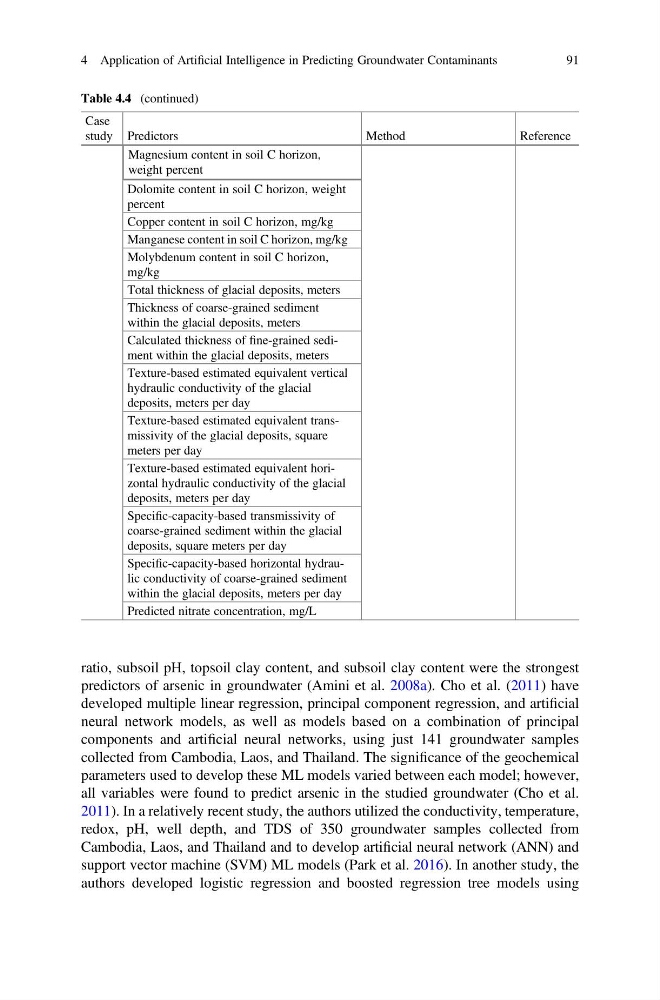
Table 4.4 (continued)
Case
study Predictors
Method
Reference
Magnesium content in soil C horizon,
weight percent
Dolomite content in soil C horizon, weight
percent
Copper content in soil C horizon, mg/kg
Manganese content in soil C horizon, mg/kg
Molybdenum content in soil C horizon,
mg/kg
Total thickness of glacial deposits, meters
Thickness of coarse-grained sediment
within the glacial deposits, meters
Calculated thickness of fine-grained sediment within the glacial deposits, meters
Texture-based estimated equivalent vertical
hydraulic conductivity of the glacial
deposits, meters per day
Texture-based estimated equivalent transmissivity of the glacial deposits, square
meters per day
Texture-based estimated equivalent horizontal hydraulic conductivity of the glacial
deposits, meters per day
Specific-capacity-based transmissivity of
coarse-grained sediment within the glacial
deposits, square meters per day
Specific-capacity-based horizontal hydraulic conductivity of coarse-grained sediment
within the glacial deposits, meters per day
Predicted nitrate concentration, mg/L
4 Application of Artificial Intelligence in Predicting Groundwater Contaminants
91
predictors of arsenic in groundwater (Amini et al. 2008a). Cho et al. (2011) have
developed multiple linear regression, principal component regression, and artificial
neural network models, as well as models based on a combination of principal
components and artificial neural networks, using just 141 groundwater samples
collected from Cambodia, Laos, and Thailand. The significance of the geochemical
parameters used to develop these ML models varied between each model; however,
all variables were found to predict arsenic in the studied groundwater (Cho et al.
2011). In a relatively recent study, the authors utilized the conductivity, temperature,
redox, pH, well depth, and TDS of 350 groundwater samples collected from
Cambodia, Laos, and Thailand and to develop artificial neural network (ANN) and
support vector machine (SVM) ML models (Park et al. 2016). In another study, the
authors developed logistic regression and boosted regression tree models using
Table 4.4 (continued)
Case
study Predictors
Method
Reference
Magnesium content in soil C horizon,
weight percent
Dolomite content in soil C horizon, weight
percent
Copper content in soil C horizon, mg/kg
Manganese content in soil C horizon, mg/kg
Molybdenum content in soil C horizon,
mg/kg
Total thickness of glacial deposits, meters
Thickness of coarse-grained sediment
within the glacial deposits, meters
Calculated thickness of fine-grained sediment within the glacial deposits, meters
Texture-based estimated equivalent vertical
hydraulic conductivity of the glacial
deposits, meters per day
Texture-based estimated equivalent transmissivity of the glacial deposits, square
meters per day
Texture-based estimated equivalent horizontal hydraulic conductivity of the glacial
deposits, meters per day
Specific-capacity-based transmissivity of
coarse-grained sediment within the glacial
deposits, square meters per day
Specific-capacity-based horizontal hydraulic conductivity of coarse-grained sediment
within the glacial deposits, meters per day
Predicted nitrate concentration, mg/L
4 Application of Artificial Intelligence in Predicting Groundwater Contaminants
91