

33
environmental concern in the twenty-first century. Hence, the obliteration of
persistent pesticides is essential to their sustained use.
2.1.1 S-Triazine Herbicides
Symmetrical triazine (s-triazine) relates to a large family of herbicides widely used
worldwide to control broadleaf weeds and annual grasses in various plantations,
residential lawns, and golf courses. The first triazine, chlorazine, was discovered in
1952 at J.R. Geigy Ltd. in Switzerland. Later in 1956, atrazine and simazine were
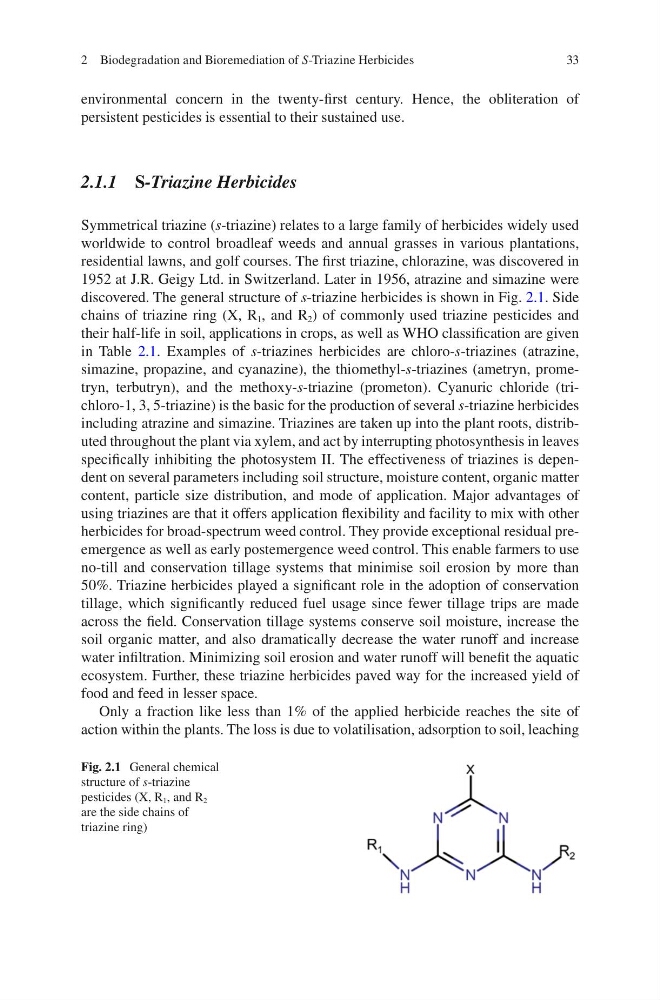
discovered. The general structure of s-triazine herbicides is shown in Fig. 2.1. Side
chains of triazine ring (X, R 1 , and R 2 ) of commonly used triazine pesticides and
their half-life in soil, applications in crops, as well as WHO classification are given
in Table 2.1. Examples of s-triazines herbicides are chloro-s-triazines (atrazine,
simazine, propazine, and cyanazine), the thiomethyl-s-triazines (ametryn, prometryn, terbutryn), and the methoxy-s-triazine (prometon). Cyanuric chloride (trichloro- 1, 3, 5-triazine) is the basic for the production of several s-triazine herbicides
including atrazine and simazine. Triazines are taken up into the plant roots, distributed throughout the plant via xylem, and act by interrupting photosynthesis in leaves
specifically inhibiting the photosystem II. The effectiveness of triazines is dependent on several parameters including soil structure, moisture content, organic matter
content, particle size distribution, and mode of application. Major advantages of
using triazines are that it offers application flexibility and facility to mix with other
herbicides for broad-spectrum weed control. They provide exceptional residual preemergence as well as early postemergence weed control. This enable farmers to use
no-till and conservation tillage systems that minimise soil erosion by more than
50%. Triazine herbicides played a significant role in the adoption of conservation
tillage, which significantly reduced fuel usage since fewer tillage trips are made
across the field. Conservation tillage systems conserve soil moisture, increase the
soil organic matter, and also dramatically decrease the water runoff and increase
water infiltration. Minimizing soil erosion and water runoff will benefit the aquatic
ecosystem. Further, these triazine herbicides paved way for the increased yield of
food and feed in lesser space.
Only a fraction like less than 1% of the applied herbicide reaches the site of
action within the plants. The loss is due to volatilisation, adsorption to soil, leaching
Fig. 2.1 General chemical
structure of s-triazine
pesticides (X, R 1 , and R 2
are the side chains of
triazine ring)
2 Biodegradation and Bioremediation of S-Triazine Herbicides
environmental concern in the twenty-first century. Hence, the obliteration of
persistent pesticides is essential to their sustained use.
2.1.1 S-Triazine Herbicides
Symmetrical triazine (s-triazine) relates to a large family of herbicides widely used
worldwide to control broadleaf weeds and annual grasses in various plantations,
residential lawns, and golf courses. The first triazine, chlorazine, was discovered in
1952 at J.R. Geigy Ltd. in Switzerland. Later in 1956, atrazine and simazine were
discovered. The general structure of s-triazine herbicides is shown in Fig. 2.1. Side
chains of triazine ring (X, R 1 , and R 2 ) of commonly used triazine pesticides and
their half-life in soil, applications in crops, as well as WHO classification are given
in Table 2.1. Examples of s-triazines herbicides are chloro-s-triazines (atrazine,
simazine, propazine, and cyanazine), the thiomethyl-s-triazines (ametryn, prometryn, terbutryn), and the methoxy-s-triazine (prometon). Cyanuric chloride (trichloro- 1, 3, 5-triazine) is the basic for the production of several s-triazine herbicides
including atrazine and simazine. Triazines are taken up into the plant roots, distributed throughout the plant via xylem, and act by interrupting photosynthesis in leaves
specifically inhibiting the photosystem II. The effectiveness of triazines is dependent on several parameters including soil structure, moisture content, organic matter
content, particle size distribution, and mode of application. Major advantages of
using triazines are that it offers application flexibility and facility to mix with other
herbicides for broad-spectrum weed control. They provide exceptional residual preemergence as well as early postemergence weed control. This enable farmers to use
no-till and conservation tillage systems that minimise soil erosion by more than
50%. Triazine herbicides played a significant role in the adoption of conservation
tillage, which significantly reduced fuel usage since fewer tillage trips are made
across the field. Conservation tillage systems conserve soil moisture, increase the
soil organic matter, and also dramatically decrease the water runoff and increase
water infiltration. Minimizing soil erosion and water runoff will benefit the aquatic
ecosystem. Further, these triazine herbicides paved way for the increased yield of
food and feed in lesser space.
Only a fraction like less than 1% of the applied herbicide reaches the site of
action within the plants. The loss is due to volatilisation, adsorption to soil, leaching
Fig. 2.1 General chemical
structure of s-triazine
pesticides (X, R 1 , and R 2
are the side chains of
triazine ring)
2 Biodegradation and Bioremediation of S-Triazine Herbicides