

16
Amorphous regions of plastics are more exposed to microbial attack and attachment
than internal structure and crystalline structures due to their structural and morphological complexity (Restrepo-Flórez et al. 2014). Microbial affinity and colonization over the polymer surface are the primary step in the degradation process
followed by the beginning of the biochemical pathway for chain fragmentation and
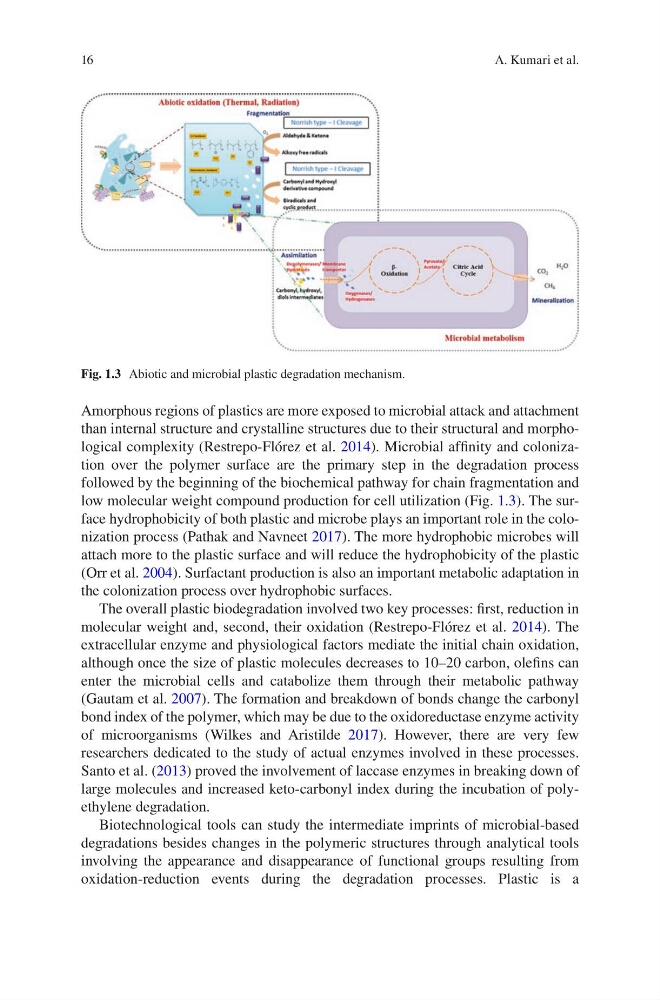
low molecular weight compound production for cell utilization (Fig. 1.3). The surface hydrophobicity of both plastic and microbe plays an important role in the colonization process (Pathak and Navneet 2017). The more hydrophobic microbes will
attach more to the plastic surface and will reduce the hydrophobicity of the plastic
(Orr et al. 2004). Surfactant production is also an important metabolic adaptation in
the colonization process over hydrophobic surfaces.
The overall plastic biodegradation involved two key processes: first, reduction in
molecular weight and, second, their oxidation (Restrepo-Flórez et al. 2014). The
extracellular enzyme and physiological factors mediate the initial chain oxidation,
although once the size of plastic molecules decreases to 10–20 carbon, olefins can
enter the microbial cells and catabolize them through their metabolic pathway
(Gautam et al. 2007). The formation and breakdown of bonds change the carbonyl
bond index of the polymer, which may be due to the oxidoreductase enzyme activity
of microorganisms (Wilkes and Aristilde 2017). However, there are very few
researchers dedicated to the study of actual enzymes involved in these processes.
Santo et al. (2013) proved the involvement of laccase enzymes in breaking down of
large molecules and increased keto-carbonyl index during the incubation of polyethylene degradation.
Biotechnological tools can study the intermediate imprints of microbial-based
degradations besides changes in the polymeric structures through analytical tools
involving the appearance and disappearance of functional groups resulting from
oxidation-reduction events during the degradation processes. Plastic is a
Fig. 1.3 Abiotic and microbial plastic degradation mechanism.
A. Kumari et al.
Amorphous regions of plastics are more exposed to microbial attack and attachment
than internal structure and crystalline structures due to their structural and morphological complexity (Restrepo-Flórez et al. 2014). Microbial affinity and colonization over the polymer surface are the primary step in the degradation process
followed by the beginning of the biochemical pathway for chain fragmentation and
low molecular weight compound production for cell utilization (Fig. 1.3). The surface hydrophobicity of both plastic and microbe plays an important role in the colonization process (Pathak and Navneet 2017). The more hydrophobic microbes will
attach more to the plastic surface and will reduce the hydrophobicity of the plastic
(Orr et al. 2004). Surfactant production is also an important metabolic adaptation in
the colonization process over hydrophobic surfaces.
The overall plastic biodegradation involved two key processes: first, reduction in
molecular weight and, second, their oxidation (Restrepo-Flórez et al. 2014). The
extracellular enzyme and physiological factors mediate the initial chain oxidation,
although once the size of plastic molecules decreases to 10–20 carbon, olefins can
enter the microbial cells and catabolize them through their metabolic pathway
(Gautam et al. 2007). The formation and breakdown of bonds change the carbonyl
bond index of the polymer, which may be due to the oxidoreductase enzyme activity
of microorganisms (Wilkes and Aristilde 2017). However, there are very few
researchers dedicated to the study of actual enzymes involved in these processes.
Santo et al. (2013) proved the involvement of laccase enzymes in breaking down of
large molecules and increased keto-carbonyl index during the incubation of polyethylene degradation.
Biotechnological tools can study the intermediate imprints of microbial-based
degradations besides changes in the polymeric structures through analytical tools
involving the appearance and disappearance of functional groups resulting from
oxidation-reduction events during the degradation processes. Plastic is a
Fig. 1.3 Abiotic and microbial plastic degradation mechanism.
A. Kumari et al.