

9
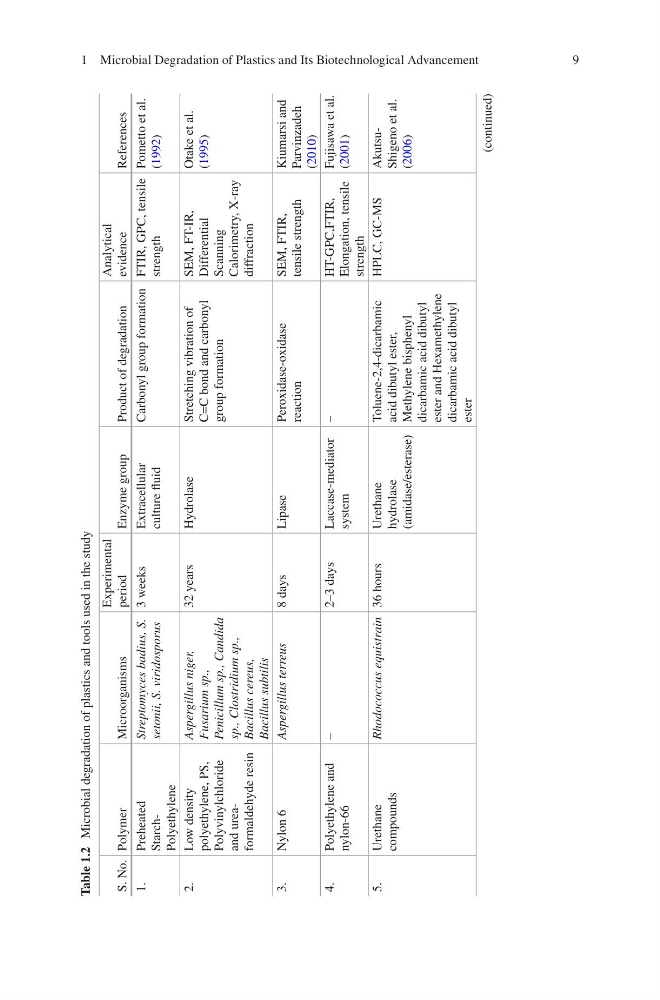
Table 1.2 Microbial degradation of plastics and tools used in the study
S. No. Polymer
Microorganisms
Experimental
period
Enzyme group
Product of degradation
Analytical
evidence
References
1.
Preheated
StarchPolyethylene
Streptomyces badius, S.
setonii, S. viridosporus
3 weeks
Extracellular
culture fluid
Carbonyl group formation FTIR, GPC, tensile
strength
Pometto et al.
(1992)
2.
Low density
polyethylene, PS,
Polyvinylchloride
and ureaformaldehyde resin
Aspergillus niger,
Fusarium sp.,
Penicillum sp., Candida
sp., Clostridium sp.,
Bacillus cereus,
Bacillus subtilis
32 years
Hydrolase
Stretching vibration of
C=C bond and carbonyl
group formation
SEM, FT-IR,
Differential
Scanning
Calorimetry, X-ray
diffraction
Otake et al.
(1995)
3.
Nylon 6
Aspergillus terreus
8 days
Lipase
Peroxidase-oxidase
reaction
SEM, FTIR,
tensile strength
Kiumarsi and
Parvinzadeh
(2010)
4.
Polyethylene and
nylon-66
–
2–3 days
Laccase-mediator
system
–
HT-GPC,FTIR,
Elongation, tensile
strength
Fujisawa et al.
(2001)
5.
Urethane
compounds
Rhodococcus equistrain
36 hours
Urethane
hydrolase
(amidase/esterase)
Toluene-2,4-dicarbamic
acid dibutyl ester,
Methylene bisphenyl
dicarbamic acid dibutyl
ester and Hexamethylene
dicarbamic acid dibutyl
ester
HPLC, GC-MS
AkutsuShigeno et al.
(2006)
(continued)
1 Microbial Degradation of Plastics and Its Biotechnological Advancement
Table 1.2 Microbial degradation of plastics and tools used in the study
S. No. Polymer
Microorganisms
Experimental
period
Enzyme group
Product of degradation
Analytical
evidence
References
1.
Preheated
StarchPolyethylene
Streptomyces badius, S.
setonii, S. viridosporus
3 weeks
Extracellular
culture fluid
Carbonyl group formation FTIR, GPC, tensile
strength
Pometto et al.
(1992)
2.
Low density
polyethylene, PS,
Polyvinylchloride
and ureaformaldehyde resin
Aspergillus niger,
Fusarium sp.,
Penicillum sp., Candida
sp., Clostridium sp.,
Bacillus cereus,
Bacillus subtilis
32 years
Hydrolase
Stretching vibration of
C=C bond and carbonyl
group formation
SEM, FT-IR,
Differential
Scanning
Calorimetry, X-ray
diffraction
Otake et al.
(1995)
3.
Nylon 6
Aspergillus terreus
8 days
Lipase
Peroxidase-oxidase
reaction
SEM, FTIR,
tensile strength
Kiumarsi and
Parvinzadeh
(2010)
4.
Polyethylene and
nylon-66
–
2–3 days
Laccase-mediator
system
–
HT-GPC,FTIR,
Elongation, tensile
strength
Fujisawa et al.
(2001)
5.
Urethane
compounds
Rhodococcus equistrain
36 hours
Urethane
hydrolase
(amidase/esterase)
Toluene-2,4-dicarbamic
acid dibutyl ester,
Methylene bisphenyl
dicarbamic acid dibutyl
ester and Hexamethylene
dicarbamic acid dibutyl
ester
HPLC, GC-MS
AkutsuShigeno et al.
(2006)
(continued)
1 Microbial Degradation of Plastics and Its Biotechnological Advancement