

173
Similarly, uncharged molecules like silica form scales. These lesser-soluble molecules dissociate highly polar water molecules to dissolve salts and lead to particulate scaling (Curcio et al. 2010). Among all scaling agents, calcium carbonate is one
of the most common scales in membrane distillation desalination systems, further
effecting the operating conditions in brackish, groundwater, and seawater desalination. Furthermore, CaCO 3 is a pervasive scale in both membrane distillation and
reverse osmosis desalination that readily reaches supersaturated conditions followed by the breakdown of bicarbonate HCO 3
−
, as shown in the equation below
(Curcio et al. 2010):
Ca
HCO
CaCO CO H O
2
3
3
2
2
2
+
→
+
+
Additionally, higher pH and carbonate concentration enhance scale formation in membrane distillation systems, proving the carbonate equilibrium and
scaling to be complex processes. Recent investigations make it evident that this
nonporous calcium carbonate scale in membrane distillation causes significant
water flux decline.
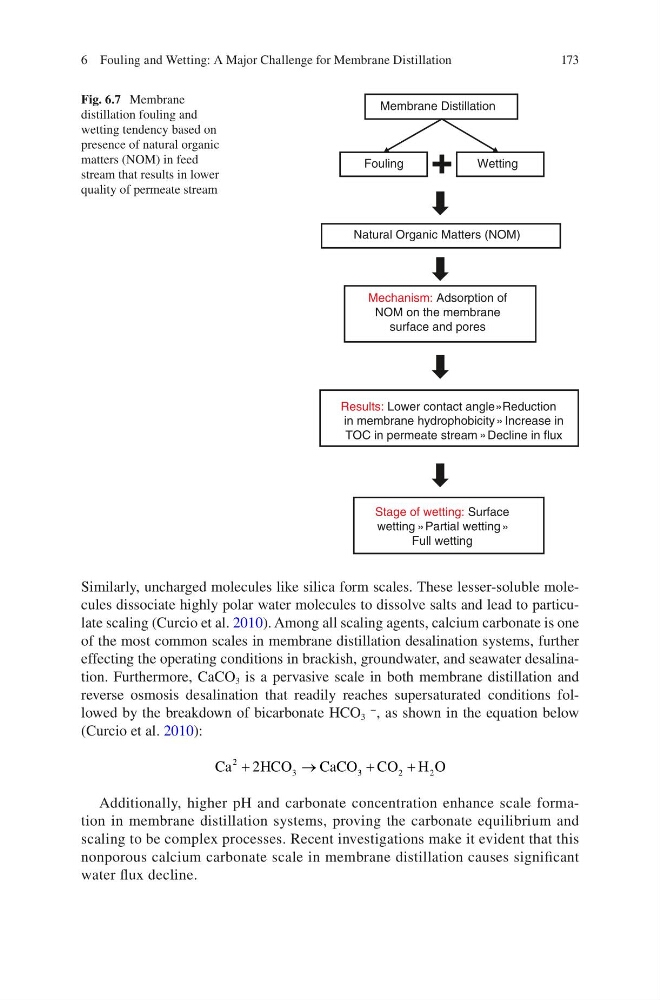
Membrane Distillation
Fouling
Wetting
Natural Organic Matters (NOM)
Mechanism: Adsorption of
NOM on the membrane
surface and pores
Results: Lower contact angle
«
«
«
Reduction
in membrane hydrophobicity Increase in
TOC in permeate stream Decline in flux
Stage of wetting: Surface
wetting Partial wetting
Full wetting
«
«
Fig. 6.7 Membrane
distillation fouling and
wetting tendency based on
presence of natural organic
matters (NOM) in feed
stream that results in lower
quality of permeate stream
6 Fouling and Wetting: A Major Challenge for Membrane Distillation
Similarly, uncharged molecules like silica form scales. These lesser-soluble molecules dissociate highly polar water molecules to dissolve salts and lead to particulate scaling (Curcio et al. 2010). Among all scaling agents, calcium carbonate is one
of the most common scales in membrane distillation desalination systems, further
effecting the operating conditions in brackish, groundwater, and seawater desalination. Furthermore, CaCO 3 is a pervasive scale in both membrane distillation and
reverse osmosis desalination that readily reaches supersaturated conditions followed by the breakdown of bicarbonate HCO 3
−
, as shown in the equation below
(Curcio et al. 2010):
Ca
HCO
CaCO CO H O
2
3
3
2
2
2
+
→
+
+
Additionally, higher pH and carbonate concentration enhance scale formation in membrane distillation systems, proving the carbonate equilibrium and
scaling to be complex processes. Recent investigations make it evident that this
nonporous calcium carbonate scale in membrane distillation causes significant
water flux decline.
Membrane Distillation
Fouling
Wetting
Natural Organic Matters (NOM)
Mechanism: Adsorption of
NOM on the membrane
surface and pores
Results: Lower contact angle
«
«
«
Reduction
in membrane hydrophobicity Increase in
TOC in permeate stream Decline in flux
Stage of wetting: Surface
wetting Partial wetting
Full wetting
«
«
Fig. 6.7 Membrane
distillation fouling and
wetting tendency based on
presence of natural organic
matters (NOM) in feed
stream that results in lower
quality of permeate stream
6 Fouling and Wetting: A Major Challenge for Membrane Distillation