

135
polyhydroxyalkanoates (Troschl et al. 2017). One of the limitations of cyanobacteria is their production of only scl-polyhydroxyalkanoates (Chee et al. 2010; Troschl
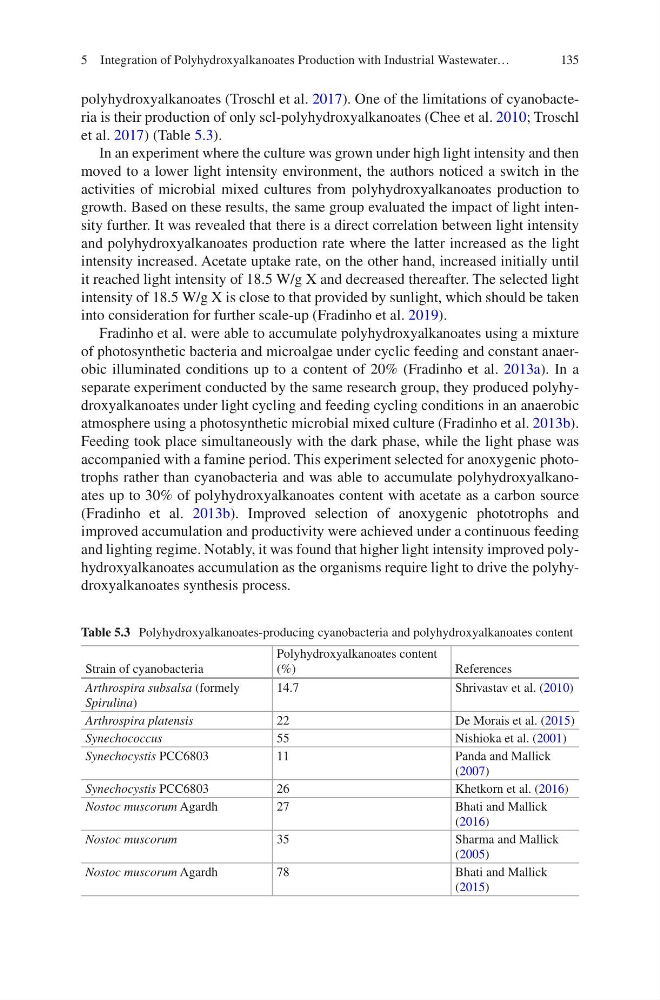
et al. 2017) (Table 5.3).
In an experiment where the culture was grown under high light intensity and then
moved to a lower light intensity environment, the authors noticed a switch in the
activities of microbial mixed cultures from polyhydroxyalkanoates production to
growth. Based on these results, the same group evaluated the impact of light intensity further. It was revealed that there is a direct correlation between light intensity
and polyhydroxyalkanoates production rate where the latter increased as the light
intensity increased. Acetate uptake rate, on the other hand, increased initially until
it reached light intensity of 18.5 W/g X and decreased thereafter. The selected light
intensity of 18.5 W/g X is close to that provided by sunlight, which should be taken
into consideration for further scale-up (Fradinho et al. 2019).
Fradinho et al. were able to accumulate polyhydroxyalkanoates using a mixture
of photosynthetic bacteria and microalgae under cyclic feeding and constant anaerobic illuminated conditions up to a content of 20% (Fradinho et al. 2013a). In a
separate experiment conducted by the same research group, they produced polyhydroxyalkanoates under light cycling and feeding cycling conditions in an anaerobic
atmosphere using a photosynthetic microbial mixed culture (Fradinho et al. 2013b).
Feeding took place simultaneously with the dark phase, while the light phase was
accompanied with a famine period. This experiment selected for anoxygenic phototrophs rather than cyanobacteria and was able to accumulate polyhydroxyalkanoates up to 30% of polyhydroxyalkanoates content with acetate as a carbon source
(Fradinho et al. 2013b). Improved selection of anoxygenic phototrophs and
improved accumulation and productivity were achieved under a continuous feeding
and lighting regime. Notably, it was found that higher light intensity improved polyhydroxyalkanoates accumulation as the organisms require light to drive the polyhydroxyalkanoates synthesis process.
Table 5.3 Polyhydroxyalkanoates-producing cyanobacteria and polyhydroxyalkanoates content
Strain of cyanobacteria
Polyhydroxyalkanoates content
(%)
References
Arthrospira subsalsa (formely
Spirulina)
14.7
Shrivastav et al. (2010)
Arthrospira platensis
22
De Morais et al. (2015)
Synechococcus
55
Nishioka et al. (2001)
Synechocystis PCC6803
11
Panda and Mallick
(2007)
Synechocystis PCC6803
26
Khetkorn et al. (2016)
Nostoc muscorum Agardh
27
Bhati and Mallick
(2016)
Nostoc muscorum
35
Sharma and Mallick
(2005)
Nostoc muscorum Agardh
78
Bhati and Mallick
(2015)
5 Integration of Polyhydroxyalkanoates Production with Industrial Wastewater…
polyhydroxyalkanoates (Troschl et al. 2017). One of the limitations of cyanobacteria is their production of only scl-polyhydroxyalkanoates (Chee et al. 2010; Troschl
et al. 2017) (Table 5.3).
In an experiment where the culture was grown under high light intensity and then
moved to a lower light intensity environment, the authors noticed a switch in the
activities of microbial mixed cultures from polyhydroxyalkanoates production to
growth. Based on these results, the same group evaluated the impact of light intensity further. It was revealed that there is a direct correlation between light intensity
and polyhydroxyalkanoates production rate where the latter increased as the light
intensity increased. Acetate uptake rate, on the other hand, increased initially until
it reached light intensity of 18.5 W/g X and decreased thereafter. The selected light
intensity of 18.5 W/g X is close to that provided by sunlight, which should be taken
into consideration for further scale-up (Fradinho et al. 2019).
Fradinho et al. were able to accumulate polyhydroxyalkanoates using a mixture
of photosynthetic bacteria and microalgae under cyclic feeding and constant anaerobic illuminated conditions up to a content of 20% (Fradinho et al. 2013a). In a
separate experiment conducted by the same research group, they produced polyhydroxyalkanoates under light cycling and feeding cycling conditions in an anaerobic
atmosphere using a photosynthetic microbial mixed culture (Fradinho et al. 2013b).
Feeding took place simultaneously with the dark phase, while the light phase was
accompanied with a famine period. This experiment selected for anoxygenic phototrophs rather than cyanobacteria and was able to accumulate polyhydroxyalkanoates up to 30% of polyhydroxyalkanoates content with acetate as a carbon source
(Fradinho et al. 2013b). Improved selection of anoxygenic phototrophs and
improved accumulation and productivity were achieved under a continuous feeding
and lighting regime. Notably, it was found that higher light intensity improved polyhydroxyalkanoates accumulation as the organisms require light to drive the polyhydroxyalkanoates synthesis process.
Table 5.3 Polyhydroxyalkanoates-producing cyanobacteria and polyhydroxyalkanoates content
Strain of cyanobacteria
Polyhydroxyalkanoates content
(%)
References
Arthrospira subsalsa (formely
Spirulina)
14.7
Shrivastav et al. (2010)
Arthrospira platensis
22
De Morais et al. (2015)
Synechococcus
55
Nishioka et al. (2001)
Synechocystis PCC6803
11
Panda and Mallick
(2007)
Synechocystis PCC6803
26
Khetkorn et al. (2016)
Nostoc muscorum Agardh
27
Bhati and Mallick
(2016)
Nostoc muscorum
35
Sharma and Mallick
(2005)
Nostoc muscorum Agardh
78
Bhati and Mallick
(2015)
5 Integration of Polyhydroxyalkanoates Production with Industrial Wastewater…