

112
degradation temperatures (Visakh 2014), which can be overcome by the incorporation of varied monomer units into the chain.
In order to improve the performance of polyhydroxyalkanoates and lower their
costs, various types of polyhydroxyalkanoates can be blended together or with other
types of biodegradable plastics such as polylactic acid and polycaprolactone. The
blending methodology enables the addition of new functionalities into the polymer
and limits its drawbacks, resulting in higher mechanical strength and improved surface features and amphiphilicity (Li et al. 2016; Visakh 2014). Additionally, blends
of polyhydroxybutyrate and polyhydroxybutyrate-co-3-hydroxyhexanoate prepared
by Yang et al. revealed a lower degree of crystallization (Yang et al. 2002), which
was later confirmed by the work of Lim et al. that prepared a blend of
polyhydroxybutyrate- co-3-hydroxyhexanoate and polycaprolactone (Lim et al.
2013). Another research group mixed polyhydroxybutyrate with starch, which
resulted in materials approved for usage in the medical field. They prepared a blend
of 30:70 ratio of starch to polyhydroxybutyrate, and characterization results revealed
a higher tensile strength compared to a pure polyhydroxybutyrate polymer (Godbole
et al. 2003). Experiments where cellulose derivatives were mixed with polyhydroxybutyrate revealed that as the concentration of polyhydroxybutyrate decreased
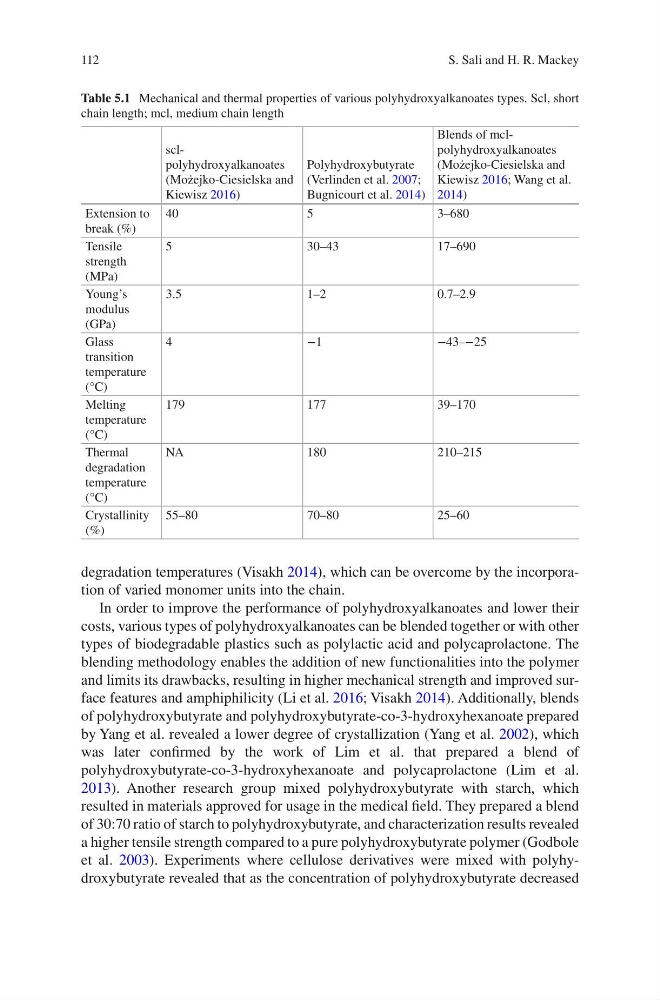
Table 5.1 Mechanical and thermal properties of various polyhydroxyalkanoates types. Scl, short
chain length; mcl, medium chain length
sclpolyhydroxyalkanoates
(Możejko-Ciesielska and
Kiewisz 2016)
Polyhydroxybutyrate
(Verlinden et al. 2007;
Bugnicourt et al. 2014)
Blends of mclpolyhydroxyalkanoates
(Możejko-Ciesielska and
Kiewisz 2016; Wang et al.
2014)
Extension to
break (%)
40
5
3–680
Tensile
strength
(MPa)
5
30–43
17–690
Young’s
modulus
(GPa)
3.5
1–2
0.7–2.9
Glass
transition
temperature
(°C)
4
−1
−43–−25
Melting
temperature
(°C)
179
177
39–170
Thermal
degradation
temperature
(°C)
NA
180
210–215
Crystallinity
(%)
55–80
70–80
25–60
S. Sali and H. R. Mackey
degradation temperatures (Visakh 2014), which can be overcome by the incorporation of varied monomer units into the chain.
In order to improve the performance of polyhydroxyalkanoates and lower their
costs, various types of polyhydroxyalkanoates can be blended together or with other
types of biodegradable plastics such as polylactic acid and polycaprolactone. The
blending methodology enables the addition of new functionalities into the polymer
and limits its drawbacks, resulting in higher mechanical strength and improved surface features and amphiphilicity (Li et al. 2016; Visakh 2014). Additionally, blends
of polyhydroxybutyrate and polyhydroxybutyrate-co-3-hydroxyhexanoate prepared
by Yang et al. revealed a lower degree of crystallization (Yang et al. 2002), which
was later confirmed by the work of Lim et al. that prepared a blend of
polyhydroxybutyrate- co-3-hydroxyhexanoate and polycaprolactone (Lim et al.
2013). Another research group mixed polyhydroxybutyrate with starch, which
resulted in materials approved for usage in the medical field. They prepared a blend
of 30:70 ratio of starch to polyhydroxybutyrate, and characterization results revealed
a higher tensile strength compared to a pure polyhydroxybutyrate polymer (Godbole
et al. 2003). Experiments where cellulose derivatives were mixed with polyhydroxybutyrate revealed that as the concentration of polyhydroxybutyrate decreased
Table 5.1 Mechanical and thermal properties of various polyhydroxyalkanoates types. Scl, short
chain length; mcl, medium chain length
sclpolyhydroxyalkanoates
(Możejko-Ciesielska and
Kiewisz 2016)
Polyhydroxybutyrate
(Verlinden et al. 2007;
Bugnicourt et al. 2014)
Blends of mclpolyhydroxyalkanoates
(Możejko-Ciesielska and
Kiewisz 2016; Wang et al.
2014)
Extension to
break (%)
40
5
3–680
Tensile
strength
(MPa)
5
30–43
17–690
Young’s
modulus
(GPa)
3.5
1–2
0.7–2.9
Glass
transition
temperature
(°C)
4
−1
−43–−25
Melting
temperature
(°C)
179
177
39–170
Thermal
degradation
temperature
(°C)
NA
180
210–215
Crystallinity
(%)
55–80
70–80
25–60
S. Sali and H. R. Mackey